
formation of this world (intresting stuffs)
the rise of the globe! with some myths!
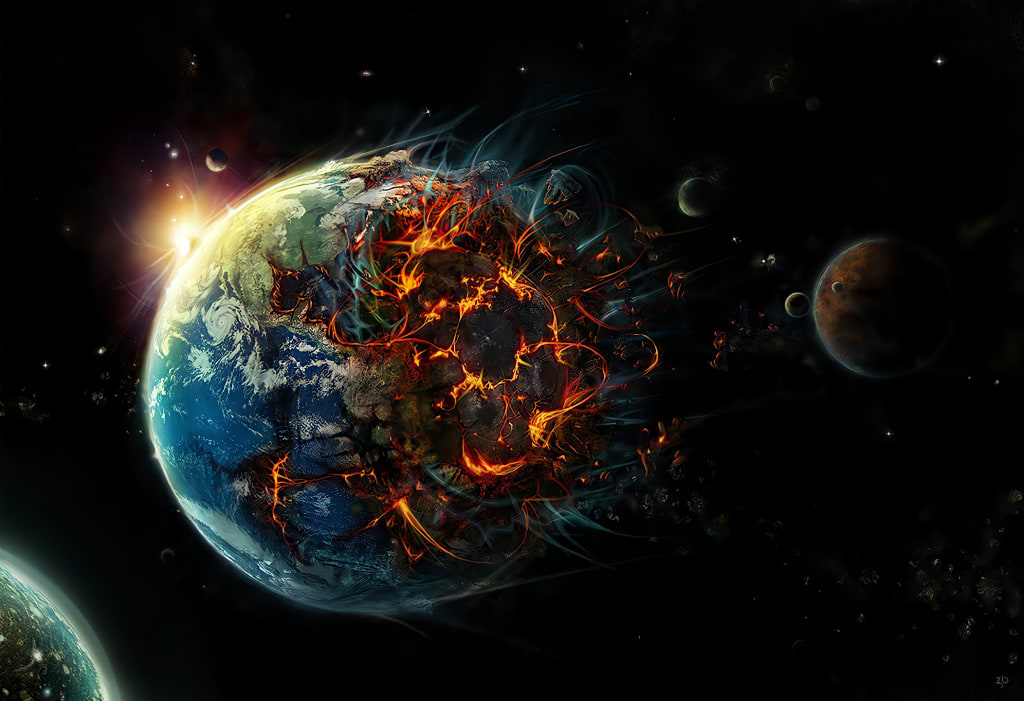
Hey.. hello! readers.... so , in this blog im just gonna splash out some few intresting stuffs about the formation this wonderfull world...Hope u have a gooa day!! :
The solar nebula was made up mostly of hydrogen and helium, as well as small amounts of other elements. Over time, the cloud began to collapse under its own gravity, forming a disk-shaped structure.
The disk eventually became dense enough to form the Sun at its center, with the remaining material in the disk forming the planets.
The inner planets, including Earth, are rocky and formed from heavier elements, while the outer planets are made mostly of gas and ice.
The early Earth was bombarded by asteroids and comets, which brought water and other organic molecules to the planet.
The movement of tectonic plates, which make up the Earth's crust, has been responsible for the formation of mountains, ocean basins, and other geological features.
The atmosphere of the Earth has evolved over time, with the early atmosphere being mostly made up of carbon dioxide and nitrogen, while today it is made up mostly of nitrogen and oxygen.
The formation of the Earth and the evolution of life on the planet are closely linked, and many scientists believe that life on Earth may have originated from organic molecules that formed in the early oceans.
NOW IT COMES TO SOME INTRESTING FACTS!!:
Over time, the Earth's surface cooled and solidified, and the atmosphere began to form as gases released from the planet's interior.
Earth is the only known planet in our Solar System that can sustain life as we know it.
Earth is the third planet from the Sun, and it takes 365.24 days to orbit the Sun.
The Earth's atmosphere is composed of approximately 78% nitrogen, 21% oxygen, and trace amounts of other gases.
The highest point on Earth is Mount Everest, which is 29,029 feet (8,848 meters) tall.
The lowest point on Earth is the Challenger Deep in the Mariana Trench, which is approximately 36,000 feet (10,972 meters) below sea level.
The Earth's magnetic field protects us from the solar wind, a stream of charged particles that flows from the Sun.
Earth's rotation causes day and night, and it also affects the way objects move across the planet's surface due to the Coriolis effect.
The Earth is not a perfect sphere, but rather an oblate spheroid, which means it bulges at the equator and is flattened at the poles.
Earth has one natural satellite, the Moon, which is the fifth-largest moon in the Solar System.
The Earth is believed to be approximately 4.5 billion years old.
As the Earth grew, it began to heat up, and its interior began to differentiate into layers. The densest materials, such as iron and nickel, sank to the center to form the core, while lighter materials, such as silicates, rose to the surface to form the crust.
Approximately 10-20 protoplanets formed in the inner Solar System, including Earth.
Earth continued to grow through the process of accretion, in which smaller particles collided and stuck to the planet.
HERE NOW SOME MYTHS OF EARTH:
Earth is the center of the universe: This myth, known as geocentrism, held that the Earth was the stationary center of the universe, with the Sun and planets revolving around it. This belief was widespread until the 16th century, when the heliocentric model, which places the Sun at the center of the solar system, gained acceptance.
Earthquakes are caused by angry gods: Many ancient cultures believed that earthquakes were caused by angry gods or supernatural beings. This myth persisted until the modern era, when scientists discovered the true cause of earthquakes: movements in the Earth's crust.
About the Creator
Keep reading
More stories from writers in Earth and other communities.
Severe Weather Conditions and School Closures in the United States
Severe Weather Conditions and School Closures in the United States Severe weather has long been one of the main reasons for school closures across the United States. From powerful winter storms and freezing temperatures to hurricanes, floods, and extreme heat, weather conditions can disrupt daily life and force education authorities to prioritize student safety. In recent years, climate variability has increased the frequency and intensity of these events, making weather-related school closures a recurring concern for families, educators, and local governments.
By America today 6 days ago in Earth


Comments
There are no comments for this story
Be the first to respond and start the conversation.