
First Ever Human X-Ray in Space: Revolutionary Breakthrough in Space Medicine 2025.
NASA Captures First Internal Body Scans Aboard ISS Opening New Frontiers in Astronaut Health and Deep Space Missions


First Ever Human X-Ray in Space: Revolutionary Breakthrough in Space Medicine 2025.
NASA Captures First Internal Body Scans Aboard ISS Opening New Frontiers in Astronaut Health and Deep Space Missions
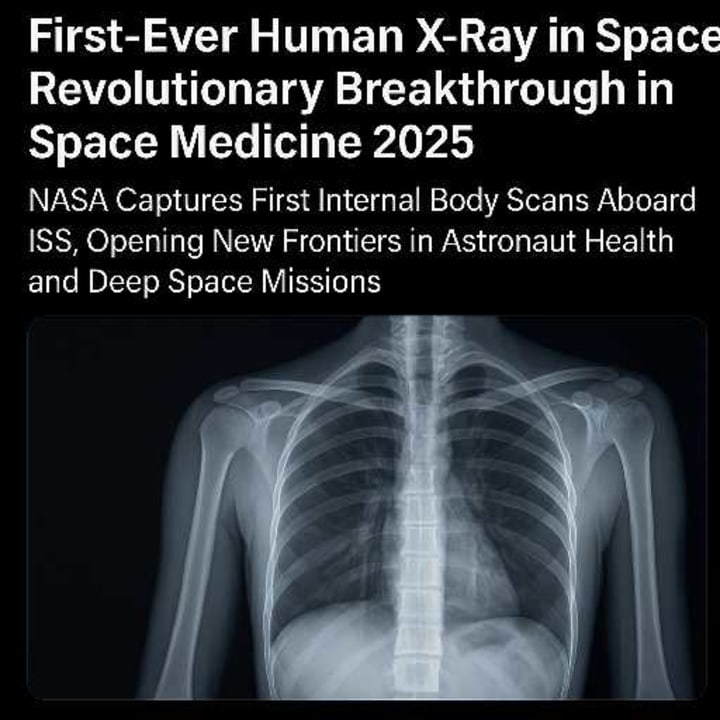
In a groundbreaking milestone for both space exploration and medical science the first ever X-ray images of the human body in space have been captured. This historic achievement marks a significant advancement in our ability to monitor and understand human health during extended missions beyond Earth’s atmosphere. For decades scientists and doctors have speculated about the effects of microgravity on the human body but now thanks to advanced X-ray technology developed specifically for space environments we finally have an inside look quite literally. The images were taken aboard the International Space Station ISS using a compact lightweight X-ray device designed to function in the unique and challenging conditions of microgravity. Unlike traditional X-ray machines which rely on bulky equipment and stable conditions this newly developed technology uses low dose radiation and digital imaging techniques to safely and effectively scan the human body in space. The device was used by astronauts to capture high resolution X-ray images of their own bodies focusing primarily on the chest spine and limbs. These images offer the first direct visual evidence of how bones and internal organs adapt to weightlessness a topic that has intrigued scientists since the beginning of human spaceflight.
Why X-Rays in Space Matter
X-ray imaging is one of the most essential tools in medical diagnostics on Earth. Being able to apply the same tool in space opens new possibilities for monitoring astronaut health in real time diagnosing injuries and even planning emergency treatments during long missions such as those to Mars or the Moon. One of the primary concerns during extended space missions is bone density loss. In the absence of gravity bones lose calcium and other minerals at a much faster rate than on Earth. While previous studies used indirect methods like ultrasound or CT scans before and after space travel, these new X-ray images provide immediate and highly accurate insights. Moreover real time X-ray capabilities allow doctors on Earth to consult live with astronauts guiding them through diagnostic procedures. This becomes critical in the event of injury or illness far from Earth where medical evacuation is not an option.

The Technology Behind the Breakthrough
The success of space based X-ray imaging comes after years of development and collaboration between space agencies tech companies and medical institutions. NASA in collaboration with private space tech developers, engineered a portable X-ray system that uses less power, emits lower radiation levels and operates efficiently in zero gravity. The system includes advanced AI software that assists astronauts in taking the correct scans analyzing image quality and even performing preliminary diagnoses. It’s a true example of the fusion between artificial intelligence medical science and aerospace engineering. With the success of this pilot test aboard the ISS space agencies are now considering making X-ray imaging a standard part of medical kits for all future crewed missions. Whether it’s a journey to the Moon under NASA’s Artemis program or the ambitious Mars missions planned for the 2030s having real time medical imaging on board will be crucial for the safety and survival of astronauts. Additionally the technology could pave the way for telemedicine in extreme environments not just in space but also in remote areas on Earth where access to medical imaging is limited. The first X-ray images of the human body in space are more than just medical pictures they are a giant leap forward in the evolution of space medicine. As humanity prepares to venture further into the cosmos tools like these will play a pivotal role in ensuring that we can not only survive but thrive beyond our home planet. This historic moment is a testament to human ingenuity and the unending pursuit of knowledge proving once again that science has no boundaries even in space.
SEO KEYWORD:
First human X-ray in space, X-ray in space 2025, NASA space medicine breakthrough, Astronaut health monitoring, Space X-ray technology, Microgravity health effects, International Space Station medical scan, Human body in zero gravity, Space-based medical imaging, ISS astronaut health check, Real-time medical diagnostics in space, Bone density loss in space, How does X-ray imaging work in space, NASA's first X-ray of human body in orbit, Impact of space on human bones, Future of space medicine 2025, Space health technology advancements.
About the Creator
Adnan Rasheed
Author & Creator | Writing News , Science Fiction, and Worldwide Update| Digital Product Designer | Sharing life-changing strategies for success.
Keep reading
More stories from Adnan Rasheed and writers in Earth and other communities.
SpaceX Starlink Launch 2025: 21 New Satellites Deployed to Boost Global Internet Coverage
SpaceX Starlink Launch 2025: 21 New Satellites Deployed to Boost Global Internet Coverage In a significant stride toward global internet coverage SpaceX successfully launched 21 Starlink satellites into low Earth orbit (LEO) on March 12 2025. The mission conducted from Cape Canaveral Space Force Station in Florida marked yet another milestone in the company’s ambitious plan to build a vast satellite internet network. The launch designated Starlink Group 12-21 took place at 10:35 p.m. EDT aboard a Falcon 9 rocket. As has become routine for SpaceX the first stage of the Falcon 9 was successfully recovered landing on the droneship A Shortfall of Gravitas stationed in the Atlantic Ocean. This was the 22nd flight for this particular booster showcasing SpaceX’s commitment to reusability and cost-effective space travel. The 21 satellites included 13 equipped with direct to cell capabilities a groundbreaking technology that allows the satellites to communicate directly with standard mobile devices. This advancement could eliminate the need for traditional cell towers in remote areas bringing reliable mobile coverage to places previously considered unreachable. Starlink is SpaceX’s satellite internet constellation project designed to provide high speed low latency broadband internet to underserved and remote regions around the world. Since its initial launches in 2019 the program has seen rapid growth. With this latest deployment SpaceX has now launched more than 8,100 Starlink satellites of which over 7,000 are currently operational. A theses satellites orbit the Earth at altitudes ranging from 340 km to 1,200 km significantly lower than traditional communication satellites. This lower altitude reduces latency and allows for faster data transmission key benefits for internet users particularly those in rural areas with limited infrastructure.
By Adnan Rasheed9 months ago in Earth
Greenland News
Greenland News Greenland has increasingly drawn global attention in recent years due to its political developments, environmental changes, and growing strategic importance. As the world looks more closely at the Arctic region, news from Greenland reflects a unique mix of local priorities and international interest. From climate-related challenges to economic opportunities and governance issues, Greenland continues to shape its own path while remaining closely connected to global affairs.
By America today about 5 hours ago in Earth
Davos 2026: The Last-Chance Saloon to Save the Old World Order?
Every January, the Swiss town of Davos becomes a temporary capital for the world’s elite. Politicians, CEOs, bankers, and thought leaders converge on the snowy Alps for the World Economic Forum (WEF), a gathering that blends diplomacy, business strategy, and high-profile networking. But in 2026, Davos carries an unusually heavy weight: many are asking whether this year’s forum is the last-chance saloon to preserve the old world order. The “old world order” refers to the system of global governance, trade, and alliances dominated by Western powers since the end of World War II. It’s a framework built on liberal democracy, free markets, and institutions like the United Nations, NATO, and the International Monetary Fund. But cracks have been appearing for years—rising nationalism, economic inequality, technological disruption, and the ascent of new global powers are challenging the old guard. Davos 2026 may be where these challenges are addressed—or exposed. A Gathering of Uneasy Allies Davos has always been more than a conference; it’s a stage. World leaders like the U.S. president, Chinese premier, and European Union officials attend alongside CEOs of tech giants, investment banks, and energy conglomerates. In past years, it has been a place for deal-making, policy announcements, and networking in an environment removed from daily political pressures. This year, however, the tone is tense. With geopolitical rivalries intensifying—from U.S.-China competition to ongoing conflicts in Eastern Europe—the forum is less about optimism and more about survival. Many attendees see it as a final opportunity to steer global institutions in a way that sustains stability, economic growth, and cooperation in a rapidly shifting world. As one European diplomat reportedly told journalists: “We’re past casual discussion. This is about whether the rules of the game we’ve known for decades can continue to function.” Economic Uncertainty and the Quest for Stability The global economy is at a crossroads. Inflation, supply chain disruptions, and debt crises have put pressure on governments and corporations alike. Davos provides a platform to coordinate strategies, whether that’s stabilizing financial markets, agreeing on new trade frameworks, or tackling climate and energy crises. But the challenge is bigger than economics alone. The rise of digital currencies, artificial intelligence, and global tech conglomerates has shifted the balance of power. Traditional Western institutions are struggling to keep pace with these innovations, while emerging economies leverage technology and alternative governance models to increase their influence. In this context, Davos 2026 is not just about discussion—it’s about defining who sets the rules for the next era. The Climate Crisis as a Litmus Test One area where the old world order faces a major test is climate policy. Despite decades of conferences and commitments, global emissions continue to rise. The forum’s agenda includes discussions on renewable energy investment, carbon taxation, and sustainable finance—yet the real question is whether collective action can overcome national self-interest. For some attendees, climate is more than an environmental issue; it’s a proxy for global governance. Nations that fail to cooperate on climate risk destabilizing trade, migration, and economic security. Davos 2026 may reveal whether the old mechanisms for multilateral cooperation can still work—or whether the world is moving toward fragmented blocs of competing interests. The Rise of New Powers Another key dynamic is the shifting balance of global power. Emerging economies in Asia, Africa, and Latin America are asserting themselves politically, economically, and technologically. Countries like China, India, and Brazil are shaping new trade and financial networks, sometimes outside traditional Western-dominated institutions. This diversification of influence poses a challenge for Davos. While the forum has historically been Western-centric, ignoring emerging voices could make its conclusions irrelevant. In 2026, the question is whether the WEF can integrate new powers into a cooperative framework—or whether the old world order will crumble under the weight of its exclusivity. Technology, AI, and the Future of Governance Technology is another frontier where the old world order is on trial. Artificial intelligence, cyber warfare, and digital surveillance are reshaping economies and politics alike. CEOs and policymakers in Davos 2026 are expected to discuss regulatory frameworks, ethical AI use, and cybersecurity collaboration. The stakes are high: how nations and corporations govern technology today could determine whether global systems remain stable or fracture. If the old world order fails to set rules for emerging tech, alternative models led by new powers could take hold, redefining global norms. Why Davos 2026 Feels Like a “Last-Chance Saloon” The term “last-chance saloon” evokes urgency. For decades, the old world order relied on cooperation, multilateralism, and shared values to maintain relative peace and prosperity. Today, cracks are visible: rising populism, regional conflicts, economic nationalism, and technological disruption all threaten the status quo. Davos 2026 is unique because it isn’t just a forum for ideas—it’s a test of relevance for the institutions themselves. Leaders will attempt to negotiate solutions, but the outcomes may reveal whether the old structures are adaptable—or obsolete. What to Watch Some of the key signals to watch at Davos 2026 include: Trade agreements and economic cooperation: Will major powers commit to joint frameworks or pursue protectionist policies? Climate action pledges: Are countries willing to act collectively, or do national priorities dominate? Technological governance: Will there be consensus on AI, cybersecurity, and digital currency regulations? Representation of emerging powers: Are new voices integrated into the conversation, or marginalized? The answers could indicate whether the forum reinforces the old order—or marks its final chapter. Final Thoughts Davos 2026 is more than a gathering of the global elite; it’s a litmus test for the old world order. The forum’s success—or failure—may determine whether multilateralism, cooperation, and shared governance survive in an era of rising nationalism, technological disruption, and shifting power dynamics. For observers, policymakers, and citizens alike, the stakes couldn’t be higher. The snowy streets of Davos may once again host ambitious speeches, networking dinners, and visionary panels—but the real question remains: can the old world order be saved, or is it time to prepare for a new world entirely?
By Muhammad Hassanabout an hour ago in Earth



Comments
There are no comments for this story
Be the first to respond and start the conversation.