
Famous Experiment - Apes and Children
Natural selection, survival of the fittest"
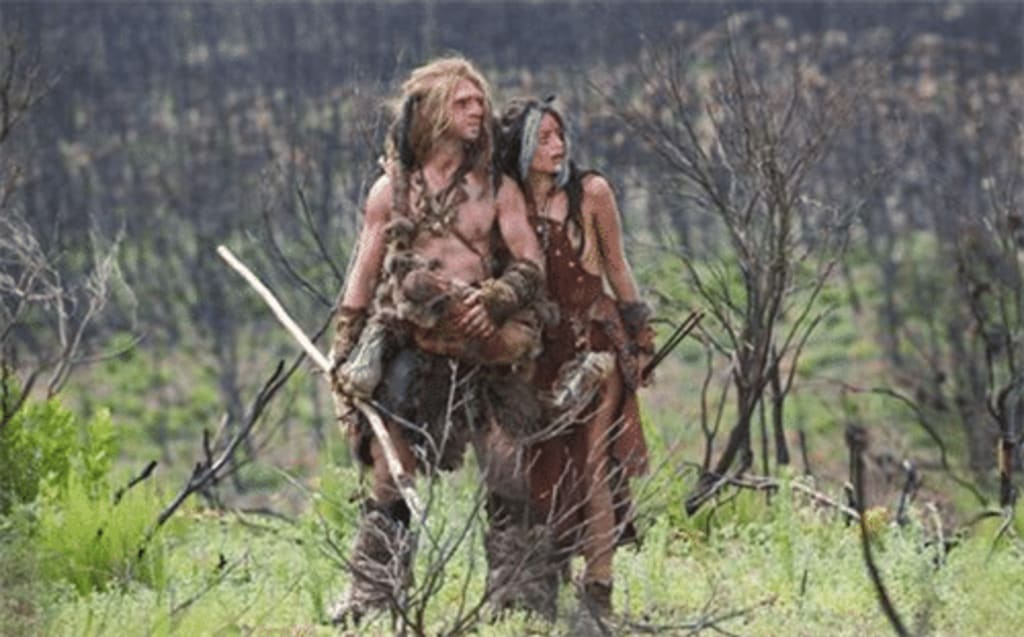
Humans are primates, so what is the difference between humans and animals?
Descartes put forward the philosophical proposition: I think therefore I am.
This sentence roughly means: The only thing I can be sure of is the existence of my own thoughts, because when I doubt others, I cannot doubt my own thoughts at the same time.
Humans have thoughts from birth, and they don't stop until death.
Archaeology shows that the brain volume of ancient apes has been developing in the process of evolution into human beings. The brain volume of apes is only 400ml~500ml, while the brain volume of modern humans can reach 1500ml.
After several experiments showed that ancient ape evolution depends on the size of the brain. However, before reaching this conclusion, scientists did a lot of experiments, and some scientists even put their sons and gorillas together for experiments, but after 9 months, it was abruptly terminated.
Winthrop Kellogg was a famous American psychologist and philosopher. During World War I, he joined the US Army Expeditionary Force and served as a pilot. After the war, he was admitted to Indiana University and Columbia University.
In 1929, he was a professor at Indiana University, where Winthrop Kellogg began a famous experiment—apes and children.
Winthrop Kellogg, who is engaged in psychology, has been thinking about "whether human beings are determined by environment or genes". Winthrop Kellogg, with the support of his wife, set out to do research.
Indiana University has ample experimental conditions, and Winthrop Kellogg just needs to pick good subjects.
In 1931, Winthrop Kellogg bought a 7.5-month-old female chimpanzee "Guya" from a zoo. Chimpanzees also belong to primates. It is the smallest species in the orangutan family. Chimpanzees look like human children.
The experimental subjects have been selected, so how should the control subjects be selected?
Winthrop Kellogg considered using the children of colleagues or volunteers for the experiment, but he gave up after asking a few people. People are worried that the child will be harmed, and they are reluctant to give the child to him for experiments.
Just when Winthrop Kellogg was about to give up, his 10-month-old son Donald came into his sight, and he had a bold idea in his mind - to experiment with Donald.
At first his wife did not support his experiment, but after Winthrop Kellogg's persuasion, the wife agreed, and they just put "Guya" and Donald to live together.
In this way, the 7-month-old "Guya" became Donald's "sister". At this time, Donald didn't realize the difference between humans and apes at all. He just regarded the ape as a little friend.
Winthrop Kellogg and his wife raised "Guya" as their daughter, dressed her, taught her to walk, and although she sometimes walked on all fours, she slowly freed her hands.
In terms of learning, "Guya" is much smarter than Donald. It first learned to walk, and at the same time, it can express its feelings through manners, and even ask Winthrop Kellogg to go to the toilet.
On the other hand, Donald learns very slowly. After spending time with chimpanzees for a long time, some of his living habits have changed a lot. He prefers to crawl on all fours rather than walking, and even learns how chimpanzees roar from "Guya".
"Guya" is behaving more and more like a human, while Donald's behavior is degenerating. It is more and more like a chimpanzee. After 9 months of the experiment, they stopped urgently. "Guya" was sent back to the zoo. After living in the human population for 9 months, it has been unable to integrate into the race. It considers itself a "human" and misses its family. "Guya" died of illness at the age of 3.
When Donald resumed his normal life, he learned very slowly at first, but after a few months, his behavior became human again.
From a nine-month experiment, Winthrop Kellogg found that the environment in which humans grow up is very important. In addition to brain capacity, the environment is also very important.
This further confirms the core idea of Darwin's "Origin of Species": "natural selection, survival of the fittest".
Darwin's "Origin of Species" expounded the evolutionary process of human beings, in which changes in the environment played a decisive role. Australopithecus left the forest, liberated its hands and feet in order to survive, and finally evolved into human beings in the process of adapting to the environment.
About the Creator
suzanne darlene
Take you to understand scientific knowledge
Keep reading
More stories from suzanne darlene and writers in Earth and other communities.
Asia’s Second-Best Island in DestinAsian Ranking
Vietnam’s largest island, Phu Quoc, has achieved a remarkable milestone in global tourism by being ranked the second-best island in Asia in the prestigious DestinAsian Readers’ Choice Awards 2026, surpassing the world-famous Maldives. The recognition marks a major moment for Vietnam’s tourism industry and highlights the island’s rapid rise as one of the most desirable tropical destinations in the world. 
By Irshad Abbasi a day ago in Earth
Hottest in the Office
Dear Rafi, You’re very distracting to work around. For the first second I saw you the other day, I thought you were some type of executive. It took a moment to realize no, you were just the new guy, dressed up for the job he wants. Be still, my heart.
By Gabriel Shames3 days ago in Pride


Comments
There are no comments for this story
Be the first to respond and start the conversation.