
Exploring the Depths of Animal Emotions
Do They Experience Grief?"
When faced with loss, do animals experience grief? This intriguing question has captured the attention of scientists and animal lovers alike. Let's delve into the fascinating world of animal emotions and explore whether grief extends beyond human beings.
In 2018, a poignant event unfolded in the ocean depths. An orca named Tahlequah tragically lost her newborn daughter within an hour of birth. What followed over the next 17 days and 1,600 kilometers was nothing short of remarkable. Tahlequah refused to leave her deceased offspring's side, tirelessly keeping the body afloat and diving to retrieve it whenever it slipped away. This behavior raised a crucial question: Was Tahlequah mourning or merely confused?
Charles Darwin, a pioneer in evolutionary theory, proposed in 1871 that animals experience a broad range of emotions, including grief. However, projecting human emotions onto other animals has been met with skepticism. Without a reliable means of deciphering their minds, many scientists have hesitated to attribute grief to non-human species. Some have argued that animals may display unusual behaviors after a death for adaptive reasons rather than emotional ones. For a long time, humans were considered exceptional, with the belief that only we possessed the capacity for deep thought and emotion. However, this notion was challenged throughout the 20th century.
An extraordinary example that highlights the potential for grief in animals comes from Koko, a gorilla who was trained to use American Sign Language. When Koko was informed of her kitten companion's death, she emitted distress calls. Several weeks later, while looking at a photo of another kitten, Koko signed "cry," "sad," and "frown." These observations provide compelling evidence that animals, particularly mammals and birds, may indeed experience what we recognize as grief.
The realm of grief expands beyond primates and marine mammals. In 2003, an elephant matriarch named Eleanor collapsed, prompting another matriarch named Grace to rush to her aid. Grace stayed by Eleanor's side, attempting to help her stand. When Eleanor eventually passed away, a female elephant named Maui positioned herself over the lifeless body, gently rocking back and forth. Over the span of a week, elephants from different families visited Eleanor's remains, demonstrating a collective response to death. Elephants have also been observed carrying the remains of their family members, including jawbones and tusks.
Giraffes, too, exhibit intriguing behavior in the face of loss. In 2010, a calf with a deformed foot struggled to walk and survived only four weeks. During this time, 22 females and four juveniles closely attended the calf, occasionally nuzzling its body. The mother giraffe, against the norm of constant grazing, refused to leave her dead calf's side. She stayed with the body, even as hyenas devoured it.
Scientists have not solely relied on observations but have also conducted quantitative studies to understand animals' responses to death. In one such study from 2006, researchers analyzed baboon fecal samples for glucocorticoids, stress hormones that surge in humans during bereavement.
Comparing samples from females who had lost close relatives in predator attacks with those who hadn't, the researchers found significantly higher glucocorticoid levels in baboons who experienced loss. The grieving baboons increased their grooming behavior and formed stronger social bonds by expanding their grooming networks. Within two months, their stress hormone levels returned to baseline.
Primate mothers have been observed engaging in perplexing behaviors towards their deceased offspring, displaying conflicting impulses. They may switch between cannibalizing or dragging the corpse and gently carrying or grooming it. This behavior suggests that mothers experience a mixture of emotions towards their lifeless young.
While our understanding of animal emotions remains limited, the growing pool of data and observations offers compelling evidence that animals can indeed experience grief. To gain a deeper understanding of mourning in the animal kingdom, further research is imperative.
In light of this, how should we approach the treatment of non-human animals? The potential for grief raises important ethical considerations. Should we assume that animals possess the capacity to grieve, even in the absence of definitive proof? Or should we withhold such assumptions until more data is available? These questions have tangible consequences, such as deciding whether orcas should be kept in captivity or whether dairy cows should be separated from their newborn calves.
As we await more comprehensive research, a compassionate and cautious approach seems warranted. Treating animals as if they may have the capacity to grieve could lead to improved welfare and a greater appreciation for the emotional lives of non-human beings. A recognition of their possible grief would help shape responsible practices and policies regarding their care.
About the Creator
Keep reading
More stories from Myke & Amy and writers in Earth and other communities.
Guardians of the Sea
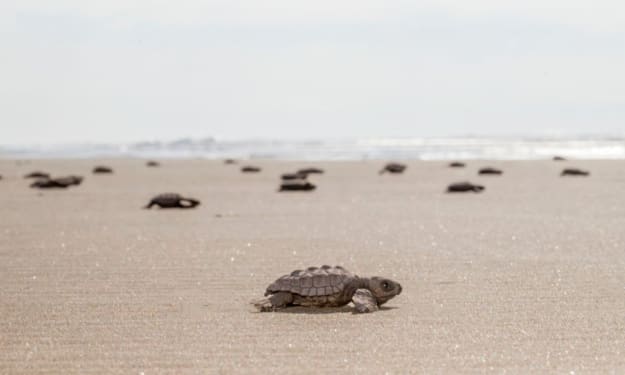
Mexico holds a special place in the hearts of nature enthusiasts, as it serves as a nesting ground for five out of the seven sea turtle species worldwide. From May to September, in the picturesque vacation towns of Tulum and Cancun, these vulnerable creatures, including the loggerhead and green turtles, grace the beaches to establish their nests. One individual, Aurora, stands out among the dedicated volunteers who patrol these nests, ensuring the safe passage of every baby turtle.
By Myke & Amy3 years ago in Earth
The Problem with Invasive Plants: Identification and Responsible Removal
This scenario plays out in gardens across the continent. Many invasive plants started as intentional garden introductions, valued for their beauty, vigor, and ease of growth. Those same qualities—rapid spread, adaptability, and resilience—make them ecological threats when they escape cultivation.
By Emma Wallace5 days ago in Earth



Comments (1)
Super!!! Excellent story!!!