
Evolution of the Sun
How Did the Sun Exist? How will it disappear?


The Sun and all the planets in our Solar System were formed about 4.5 billion years ago according to the Nebular Theory, which suggests that they were created as a result of a massive molecular cloud of gas and dust collapsing inwards.
As a result of this collapse, the cloud structure began to resemble a flatter disk. Dust and gases began to accumulate in denser areas on this disk. The denser regions caused even more material to clump together, and the initial momentum of each clump (due to the conservation of momentum) caused these clumps to start spinning. Additionally, the clumps that were growing larger were also heating up due to the increasing pressure. While most of the matter gathered at the center, a portion of it spread out into the spinning disk. The center formed the Sun, while the material in the disk formed the planets in our Solar System.
However, more time was needed for the formation of the Sun and the planets. After this formation, the Sun spent 100,000 years as a "protostar" (i.e. "primitive star") and during this time, fusion began due to increasing pressure in the interior. It took a few million more years for the Sun to reach its current form, which it spent as an active star known as a T Tauri star. The T Tauri phase is when the star does not yet have sufficient internal temperature and pressure to undergo nuclear fusion. During this phase, the star slowly collapses in order to achieve the conditions necessary for nuclear fusion.
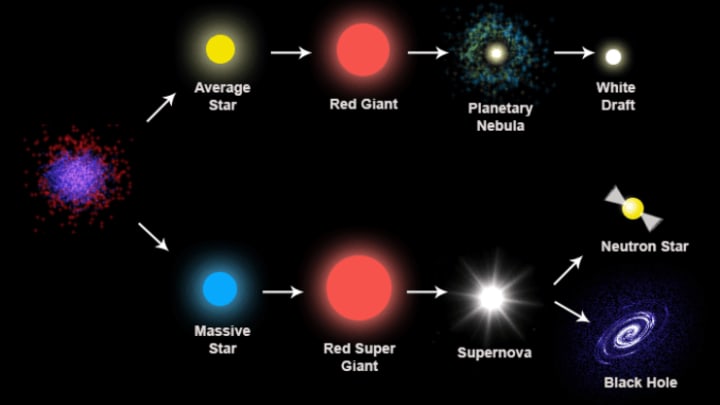
After all this time, the Sun took another step in its evolution and entered a stage called "Average star". Our Sun has been continuing on this stage for about 4.5 billion years.
During this stage, hydrogen atoms accumulating in the Sun's core are converted into helium atoms through nuclear fusion, and the energy released from this conversion forms the Sun's energy, which is then spread throughout the Solar System as heat and light. Nuclear fusion is the reaction that causes two elements to combine and form a heavier element, and a tremendous amount of energy is released as a result of this reaction. However, this process cannot continue indefinitely as there is a limit to the amount of hydrogen atoms that can accumulate in the core. In a way, the fuel of the Sun is hydrogen atoms, and therefore, the Sun does not have an unlimited supply of fuel.
What Will Happen When the Sun Runs Out of Fuel?
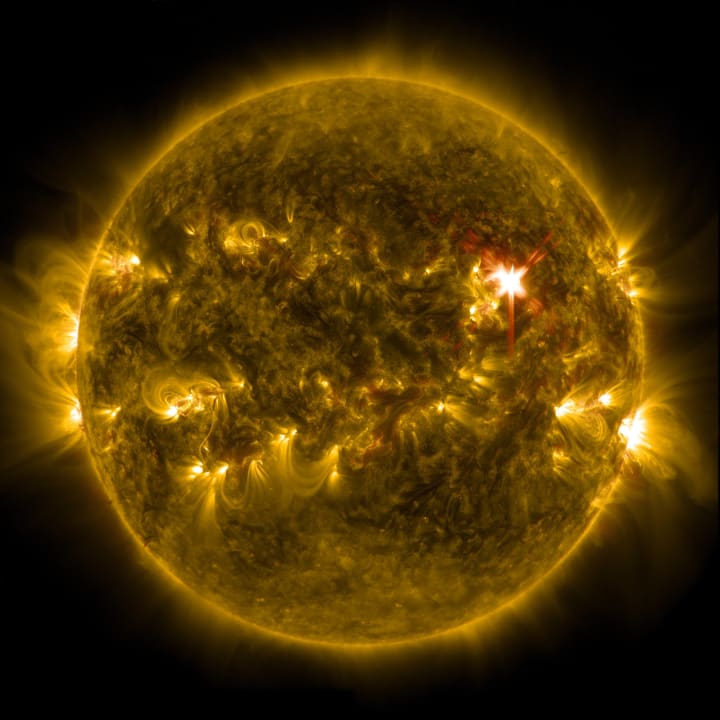
As mentioned before, the Sun is currently about 4.5 billion years old. Scientists predict that in about 5 billion years from now, the Sun will begin to run out of fuel.
When the hydrogen in the Sun's core runs out, the star will turn into a Red Giant and begin helium fusion. In this case, the star will expand to approximately a hundred times its current size, engulfing and destroying Mercury and Venus. It is uncertain whether the resulting Red Giant will also swallow Earth.
The Red Giant will eventually turn into a structure made of carbon and oxygen due to the explosion of outer layers consisting of hydrogen and helium. This will result in a White Dwarf, which will have approximately the size of Earth and half the mass of the Sun. The cooling process of this White Dwarf will take billions of years, and the planets in the inner part of the system will be destroyed. However, the planets located in the outer part of the Solar System, such as gas giants Saturn and Jupiter, will continue to exist as they will experience less gravitational pull from the Sun due to its decreased mass.
It will take approximately 10^14 to 10^15 years for the White Dwarf to cool down. This is because the White Dwarf will have a surface size only equivalent to that of Earth, and it will take a long time for it to cool down by emitting heat from this surface. At the end of this time, the White Dwarf will exit the visible spectrum and continue to cool until it reaches a temperature just a few degrees above 0 Kelvin.
After cooling down, the carbon and oxygen ball, now known as a black dwarf, will wander off among the stars and other stellar remnants in our galaxy. However, we still cannot say that the Sun is completely dead. From this point on, there are three possible scenarios that could occur:
Merging with Another Star: Half of all stellar remnants in galaxies belong to single-star systems like the Solar System. While about half of known stars are found in binary or trinary systems, the Sun is the only star in our system. This makes it possible for the Sun to merge with another star in the future or be consumed by another star. This could be a stroke of luck for our Solar System. However, if this scenario does not happen, the Sun's body will undergo countless gravitational interactions with various masses, and the remnants of our Solar System will be ejected from our galaxy in 10^17 to 10^19 years.
Finding Another Hydrogen Source: After the Sun becomes a white dwarf and cools down, it is possible for it to continue its life and emit radiation. Although the likelihood of this happening is low, the Sun's body can start nuclear fusion again by merging with a red or brown dwarf, taking hydrogen from a molecular cloud or gaseous planet, or colliding with another stellar remnant. In the scenario where it merges with a red or brown dwarf, a hydrogen source that will continue to burn for at least millions of years is provided. In the second scenario, where hydrogen is taken from another source, a fusion explosion called a nova occurs. The scenario where the Sun's body collides with another stellar remnant results in a massive supernova explosion that destroys both stellar remnants.
Being Pulled into Black Holes: In the center of our galaxy, there are small black holes made up of singular stars located approximately 25,000 light years away. These black holes have the smallest cross-sectional area of any massive object in the universe. In terms of galaxies, these black holes are the hardest targets to hit. However, this does not mean that they will never be hit. When these small black holes collide with matter, they accelerate and direct the matter into an accretion flow. In this way, some of the matter is swallowed, adding to the mass of the black hole. However, the majority of the remaining matter is ejected as debris. When active, low-mass black holes that flare up are called microquasars. Although it is unlikely, we too can become food for these black holes.
In summary, there are many possibilities for every object in the universe in the future. It is known that our Sun will become a white dwarf in less than 10 billion years. Approximately 10^14 to 10^15 years later, this white dwarf will turn into a black dwarf and be ejected from our galaxy in 10^17 to 10^19 years. At least, according to our current knowledge, this is the most likely scenario. However, it is also possible for the Sun to merge with other stars, take gas from other sources, or collide with other stellar remnants.
I hope it has enabled you to learn about our life-giving star.
Take care of yourself.
About the Creator
Emma Wilson
Hi, I'm Emma! An adventurous and compassionate animal-lover who's passionate about travel, books, and writing. I enjoy exploring new places, learning about different cultures and documenting my experiences through writing.
Keep reading
More stories from Emma Wilson and writers in Earth and other communities.
Why does rain make people feel peaceful?
Rain is one of nature's most soothing and calming phenomena, and there's something about the sound and sight of it that can make us feel relaxed and at peace. The gentle pitter-patter of raindrops on the roof or the sight of rain streaking down a windowpane can induce a sense of wonder and joy that few other things can match. But what is it about rain that makes it so enjoyable to experience, and why do we feel more at peace when it's raining?
By Emma Wilson3 years ago in Earth
Australia Horticulture Market 2026: Climate-Smart Farming, Export Demand & Agri-Tech Innovation
Australia Horticulture Market Overview Australia’s horticulture market plays a crucial role in the country’s agricultural economy, supplying fresh fruits, vegetables, nuts, flowers and nursery products to both domestic and international markets. The sector is widely recognized for high-quality produce, strong biosecurity standards and advanced farming practices. Growing consumer demand for nutritious foods, expanding export opportunities and continuous technological innovation in agriculture are driving sustained development across Australia’s horticulture industry.
By Amyra Singhabout 24 hours ago in Earth


Comments
There are no comments for this story
Be the first to respond and start the conversation.