
European Series - Spartan Hegemony in the "Peloponnesian War"
Spartan Hegemony in the "Peloponnesian War"


Obviously, there is a lot of fighting in Greece, and the happiest one is the Persian Empire, which came back that day. At the beginning of the Peloponnesian War, the Persians mainly sat on the mountain and watched tigers fight. However, after Sparta was preparing to compete with Athens at sea, Persia, which had been suppressed by the "Athenian Empire" in the Mediterranean Sea, began to directly intervene in the war. Its way of intervening in the war is not to directly participate in the war, but to provide economic support. In 408 BC, the Spartans, who were regained control of the Aegean Sea by Athens, persuaded the Persian governor of Asia Minor, Cyrus the Younger (not Cyrus the Great, but the son of Darius II), to provide A huge sum of money helped them expand their navy. In order to help the Greek "ally", the Persian prince even made additional investments two years later, using all the funds he could mobilize.
Sparta’s approach to Persia for help would probably make many people think that they were “traitors” of the Greeks, but politics is like this, there are no eternal enemies and no eternal friends. For a loose geopolitical system like ancient Greece, there was no higher-level "state" for everyone to defend. Of course, for those "Westerners" who took Greece as the source of civilization in later generations, of course, they are more willing to believe that "Greeks" fought against those powerful Asians in order to defend the so-called democracy and freedom.
In fact, the reason why little Cyrus was willing to support Sparta was not just for the benefit of the entire empire. As the governor of Asia Minor, a prince who has the opportunity to inherit the throne, he also hopes to increase his political capital to compete for the throne in the future. When both parties in this cooperation may rely on each other's support to covet the supreme power of the political group, the reasons for cooperation are even more sufficient. When Sparta defeated Athens and became the hegemon of Greece. The Spartans also reciprocated by sending troops to help their Persian allies and marching eastward to fight for the throne (401 BC". It's just that the politically minded prince was eventually defeated and killed (the Greeks retreated completely) .
Infighting among politicians is not our focus. In addition to making everyone feel that interests are the basis of political cooperation, this part is to illustrate how difficult the situation in Athens is. At the very least, the entire Asia Minor region has now become an ally of the Peloponnese. Unless Athens can also find an ally that matches its strength, it will be possible to turn the tables.
From the perspective of geographical strength, the Egyptians may be able to provide support if they are willing. However, Egypt at this time was still under the control of the Persian Empire, and it was impossible to become Athens' foreign aid. In fact, before the war. As the main grain producing areas in the Mediterranean region, both Sicily and Egypt used to be the main regions for Athens' grain imports. However, after the Battle of Sicily and Persia's support for Sparta, all Athens could count on was the Black Sea region.
A friend asked earlier, which sector is Athens referring to when importing grain from the Black Sea region. In fact, this plate is also very hot in the current politics in the end, that is "Crimea". To be more specific, it is the "Kerch Peninsula" in eastern Crimea, and the "Taman Peninsula" (Russia) in the east of the Kerch Strait. During the Peloponnesian War, the region was ruled by a kingdom called "Bosphorus". When it comes to the geographical label of "Bosphorus", I believe that people who have paid attention to European history will not be unfamiliar. The first strait through which the Black Sea enters the Mediterranean Sea, that is, the strait adjacent to Istanbul, is called the "Bosphorus Strait" (which can import the resources of the Bosphorus Kingdom into the Mediterranean region).
About the Creator
Keep reading
More stories from guanjianwenti001 and writers in Earth and other communities.
Europe Series - "Peloponnesian War" Athens Expedition to Sicily
In fact, the fifty-year peace treaty between Athens and Sparta was not strictly observed from the beginning, because both sides were reluctant to return the land they had acquired in the war to the other side. Of course, since everyone needs time to recuperate, these small frictions will not lead to new wars. However, everyone knows in their hearts that there is no need to wait another fifty years before the war will rekindle on Greek soil.
By guanjianwenti0013 years ago in Earth
Earth Is Not Our Property
There was a time when the Earth did not need us. Rivers carved their own paths without permission. Forests rose and fell like quiet empires. Ice learned the language of patience. The planet breathed in rhythms older than memory, older than names. Then we arrived—curious, clever, afraid of silence—and decided everything needed a fence.
By LUNA EDITHa day ago in Earth
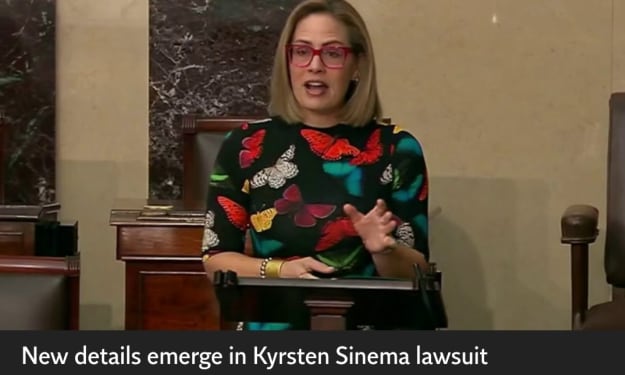
Kyrsten Sinema Panel Interrupted by Men Claiming Affairs Amid Fresh Lawsuit
Former U.S. Senator Kyrsten Sinema faced a strange and uncomfortable moment during a public policy panel in Salt Lake City on January 16, 2026. Two men in the audience interrupted the discussion, loudly claiming they were having affairs with her. The incident occurred just days after Sinema became the subject of a civil lawsuit alleging she was romantically involved with a married member of her former Senate security team.
By Aarif Lashariabout 3 hours ago in Earth



Comments
There are no comments for this story
Be the first to respond and start the conversation.