
Effects of an exploded nuclear atom bomb underwater
Environment,Climate,Earth

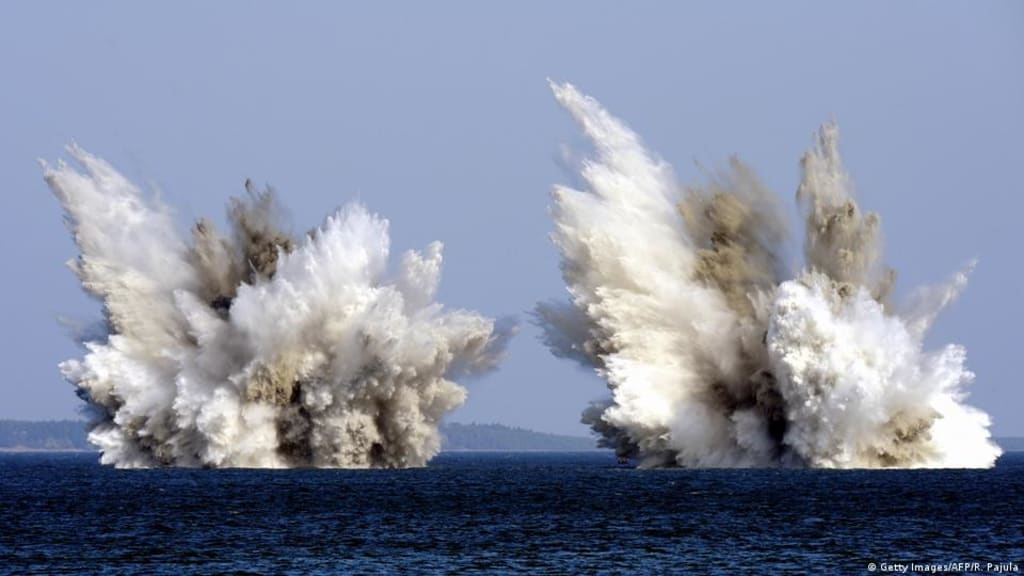
Effects of an exploded nuclear atom bomb underwater
The detonation of a nuclear atom bomb underwater can result in severe and wide-ranging consequences, causing a variety of harmful effects on the environment, marine life, and human health. Here are some potential negative impacts:
1. Shockwaves and Pressure Waves:
Underwater nuclear explosions generate powerful shockwaves and pressure waves that can travel long distances through water, causing damage to marine life and ecosystems. Rapid pressure changes can lead to the formation of destructive shock fronts underwater, harming marine organisms such as fish, mammals, and invertebrates.
2. Temperature and Radiation Effects:
The detonation of a nuclear atom bomb underwater has far-reaching and catastrophic consequences, giving rise to a phenomenon known as underwater shock and potentially triggering tsunamis. When a nuclear explosion transpires beneath the ocean's surface, it produces an intense shockwave that propagates through the water.
The underwater shockwave travels faster and farther than air-based shockwaves, exerting its influence on marine life, seafloor structures, and the water column itself. The energy unleashed by the explosion generates a rapid and forceful pressure wave that can have devastating effects on aquatic ecosystems. The shockwave often leads to the formation of a temporary cavity, followed by a rebound effect that further disturbs the surrounding environment.
Additionally, the rapid displacement of water caused by the explosion can contribute to the creation of tsunamis. As the shockwave traverses the ocean, it displaces water vertically, resulting in the formation of large waves. These waves, upon reaching coastal areas, can unleash destructive forces, causing extensive flooding and posing a threat to coastal communities.
The consequences of an underwater nuclear explosion extend beyond immediate physical damage. Radioactive fallout and the contamination of marine environments present long-term risks to both human and environmental health. The interconnected nature of Earth's oceans means that the impact can extend across vast distances, affecting ecosystems and communities far from the detonation site.
The use of nuclear weapons underwater raises profound ethical, environmental, and humanitarian concerns. The potential for widespread and enduring damage underscores the importance of international endeavors to prevent the use of nuclear weapons and promote global disarmament. Understanding the intricate interactions involved in underwater nuclear explosions is essential for developing strategies to mitigate their impact and progress toward a more secure and sustainable future.
3. Radioactive Fallout:
The explosion releases radioactive particles into the atmosphere, which can settle on the ocean surface. Marine life can absorb these radioactive contaminants, causing bioaccumulation in the food chain. This bioaccumulation poses risks to both aquatic organisms and humans who consume seafood, potentially causing long-term health issues.
4. Underwater Shocks and Tsunamis:
Detonating a nuclear bomb underwater can displace large volumes of water, potentially triggering the formation of tsunamis. These tsunamis can propagate over long distances, causing widespread destruction along coastlines and impacting coastal communities.
5. Long-term environmental damage:
The release of radioactive materials into the water can lead to long-term environmental consequences. Persistent radiation can cause genetic mutations in marine organisms, disrupting ecosystem balance and potentially causing population declines. Contaminated areas may remain hazardous for extended periods, affecting the health of both marine and terrestrial life.
6. Global Impact:
The release of radioactive materials and the resulting environmental damage from an underwater nuclear explosion are not limited to the immediate blast area. Ocean currents can transport radioactive particles over vast distances, affecting marine ecosystems globally. This can have cascading effects on interconnected food webs and ecosystems.
7. Human Health Risks:
In addition to the immediate impact on marine life, radioactive fallout can pose health risks to humans. Consuming or coming into contact with contaminated seafood or water can lead to radiation-related illnesses, including cancer and other long-term health problems.
In summary, the detonation of a nuclear atom bomb underwater can have catastrophic consequences, resulting in immediate damage to marine life and ecosystems, as well as long-term environmental and health risks for both aquatic organisms and humans. It emphasizes the importance of preventing nuclear weapons testing in the oceans to preserve the delicate balance of marine ecosystems and protect overall public health.
Article written by Engr kawsar ahmed
About the Creator
Keep reading
More stories from Engr kawsar Ahmed and writers in Earth and other communities.
Harmful effects on environment due to drying up of Euphrates River
Harmful effects on environment due to drying up of Euphrates River The evaporation of the Euphrates Waterway can have huge and expansive destructive consequences for the climate, affecting both normal environments and human networks. The Euphrates Stream is an urgent water source in the Middle East, coursing through Turkey, Syria, and Iraq, and its downfall can prompt different natural outcomes: The evaporation of the Euphrates Waterway presents a basic danger to biodiversity in the locale. As a help for different biological systems traversing Turkey, Syria, and Iraq, the Euphrates supports a rich embroidery of plant and creature life. The repercussions of its reduced stream are significant. Natural surroundings obliteration is an essential worry, as the stream and its neighboring wetlands give fundamental living spaces to various species. The decrease in water levels brings about the deficiency of these pivotal living spaces, affecting oceanic and earthly life forms alike. Fish populations, vital to the stream's environment, face critical decay. Decreased water streams and environmental debasement upset reproducing and taking care of grounds, representing a danger to the fragile harmony between sea-going life and influencing the livelihoods of networks subject to fishing. Wetland vegetation, particularly adjusted to the Euphrates climate, faces debasement. The deficiency of water prompts the decay of these biological systems, influencing the assorted plant species that rely upon the stream's circumstances. Transient bird courses are upset, influencing species that depend on the Euphrates as a pathway and wintering ground. This unsettling influence can prompt a decrease in avian biodiversity, as transient examples are essential for the endurance of many bird species. Invertebrate species, crucial parts of freshwater biological systems, are delicate to changes in water quality and quantity. The evaporation of the Euphrates brings about the deficiency of assorted invertebrate populations, affecting the whole oceanic food web. The results reach out past amphibian conditions, as the wellbeing of the Euphrates directly impacts contiguous earthly environments. The drying stream influences vegetation along its banks, upsetting herbivores and hunters, causing a gradually expanding influence all through the interconnected snare of life. Addressing the deficiency of biodiversity caused by the evaporation of the Euphrates Waterway requires earnest and facilitated protection endeavors. Reasonable water the executives rehearse, living space reclamation, and global participation are crucial for shielding the one-of-a kind biological systems and species that depend on this important water source. The Euphrates provides fundamental water to the water system, supporting agribusiness in the locale. A decrease in water accessibility can prompt soil corruption and decreased horticultural efficiency, influencing food security for networks that depend on the stream for cultivation. The evaporation of the Euphrates contributes to the general water shortage in the district. This can strengthen rivalry for restricted water assets, prompting clashes between farming, modern, and homegrown clients. As water becomes more difficult to find, networks that rely on the Euphrates for their occupations might be compelled to migrate. This can prompt social and financial difficulties, remembering the expanded rivalry for assets in regions where uprooted populations settle. The Euphrates Waterway holds authentic and social importance, and its evaporation can affect archeological locales and the social legacy in the area. Lower water levels might uncover and harm verifiable designs and relics that were recently lowered. A decreased water stream from the Euphrates can contribute to the development of parched and semi-bone-dry locales, prompting desertification. This has suggestions for the general soundness of the climate and can intensify existing difficulties connected with environmental change. Nations downstream from the Euphrates, like Iraq, intensely rely upon the stream for water supply. A diminishing water stream can prompt water deficiencies, influencing a great many individuals and compounding existing social, monetary, and political difficulties. Tending to the evaporating of the Euphrates Stream requires facilitated endeavors among the nations sharing its waters, supportable water management practices, and global participation to alleviate the natural and social results.
By Engr kawsar Ahmed2 years ago in Earth
US Balks as UK and France Pledge Troops to Postwar Ukraine
As the war in Ukraine grinds on with no clear end in sight, the debate over what comes after the fighting has taken a sharper turn. The United States has signalled reluctance about committing troops to Ukraine once the war ends, even as the United Kingdom and France openly pledge to consider deploying forces in a postwar security role. The divergence has exposed differing strategic priorities among Western allies and raised new questions about how Ukraine’s future security will be guaranteed. While all three nations remain united in their support for Kyiv during the war, the emerging split over postwar troop commitments highlights the complexity of planning for peace in a conflict that continues to reshape Europe’s security landscape. What the UK and France Are Proposing British and French leaders have increasingly spoken about the need for long-term security arrangements for Ukraine once active hostilities end. Their position reflects a growing concern that any ceasefire or peace agreement could be fragile, leaving Ukraine vulnerable to renewed aggression. The idea under discussion is not a combat deployment in an active war zone, but rather a stabilisation or reassurance force. Such troops could help train Ukrainian forces, protect critical infrastructure, and serve as a visible deterrent against future attacks. Supporters argue that a limited but credible international presence would help ensure that any peace settlement is respected. For London and Paris, this approach fits within a broader European push to take more responsibility for continental security. Both governments see Ukraine not only as a partner but as a frontline state whose stability directly affects Europe as a whole. Why Washington Is Hesitant The United States, while remaining Ukraine’s most significant military backer during the war, has taken a more cautious stance on postwar troop deployments. American officials have stressed that there are no plans to send US forces into Ukraine, even after a potential peace agreement. This hesitation is rooted in several factors. First, Washington remains wary of any move that could risk a direct confrontation with Russia. Even in a postwar scenario, the presence of US troops on Ukrainian soil could be portrayed by Moscow as a provocation, escalating tensions rather than reducing them. Second, domestic considerations play a major role. After years of overseas military engagements, there is limited appetite among the American public and political class for new long-term deployments abroad, particularly in a region where risks remain high and outcomes uncertain. Finally, US strategy has increasingly emphasised supporting allies through funding, training, and equipment rather than large-scale troop commitments. From Washington’s perspective, enabling Ukraine to defend itself may be preferable to stationing American forces on the ground. A Question of Deterrence At the heart of the debate lies a fundamental question: what will actually deter future aggression against Ukraine? The UK and France appear to believe that a physical presence, however limited, would send a powerful signal of commitment. Troops on the ground would demonstrate that Ukraine’s security is directly tied to that of major European powers, raising the cost of any future attack. The US, by contrast, seems to place greater faith in alternative mechanisms such as long-term military aid, security guarantees, and sanctions frameworks. American officials argue that deterrence does not necessarily require boots on the ground, especially if Ukraine emerges from the war better armed and more integrated with Western institutions. This difference reflects broader strategic cultures. European powers, facing the immediate proximity of the conflict, may feel a stronger need for visible reassurance measures, while the US assesses risks from a more global perspective. Implications for NATO Unity Although Ukraine is not a NATO member, the discussion has clear implications for the alliance. Any deployment of UK or French troops would be closely scrutinised for what it means for NATO’s role and credibility. NATO operates on consensus, and the absence of US support for a postwar troop presence could complicate coordination. Even if London and Paris act independently or as part of a smaller coalition, questions would remain about command structures, rules of engagement, and the political backing required for such a mission. At the same time, the situation underscores a broader shift within NATO, with European members increasingly expected to shoulder more responsibility. If the UK and France proceed with their plans, it could mark a significant step toward a more autonomous European security posture. Ukraine’s Perspective For Kyiv, the debate is both encouraging and frustrating. On one hand, the willingness of major European powers to consider troop deployments signals long-term commitment and recognition of Ukraine’s security concerns. On the other hand, uncertainty from the US—Ukraine’s most powerful ally—adds another layer of unpredictability. Ukrainian leaders have consistently argued that security guarantees must be concrete, not symbolic. From their perspective, any postwar arrangement must ensure that Russia cannot simply regroup and strike again. Whether this is achieved through foreign troops, binding treaties, or accelerated integration with Western institutions remains an open question. What is clear is that Ukraine wants assurances that go beyond promises and declarations. The Risk of Mixed Signals One potential danger of the current divergence is the message it sends to Moscow. Differing positions among Western allies could be interpreted as hesitation or lack of unity, potentially weakening deterrence rather than strengthening it. At the same time, open debate is not necessarily a sign of weakness. Allies often disagree on tactics while remaining aligned on broader goals. The challenge will be ensuring that these differences do not undermine the core objective of securing a stable and sovereign Ukraine. Diplomats on both sides of the Atlantic are likely to continue working behind the scenes to narrow the gap, even if public statements suggest a clear divide. Looking Ahead The question of postwar Ukraine remains largely theoretical while fighting continues. Yet the discussion itself reveals how seriously Western governments are taking the long-term consequences of the conflict. The UK and France’s willingness to pledge troops reflects a belief that peace must be actively protected. The US reluctance highlights concerns about escalation, sustainability, and domestic support. Reconciling these approaches will be one of the most important diplomatic challenges once the guns eventually fall silent. For now, the disagreement does not signal a breakdown in alliance unity, but it does expose the difficult choices ahead. As the war continues, planning for peace is proving almost as complex—and politically sensitive—as managing the conflict itself.
By Muhammad Hassan6 days ago in Earth
US Lawmakers Arrive in Copenhagen to Counter Trump’s Greenland Threats
In a high-stakes diplomatic maneuver, a delegation of U.S. lawmakers recently arrived in Copenhagen to discuss Greenland’s future, aiming to counteract the aggressive rhetoric and territorial ambitions expressed by former President Donald Trump. The visit comes amid rising concerns over Greenland’s strategic importance in the Arctic and the implications of any unilateral moves by the United States. For Denmark, Greenland’s autonomous territory, the presence of U.S. lawmakers underscores both Washington’s interest in Arctic security and the need to maintain strong transatlantic ties. For the United States, the visit signals a delicate recalibration of policy following Trump’s controversial proposals regarding Greenland, including his infamous attempt to buy the island outright during his presidency. Why Greenland Matters Geopolitically Greenland is more than a frozen expanse of ice; it is a geopolitical prize. Strategically located between North America and Europe, Greenland is key to: Arctic shipping routes that are becoming increasingly navigable due to melting ice Natural resources, including rare earth minerals, oil, and gas reserves Military and surveillance installations, notably the Thule Air Base, which is critical to U.S. missile warning systems and space surveillance The Arctic region is warming faster than any other part of the planet, making Greenland both a resource hub and a potential flashpoint for international competition. Trump’s proposals had alarmed Denmark and other NATO allies, raising questions about the United States’ long-term commitment to respecting international norms and allied sovereignty. The Lawmakers’ Mission The delegation, composed of senators and representatives from both political parties, is tasked with: Reassuring Denmark that the U.S. government respects Greenland’s autonomy Discussing security cooperation, particularly regarding Arctic defense and NATO commitments Exploring economic partnerships that benefit Greenland while maintaining regional stability Officials emphasize that this visit is not about reversing Trump’s statements retroactively, but about ensuring that future U.S. policy reflects diplomatic consensus rather than unilateral ambition. Denmark’s Response Denmark has maintained a firm stance on Greenland’s sovereignty, consistently stating that the island is not for sale. Danish leaders have welcomed the U.S. delegation as a positive step toward strengthening trust and clarifying intentions. Copenhagen also hopes to use the opportunity to reinforce cooperative approaches to Arctic security, particularly in light of growing Russian and Chinese interest in the region. For Denmark, maintaining strong relations with the United States — while safeguarding Greenland’s autonomy — is a balancing act that requires careful diplomacy. Greenland’s Perspective Greenlanders themselves are increasingly vocal in the debate over their future. Many support greater economic independence and political autonomy, and local leaders insist that Greenlanders should have the final say over any decisions affecting their land and resources. The U.S. delegation’s visit highlights the need to consult Greenlandic authorities directly, rather than negotiating solely with Denmark. This approach is seen as a step toward more inclusive, respectful diplomacy, which acknowledges Greenland’s status as more than just a strategic asset. The Role of NATO and Transatlantic Relations Trump’s proposals regarding Greenland strained transatlantic relations, raising concerns among NATO members about the reliability of U.S. commitments. The arrival of bipartisan lawmakers in Copenhagen aims to reaffirm NATO solidarity and demonstrate that U.S. policy is consistent with alliance obligations. By engaging Denmark directly, Congress seeks to prevent miscommunication and maintain stability in a region that is increasingly vital for global security. Analysts note that Greenland’s location provides the United States with a critical vantage point for Arctic monitoring and missile defense, making cooperative relations essential. Global Implications The Greenland issue has broader consequences for international geopolitics and Arctic governance. Key points include: Resource security: Greenland’s rare earth minerals are essential for electronics, renewable energy, and defense technologies, making control and access highly strategic. Climate change and navigation: Melting ice is opening new shipping lanes, which could shift global trade patterns and increase competition for influence. Power dynamics in the Arctic: Russia and China have also shown growing interest in the Arctic, prompting the United States and Europe to strengthen alliances and prevent unilateral exploitation. The lawmakers’ visit signals to the international community that the U.S. is committed to diplomatic solutions rather than transactional or coercive strategies. Challenges Ahead Despite the visit’s diplomatic intent, challenges remain: Political polarization in the U.S.: Future administrations may have different approaches to Greenland, raising uncertainty about long-term commitments. Geopolitical competition: Russia and China continue to advance their presence in the Arctic, complicating cooperative efforts. Local autonomy: Greenlandic voices must be prioritized, or any policy may face resistance at the local level. Successfully navigating these challenges will require transparent dialogue, careful planning, and sustained international cooperation. The Path Forward The visit of U.S. lawmakers to Copenhagen is a cautionary and corrective measure. It signals that while Greenland is strategically important, it is not a bargaining chip. Future cooperation will likely focus on: Strengthening Arctic security frameworks Promoting economic development for Greenlanders Maintaining stability in U.S.-European relations Ensuring that Greenlandic voices remain central to decision-making This proactive approach reflects a broader understanding that diplomacy, not unilateral action, is essential in regions of high strategic value. Final Thoughts Greenland has moved from the margins of global attention to the forefront of geopolitical strategy and climate concern. The arrival of U.S. lawmakers in Copenhagen underscores the importance of measured, inclusive diplomacy in the Arctic, contrasting sharply with the impulsive rhetoric that characterized Trump’s Greenland proposals. As nations navigate the Arctic’s emerging opportunities and challenges, Greenland’s sovereignty and the voices of its people will remain central to regional stability, global security, and international cooperation. The lawmakers’ visit represents a step toward rebuilding trust, reinforcing alliances, and charting a sustainable path forward for one of the planet’s most strategically vital territories.
By Muhammad Hassanabout 20 hours ago in Earth




Comments
There are no comments for this story
Be the first to respond and start the conversation.