
🦖 Echoes of the Lost Roar
When Earth remembers, the beasts return…

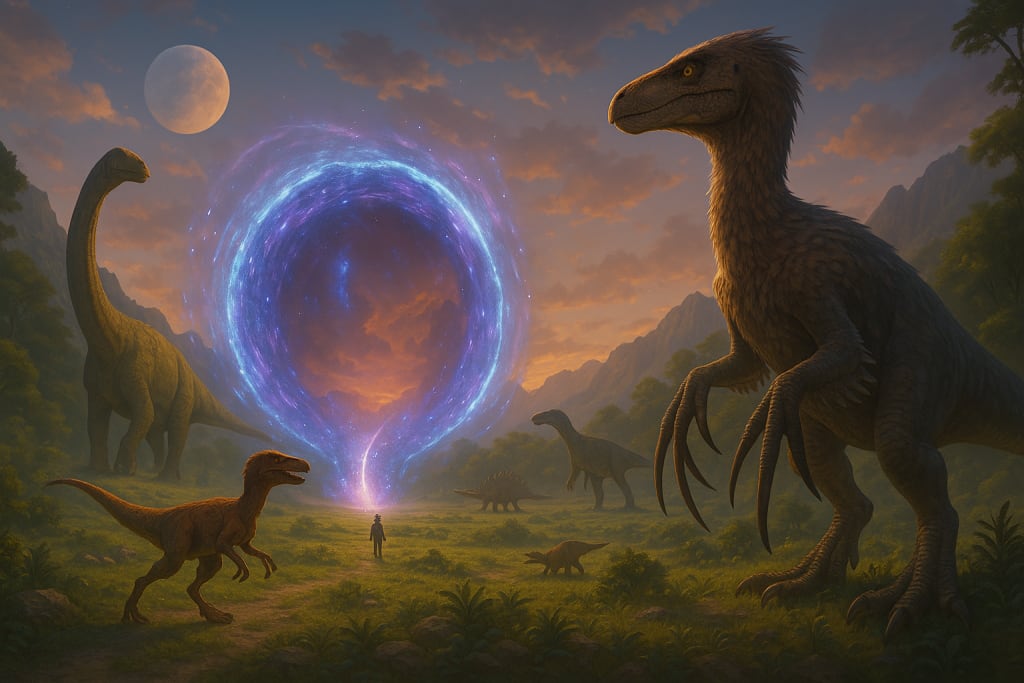
In the year 2087, Earth was no longer the planet humanity once knew. Cities floated in the sky, deserts bloomed with genetically modified flora, and technology touched every grain of sand. Yet, beneath the shimmering progress, something ancient stirred.
Deep in the heart of Patagonia, where the wind howled through forgotten canyons, a rift had opened. Not a metaphorical one—but a pulsing, violet tear in the fabric of time. It shimmered like oil in sunlight, humming with energy that bent gravity itself. The rift had a name, given by those who studied it: The Echo Gate.
At first, the gate was considered a scientific anomaly. But when a satellite captured a herd of thunder-lizards—actual living sauropods—lumbering across the valley, the world’s attention snapped to Patagonia.
Enter Dr. Calla Reyes, a paleo-ecologist with a stubborn streak and a fascination for time paradoxes.
“They’re not clones,” she said, watching the footage at the International Temporal Research Authority (ITRA). “Look at the movement. The skin texture. They belong to their time.”
“Exactly,” replied Commander Li of ITRA. “But they’re in ours.”
Calla was chosen to lead the first team through the Echo Gate. She wasn’t going in alone.
Her crew included Toshi, a neuro-hacker; Maro, a hardened ex-military survivalist; and Ada, a 12-year-old genius with an AI companion that hovered like a glowing orb over her shoulder. They called it "Lux."
As they stepped through the shimmering tear, their senses twisted. Colors bled into each other. Sounds stretched like rubber bands. Then—stillness.
They landed in the Cretaceous period.
But this wasn’t the chaotic, primitive wilderness they'd expected.
Instead, vast meadows stretched to purple-tinted skies, ruled not just by instinct—but intelligence.
It began subtly. A pack of Velociraptors flanked them on their second day, not attacking, just observing. When Maro raised his weapon, they scattered—not in fear, but strategy. One left a spiraled shell behind. On it were carved markings. Symbols.
“They’re writing,” whispered Ada, stunned. “They know we’re not from here.”
The team pressed deeper and found the unimaginable—a city. Not stone or metal, but bone and crystal, woven together with vines that shimmered with bioluminescent code. Dinosaurs of all species roamed freely, coexisting under a canopy of intelligent order.
And at the center of it all stood the Primordials—towering saurian creatures, eyes glowing with thought, speech vibrating through the ground itself.
Calla stepped forward. “You’re not… animals.”
A massive Therizinosaurus lowered its feathered head. “We are memory. We are roar. We are what Earth left behind.”
Their voices were not heard with ears, but within the skull—telepathy that resonated through bone.
The Primordials explained: Earth, in a moment of temporal instability, had remembered a past so strongly that it folded time inward. The Echo Gate wasn’t a portal—it was a reminder. Life’s ancient echo brought forward to correct something broken.
“There is a wound,” said the Primordial. “Your world consumes. Your sky burns. The chain of life rusts.”
“You’re here to fix it?” Calla asked.
“No. We are here to offer a choice.”
In the days that followed, the crew learned that these evolved dinosaurs weren’t the mindless beasts from history books. Their intelligence came from deep-time evolution that branched away from extinction. They developed symbiosis with their world, communication through resonance, harmony rather than conquest.
They had been watching humanity through fractures in time.
“We offer balance,” said the Primordial. “Or we reclaim the Earth.”
Back at the gate, ITRA detected a surge of energy. More rifts began appearing globally. From the Grand Canyon to the Himalayas, the past was bleeding into the present.
Dinosaurs—massive, sentient, coordinated—emerged. But they weren’t attacking. They were planting. Singing. Healing.
“Why now?” Commander Li demanded.
“Because we are failing,” said Calla, her voice coming through the live feed. “They’re not our enemies. They’re Earth’s antibodies.”
But not all humans agreed.
Private militaries and rogue states saw the Primordials as threats. One launched a nuclear strike on a rift site in Russia. The dinosaurs responded by encasing the area in a dome of crystallized time, freezing it mid-detonation. No war, no death. Just silence.
Calla made her choice.
She stayed beyond the gate.
Months passed. On Earth, borders began to fade. Where dinosaurs walked, ecosystems flourished. Fossil fuels were abandoned. The old systems began to crumble—but in their place, something new took root.
Ada, now a leading voice in Earth’s new alliance with the Primordials, broadcast a message worldwide:
“We thought we were the peak of evolution. But we were only one breath in Earth’s long song. Now, we listen.”
---
EPILOGUE
Years later, children would play beside grazing Stegosaurus herds. Cities learned to grow rather than build. And in the starlit nights, deep rumbles echoed from the Earth’s crust—songs of the Primordials, singing with the planet they had once lost, and now helped save.
The roar had returned—not as destruction—but as memory. As warning. As hope.
---
About the Creator
Waleed Khan
Nature lover, student, story creator, Mimi poet etc.
Keep reading
More stories from Waleed Khan and writers in Earth and other communities.
The Clockmaker's Paradox
Chapter One: The Silence of Verin Hollow Verin Hollow had no working clocks. Not because they were broken — no, every gear and spring was finely tuned — but because the moment a clock was set and wound in Verin Hollow, it simply… stopped. Not immediately. Not dramatically. It would tick, sometimes for hours, days even, and then—nothing. Silence.
By Waleed Khan 7 months ago in Fiction
The Day the Forest Spoke
A Walk Into the Unknown It began as an ordinary hike, a chance to escape the chaos of the city and immerse myself in the green stillness of the old Redwood Forest at the edge of my town. The sun filtered through the towering trees in long golden beams, the leaves rustling faintly with a whisper of wind, and for a moment, I felt at peace — detached from deadlines, notifications, and the endless noise of human life. I hadn’t planned for anything extraordinary, just a few hours of solitude surrounded by the ancient giants that had stood for centuries, quietly observing the world.
By The Curious Writerabout 13 hours ago in Earth


Comments
There are no comments for this story
Be the first to respond and start the conversation.