
Echoes from Earth
Alone in space, he hears the impossible: a signal from a world long gone


The silence of space was absolute—until the day he heard it.
Commander Reuben Kale floated alone aboard the Oasis-7, a deep-space research vessel that had long outlived its original mission. Earth had fallen silent seventy-two years ago, its last broadcast a garbled emergency transmission swallowed by static. No one knew what had truly happened—only that the blue marble that once brimmed with life now spun quietly in the darkness, its atmosphere choked and unstable, its surface abandoned.
Most humans had fled to the outer colonies—floating cities on Venus, domed habitats on Mars, and mining outposts scattered across the moons of Jupiter and Saturn. But Reuben had stayed behind longer than most. When he finally left, it wasn’t to escape—it was to observe. To listen. To remember.
The Oasis-7 orbited what used to be called the Lagrange Point between Earth and the Moon. It drifted there, powered by slow nuclear burn, equipped with instruments once used for planetary monitoring. It was now a relic and so was he—a solitary sentinel guarding a planet that no longer spoke.
Until it did.
At precisely 04:12 Earth Universal Time, Reuben was sipping rehydrated coffee in the observation deck, watching the cratered shell of the Moon spin gently outside his window, when a high-pitched whine pierced the silence.
The ship's ancient comms array sputtered to life. Lights flickered on a console that hadn’t glowed in years. A faint, pulsing wave.
He dropped the cup. It spun in zero-G, spilling brown beads across the air. His hands moved on instinct, punching in commands, calibrating the signal receiver. It was real.
A transmission.
And it was coming from Earth.
His mind raced. Earth’s orbital towers had collapsed decades ago. Its power grids were fried. Satellites had long since fallen from the sky, most burning up in the upper atmosphere. No known infrastructure could produce such a signal.
He traced the coordinates. Somewhere in what used to be Eastern Europe.
The signal was faint. A repeating tone. Then… a voice.
Not synthetic. Human.
It came in bursts. “...is anyone... alive... this is Echo Station... Earth... please respond...”
Reuben stared in disbelief. His heart pounded in his chest. He initiated a recorder and began tracking the frequency. Each loop repeated every ninety-seven seconds, followed by static.
Echo Station. He vaguely remembered the name from ancient Earth systems—a subterranean research facility built during the climate collapse, designed to survive anything: floods, fires, even nuclear fallout.
But no one had heard from it. Not in over half a century.
He had two choices. Log the anomaly and alert the Martian Relay. Or go down himself.
He chose Earth.
The descent was rough. The shuttle rattled violently as it pierced the upper atmosphere, buffeted by ash storms and electromagnetic interference. Through gaps in the gray clouds, he glimpsed scorched continents, oceans turned into mirror-flat plains of chemical sludge, and mountain ranges buried under decades of soot.
But then he saw it—a flicker of light in the Carpathian Mountains. Buried deep in stone, surrounded by dead forests, was a faint blue beacon blinking like a heartbeat.
He landed the shuttle a few kilometers away and trekked across the ruined landscape in a pressure suit. The air was unbreathable, thick with radiation and carbon monoxide. As he approached the coordinates, he found a massive metal hatch embedded in the side of a mountain, half-covered by dust and rubble.
It hissed open.
The air inside was filtered. Lights flickered weakly. Systems still hummed. And in the main operations room, he found her.
She looked up from the terminal—disheveled, pale, but alive.
“My God,” she whispered. “You came.”
Her name was Dr. Alina Sorin. She had been born in Echo Station. Her parents were among the last scientists who stayed behind when the world went silent. They believed Earth could still be saved.
They were wrong.
When the final storms came, most of the staff perished. Alina, just a child, grew up inside these walls. Taught by archived lectures, cared for by decaying robots and recorded voices. She had known no other world.
She had spent years repairing the comms, boosting its ancient transmitter with scavenged tech from weather satellites and broken drones.
“I thought I was the last,” she said.
Reuben sat in silence, overwhelmed. Two souls, separated by a century of ruin, now face to face on a dead world.
He offered her a seat on the Oasis-7. A new home among the stars.
But Alina shook her head. “Not yet. I have work to finish.”
“What kind of work?”
She turned her screen to him. An entire database of Earth’s genetic archive, species catalogs, soil and water purification protocols—solutions developed too late, buried too deep. Her plan was simple: transmit this knowledge back into the galaxy. Let humanity remember its home. Let it learn.
Reuben stayed with her for seven days, helping repair the main antenna, optimizing the signal reach. Before he left, they stood at the hatch.
“Do you think Earth will ever live again?” he asked.
Alina looked up at the gray sky. “Maybe not in our time. But one day, someone will come back. Someone will try.”
As the shuttle rose from the mountains, Reuben looked back one last time. The station’s beacon blinked steadily below—a soft blue echo in the dark.
The Earth was speaking again.
And someone was listening.
About the Creator
Muhammad Sabeel
I write not for silence, but for the echo—where mystery lingers, hearts awaken, and every story dares to leave a mark
Keep reading
More stories from Muhammad Sabeel and writers in Earth and other communities.
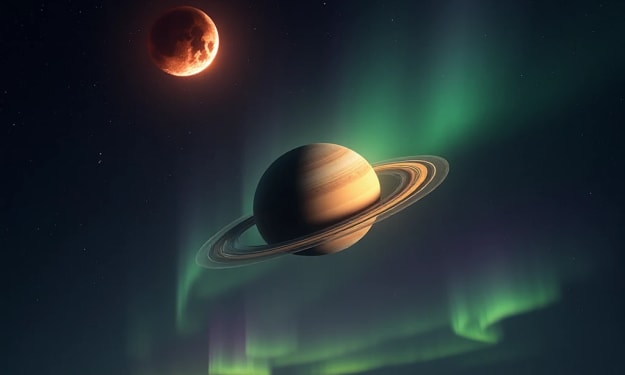
The Night Sky In September 2025: Two Eclipses, Bright Aurora And Saturn
September ushers in a season of dramatic celestial events, from Saturn at opposition and some close planetaring pairings to a spectacular “blood moon” total lunar eclipse — though the latter is not visible in North America. As days shorten ahead of the autumnal equinox, stargazing becomes an evening activity, and a rewarding one as the constellations rise and fall with the changing of the season up above. Here’s everything you need to know about stargazing in September 2025.
By Muhammad Sabeel6 months ago in Earth
Magic
Note from the Author: I want to let you know that this is an unusual story, and it has been written purely from whatever is in my unconscious mind, because before I start writing, I get into a flow state that reaches my unconsciousness. I also write in my subconscious mind, which is like a mid-flow state between the conscious and unconscious mind.
By Denise Larkin7 days ago in Fiction


Comments
There are no comments for this story
Be the first to respond and start the conversation.