
Eaten Alive By The Bears He Called ‘Friends’
One man's mission to befriend one of nature's deadliest predators comes to a tragic end...


Born in New York in 1957, Timothy Treadwell was never one to shy away from the spotlight. As a young boy, he excelled in many areas and became the star diving champion of his high school. Once described as an “ordinary boy,” those close to Timothy began to notice a shift in his behaviour after he left for college.
During this time, he fabricated stories to attract attention from his peers—claiming on one occasion to be a British orphan, and on another to be from Australia. Timothy realised early in life that he could command attention by saying or doing things that were unusual or controversial, a pattern of behaviour that would persist throughout his later years.

As Timothy entered adolescence, he began pursuing acting roles, driven by ambitions of fame. In 1985, however, his life took a decisive downturn after he lost the role of Woody Boyd on the popular sitcom Cheers to Woody Harrelson.
Following this disappointment, Timothy turned to drugs and alcohol to numb his frustration, gradually losing both his sense of direction and his motivation.

By the late 1980s, Timothy had overdosed on heroin and narrowly escaped death. This near-fatal experience served as the wake-up call he needed to turn his life around. With the encouragement of a friend, he relocated to Alaska, setting his sights on a new ambition: observing bears.

In his 1997 book, Among Grizzlies, Timothy wrote that after his first close encounter with a bear, he knew he had discovered his true calling. Experiencing a renewed sense of purpose, he credited his recovery and sobriety to the bond he formed with the animals. This deep affection for wildlife had been present since childhood—he had even raised a squirrel named Willie as a pet.
Over the next 13 years, Timothy spent his summers camping along the Katmai Coast. During the first half of each season, he returned to a grassy area of Hallo Bay he called “the Big Green,” a location known for its heavy bear traffic.

Timothy used this opportunity to document his time among the bears, recording raw footage that he later shaped into short films. His goal was to educate the public about the challenges the bears faced, while also sharing his own close encounters with them.
As he spent more time immersed in the bears’ natural habitat, Timothy’s confidence steadily grew. The personal connection he believed he had formed with the animals fostered an illusion of bonding, one that would increasingly blur the line between observation and involvement.

At times, Timothy ventured dangerously close to the wild animals, occasionally touching them or even playing with bear cubs. He placed complete trust in the bears around him, claiming in his book that this trust was mutual and returned.
By 2001, Timothy appeared to have achieved his original ambition: fame. Through his filmmaking and passionate advocacy for the animals he loved so deeply, media outlets began publishing articles and conducting television interviews with him. However, not all of the attention he received would prove to be positive or well received.

Fellow environmental activists and members of the surrounding community began to scrutinise Timothy’s intentions. He was warned repeatedly about the dangers he was placing himself in, yet he consistently dismissed these concerns.
One research ecologist, Tom Smith of the Alaska Science Centre, spoke out openly against Timothy’s actions, stating that he was violating park regulations, harassing wildlife, and interfering with natural processes.
Meanwhile, Timothy felt entirely in his element. He believed that those who criticised him were simply resentful—unwilling or unable to take the risks he felt brave enough to embrace.

When the season drew to a close, Timothy would relocate further up the coast to Kaflia Bay, an area of dense brush he dubbed the “Grizzly Maze.” With its numerous bear trails, the likelihood of encountering a bear there was significantly higher.

More than 100 hours of footage recorded by Timothy would later be featured in Werner Herzog’s 2005 documentary Grizzly Man. The German director was deeply captivated by Timothy and the extraordinary life he had chosen to lead.
During the final three years of Timothy’s pursuits, he was accompanied by his girlfriend, Amie Huguenard, a physician’s assistant.
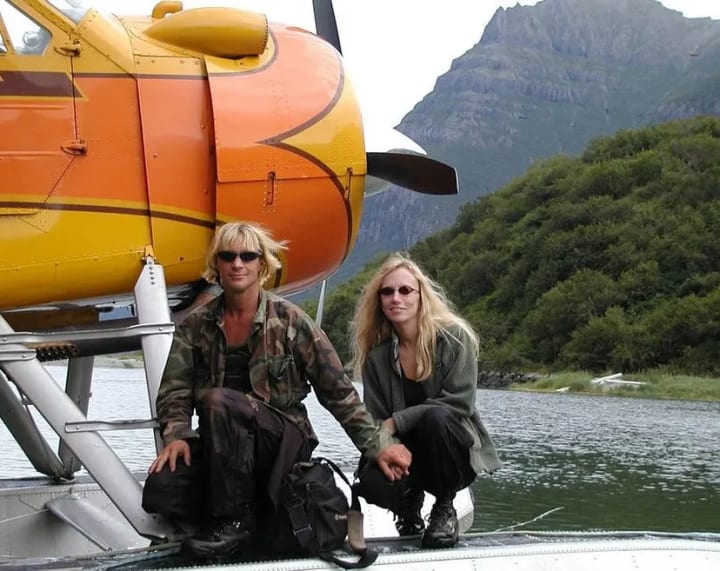
With the odds seemingly stacked against him, Timothy appeared to be defying expectations and silencing his critics. Yet, his prolonged proximity to danger suggested that his time spent brushing shoulders with death was running out.
In October 2003, Timothy and Amie returned to Katmai National Park, setting up their campsite near a salmon stream—a well-known focal point where bears commonly hunted for fish throughout the fall.

In a diary excerpt shared by Amie, she confessed that she did not share Timothy’s fearless approach to bears and often felt “uncomfortable” in their presence. She also indicated that she wanted to leave the Katmai area.
Unfortunately for Amie, the pair had originally been scheduled to return to their California home on September 26th. However, a dispute with the airline over a price increase for their return tickets forced them to stay at the campsite for an additional week.
For the first time, they were in the park much later in the year than usual—a period when bears were intensely focused on fattening up for the winter, consuming as much food as they could find. To make matters worse, autumn food was scarce that year, increasing the bears’ aggression beyond the norm.
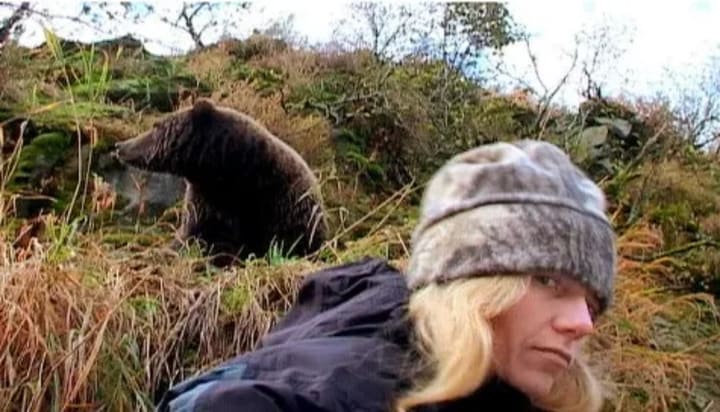
Timothy was more than happy to spend an extra week in the place he loved, feeling more at home among the bears than he ever had in the city with other humans.
Having moved to a different area from where they had spent the summer, Timothy and Amie were now in the territory of bears they had never encountered before. The bears Timothy had grown familiar with—and even given names to—were now in hibernation, leaving him among entirely unfamiliar wildlife.

Later, a clip recovered from Timothy’s tapes showed a bear plunging into the river to retrieve a piece of dead salmon floating on the surface. The camera then cut to Timothy, who admitted that he did not fully trust that particular bear.
He offered no further explanation, but having spent so much time among the creatures, he likely had a keen ability to read their behaviour and gauge which bears were potentially more hostile.

The day of Timothy and Amie’s planned departure for the season finally arrived. On October 6th 2003, just after noon, an air taxi pilot arrived to pick them up and transport them to the airport.
However, when the pilot reached the campsite, there was no sign of the couple. The only presence nearby was a bear lingering in the area. Park rangers were called, and upon arriving at the site, they made a grisly discovery.

Laying next to the now shredded and trampled tent, was Timothy’s disfigured head and a severed forearm with his wristwatch still attached. The mangled remains of Amie would also be found close by.
She had been partially buried with soil and twigs scattered over the top of her — an act carried out by bears to mask the smell of carcasses from other predators. The bears then tend to rest nearby in an area of thick brush before returning to feast on their prey.

The large bear first spotted by the air taxi pilot was still guarding the campsite when park rangers arrived. The rangers were forced to shoot the bear in order to recover the couple’s remains.
A second bear—an adolescent—was also killed after it charged at the rangers upon noticing them.
An autopsy on the first bear, conducted at the scene, revealed human body parts, including fingers and limbs, as well as pieces of clothing in its stomach. The smaller bear had been consumed by other wildlife before an autopsy could be performed. In the 85-year history of Katmai National Park, this incident marked the first known bear attack on humans.

Alongside the grim discovery, investigators recovered footage containing the audio of the couple’s final moments. The six-minute recording did not capture visuals, as a cap had been covering the camera lens, but the horrifying sounds of the victims’ screams were unmistakable.
As the attack began, Timothy could be heard calling to Amie, shouting for her to come out of the tent and help him. The sound of the tent zipper opening is audible, and as Amie emerges, she frantically instructs Timothy to “play dead.”

The bear continued its assault on Timothy, whose screams were almost constant, but at one point, the attack momentarily subsided. During this brief lull, a short exchange between Timothy and Amie could be heard as they tried to determine whether the bear had left.
The tape then captures Amie attempting to reach Timothy to assess his injuries, but she was forced to retreat when the bear suddenly returned. Timothy’s screams intensified as he begged Amie to find something to strike the bear with. Amid the chaos, Amie could be heard urging him to “fight back.”

Timothy’s death was prolonged and agonising—he did not die quickly. The recording captures the grunts and growls of the bear, followed by Timothy’s fading screams as it dragged him into the brush, his fate sealed. Some have speculated that the bear responsible for his death may have been the same “untrustworthy” one he had recorded near the stream before the attack.

Before the video recorder cut out due to low battery, Amie’s frantic screams can be heard as she helplessly witnessed the unfolding horror. These screams were later compared to a “predator call”—a device hunters use to mimic the distress sounds of a wounded animal. Some experts have theorized that these cries may have inadvertently drawn the bear back, ultimately leading to her death as well.

Today, the tape is in the possession of Jewel Palvonak, a longtime friend of Timothy’s. In an interview, she admitted that she has never listened to it and could not bear the thought of hearing it.

For the purposes of his documentary, she allowed Werner Herzog to listen to the audio during a recorded interview. So disturbed was he by what he heard that he asked Jewel to stop the tape just a few minutes in.
The recording has never been publicly released.
About the Creator
Matesanz
I write about history, true crime and strange phenomenon from around the world, subscribe for updates! I post daily.
Tea of Silence
The snow had covered the hills for days, turning the land into a quiet white world where sound seemed afraid to exist. On the highest of these hills, beneath a dry, leafless tree, a young man sat alone. The tree had long ago lost its strength, its branches thin and broken, but it still stood, as if refusing to disappear. The young man chose this place often, not because it was comfortable, but because it was honest.
By Bilal Mohammadi2 days ago in Earth
The Most Earthquake-Prone Places in the World and Why They Shake so Often
My interest in earthquakes began when I was a little girl. I remember watching footage of the ground shaking and wondering how something as solid as the Earth could suddenly move. That early curiosity stayed with me and eventually led me to learn more about why earthquakes happen and why some places experience them far more often than others.
By Marla Samuel6 days ago in Earth



Comments
There are no comments for this story
Be the first to respond and start the conversation.