
Earth's Core Unplugged
Exploring the Hypothetical Consequences of a Halt in Rotation.


Hey there, fellow Earth explorer! Ready for a dig into the mysteries beneath our feet? But before we journey to the core, let's dive into a recent discovery that's raising eyebrows among the scientific community. Picture this: a blazing-hot, molten metal sphere deep within our planet, and it seems like things might be a bit off-kilter. So, here's the big question: Is the Earth's inner core putting on the brakes? And if it really did, what sort of doomsday scenarios would this unleash? Could we end up like our desolate neighbor, Mars? Let's dive into the realm of "what if" and uncover the truth behind the Earth's core potentially stopping its spin.
Imagine burrowing straight down into our planet's layers. As you journey deeper, you'd traverse four distinct realms, starting with the rocky crust, then delving into the sizzling liquid mantle. After a trek of about 2,900 kilometers, you'd reach the Earth's outer core – a molten mix of iron and nickel. And finally, you'd encounter the solid iron inner core, a sizzling core duo roughly the size of Mars. But here's the kicker: These fiery layers are no less scorching than a sizzling 10,000 degrees Celsius, surpassing even the Sun's blazing surface.
But hold on, it's not just a hot mess down there. The outer core's molten dance is choreographing something quite spectacular – Earth's magnetic field. This cosmic shield is vital for safeguarding our atmosphere and shielding us from the perils of space radiation. And as for the inner core, well, it's no wallflower either. Recent research indicates that it might be slowing down its spin, syncing up with the planet's overall rhythm.
Now, let's dive into some tantalizing "what ifs." Suppose both layers of the core decided to throw in the towel and stop their celestial shimmy. If only the solid inner core took a breather, no need to hit the panic button just yet. This gentle slowdown would mainly affect Earth's rotation, making our days a tad longer and potentially dimming our magnetic prowess over time. Not exactly a cosmic catastrophe, but not a walk in the park either.
However, let's get to the real nail-biter – if the outer core decided to join the cosmic siesta. Say goodbye to our magnetic guardian, and brace yourself for a tale that parallels Mars' fate. Eons ago, Mars was a toasty haven, perhaps with oceans brimming with life. But as its core cooled, its magnetic embrace faded, opening the door for solar winds to whisk away its atmosphere. What was once a promising world became the desolate desert we now know.
But back to Earth. Should its core suddenly decide to pull a spin-stopping stunt, we'd be in for a bumpy ride. Tectonic plates would jolt into collision mode, setting off worldwide seismic rumbles. It's like slamming on the brakes during a bus ride and watching everyone tumble around. Buildings, roads, bridges – all in jeopardy. Services disrupted, lives displaced, and an untold aftermath of chaos.
And that's just the beginning. Without our trusty magnetic shield, we'd become cosmic radiation magnets. High-energy particles from the Sun would stage a relentless assault on our atmosphere, smashing into nitrogen and oxygen. This cosmic showdown would obliterate our protective ozone layer, inviting more UV radiation to join the party. This lethal cocktail could rewrite our DNA, spawning mutations and cancer, posing an existential challenge.
But wait, there's more. Navigation would become a cosmic riddle. Compasses would spin aimlessly, and migratory animals could end up playing cosmic Marco Polo. Global power networks would be sent into a tailspin, leading to a symphony of outages, both temporary and potentially long-lasting.
But before we go spiraling into full-blown panic mode, let's take a breath. The study that stirred these cosmic ponderings had its wires a bit crossed. It didn't call out the outer core; it was simply pointing at the inner core, engaging in a cosmic waltz that's been ongoing for billions of years.
So, fellow cosmic wayfarer, as we resurface from the enigmatic depths of Earth's core, rest assured that our planet's heart is still in the groove. While the secrets of our core remain elusive, our Earth keeps its rhythmic twirl, an eternal dance with the cosmos. And as we bask in the gentle embrace of gravity, we can marvel at the wonders that lie both beneath and above. Just imagine – what if our planet's spin truly came to a halt? But that, my friend, is a tale for another "time."
About the Creator
Keep reading
More stories from Phylicia Taylor-Grant and writers in Earth and other communities.
Revolutionizing Waste Management
Introduction: When we think of Disney World's Magic Kingdom, images of enchantment and wonder fill our minds, but what we often overlook is the massive amount of garbage generated on a daily basis – 15,000 pounds to be precise, solely at the Magic Kingdom. However, Disney has devised a futuristic approach to tackle this issue by implementing a hidden network of tubes that swiftly transports trash at an astonishing speed of 60 miles per hour. This sci-fi inspired solution might seem unique, but it's not the only place where this technology is employed. Let's take a detour to Roosevelt Island in New York City, a small patch of land nestled between Manhattan and Queens, where the same trash-tube system has been successfully adopted for almost fifty years. So why haven't these innovative trash-handling systems caught on throughout the United States? Let's navigate through the history and evolution of pneumatic tubes and explore Roosevelt Island's waste management revolution.
By Phylicia Taylor-Grant2 years ago in Earth
France’s Navy Intercepts an Oil Tanker in the Mediterranean Sailing From Russia
France’s navy has intercepted an oil tanker sailing from Russia in the Mediterranean Sea, a move that underscores the growing complexity of enforcing international sanctions amid ongoing geopolitical tensions. The interception, while not unprecedented, highlights how European nations are increasingly using naval assets to monitor, inspect, and sometimes detain vessels suspected of violating sanctions or maritime regulations linked to Russian energy exports.
By Muhammad Hassan7 days ago in Earth
Hunt for the Names of Mysterious Dwarf Planets
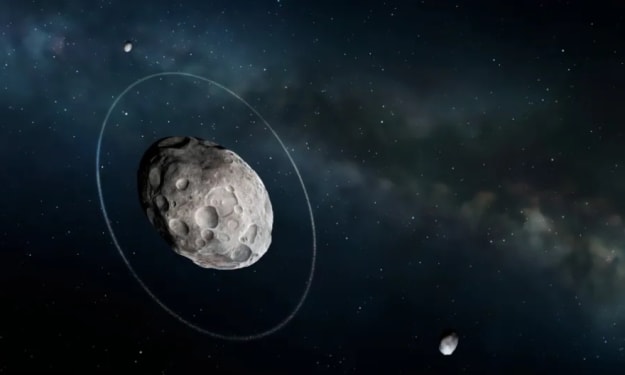
Far beyond the familiar planets of our solar system lies a cold, dark region filled with icy bodies, ancient debris, and mysterious worlds yet to be fully understood. Among these distant objects are dwarf planets, many of which orbit on the fringes of our solar system in regions like the Kuiper Belt and beyond. While some, such as Pluto, have captured public imagination for decades, many others remain unnamed, sparking a fascinating hunt among astronomers to discover, study, and ultimately name these elusive celestial bodies.
By Aarif Lashari2 days ago in Earth



Comments
There are no comments for this story
Be the first to respond and start the conversation.