
Earth is it really flat?
How does the earth actually appear?

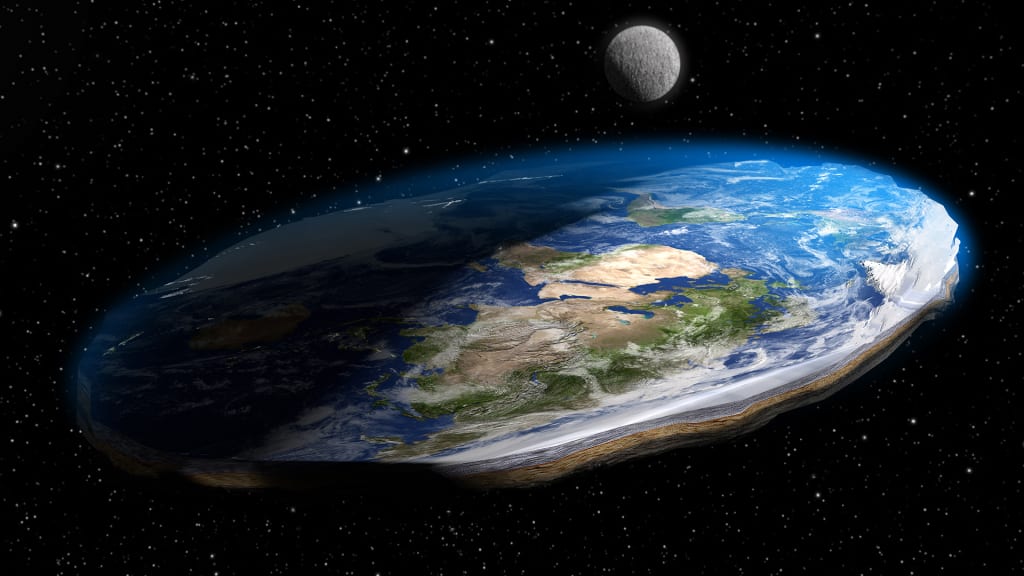
Earth is an oblate spheroid, according to the vast body of scientific evidence that has amassed through time. Because of its rotation, an oblate spheroid has a roughly spherical form that is somewhat flattened at the poles and bulges at the equator.
Several sources provide evidence for Earth's spherical shape, including:
Satellite imagery: Satellite and spacecraft observations depict a curving Earth from a variety of perspectives, which is not feasible if the Earth were flat.
Gravity: The Earth's gravitational field is distributed in a way that is compatible with its spherical shape. The gravitational field, which pushes objects toward the center of mass, can best be understood by a spherical Earth.
Moon's shadow cast by Earth during lunar eclipses: During a lunar eclipse, the Moon's shadow cast by the Earth is always round, demonstrating that the Moon is spherical in shape.
Travel and navigation: The curvature of the Earth is taken into account while planning ship routes, airplane flight trajectories, and other types of long-distance travel.
photographs from space: Many photographs of Earth from orbit, revealing its spherical shape, have been taken by astronauts and satellites.
Earth's rotation: The planet's day-night cycle and the Coriolis effect, which causes moving objects to be deflected, both confirm the spherical form of the planet.
The notion that the Earth is flat is a long-debunked myth that conflicts with the available scientific data. The proof that the Earth is spherical is strong and extensive.
Science does not provide proof for the hypothesis that the Earth is flat. The rotation of Earth causes it to be an oblate spheroid, which is approximately spherical, somewhat flattened at the poles, and bulging at the equator. This conclusion is supported by an extensive amount of scientific evidence, such as satellite imaging, gravitational measurements, lunar eclipses, travel and navigation, and images from space.
Extensive scientific investigation, discovery, and observation have continuously supported the idea that Earth is a sphere throughout history. The notion that the Earth is flat has been fully refuted and is now discredited. Accurate navigation, satellite technology, and our entire grasp of the world we live in depend on us accepting the scientific data and realizing that the Earth is an oblate spheroid.
Earth would appear to be a slightly flattened sphere if it were an oblate spheroid rather than a flat planet. Imagine a globe or ball that has a slight bulge at the equator and a slight compression at the poles. The main features of an oblate spheroid are as follows:
Spherical form: The Earth is generally circular and has an overall form resembling a sphere.
Flattening at the Poles: The diameter of the Earth's polar region (measured along its north-south axis) is a little less than that of its equatorial region (measured along its east-west axis). The centrifugal force generated by the rotation of the Earth is what causes this flatness.
The equatorial part of Earth has a little bigger diameter than the polar zone, which results in a bulging effect.
Smooth Curvature: The Earth's surface curves gently in all directions, as may be seen when gazing at the horizon or admiring vast oceanic expanses.
The distinctive behavior of a spherical object is caused by the gravitational pull, which works toward the center of mass and pulls objects toward the center of the Earth.
Using satellite imagery, scientists can see the Earth's spherical shape and smooth, continuous curvature.
For all practical purposes, the Earth seems to be a sphere to the naked eye because the divergence from a perfect sphere is relatively minor. Scientific understanding of Earth as an oblate spheroid is well-established, and it is backed up by a variety of facts and information discovered through astronomy, geodesy, and space research.
About the Creator
Marvin Abon
Be the center of your own show.
Keep reading
More stories from Marvin Abon and writers in Earth and other communities.
The Invisible Grid Build-out
by Futoshi Tachino Why this is under-the-radar progress Everyone talks about how slow it is to build new transmission lines. Less noticed is how much capacity is being freed — right now — on the wires we already have. Three families of “grid-enhancing technologies” (GETs) are scaling fast: (1) advanced reconductoring with modern high-performance conductors that can double capacity within existing rights-of-way; (2) dynamic and ambient-adjusted line ratings (DLR/AAR) that raise safe operating limits based on real weather, not worst-case assumptions; and (3) power-flow control, topology optimization, and other software tools that route power away from bottlenecks to under-used lines. Together, these are connecting more renewables, cutting curtailment and congestion, and buying precious time while big new lines are planned and built [1–3,13–14].
By Futoshi Tachinoa day ago in Earth
Europe Is About to Sign a Long-Awaited Free-Trade Deal With India
After years of negotiations, pauses, and political recalculations, Europe and India are finally on the brink of signing a long-awaited free-trade agreement. What once seemed like an overly ambitious diplomatic project is now becoming a reality—one that could redefine trade relations between two of the world’s most influential economic regions. This deal is not just about tariffs and exports. It’s about shifting global power, strengthening supply chains, and creating new opportunities for communities on both sides. Why This Deal Took So Long Talks between the European Union and India began well over a decade ago, but progress was slow. Differences over labor standards, environmental rules, market access, and intellectual property rights repeatedly stalled negotiations. Both sides had strong priorities—and neither wanted to compromise too much. However, the global landscape has changed dramatically in recent years. Supply chain disruptions, geopolitical tensions, and a growing desire to reduce over-reliance on single markets have pushed both Europe and India to rethink their strategies. Suddenly, cooperation feels less optional and more necessary. What the Agreement Is Expected to Cover At its core, the free-trade deal aims to reduce tariffs, ease regulations, and open markets between Europe and India. European companies are seeking better access to India’s vast consumer market, while India wants smoother entry into European industries such as technology, pharmaceuticals, and manufacturing. The agreement is also expected to include provisions related to: Digital trade Sustainable development Labor rights Investment protection These elements reflect modern trade priorities, where economic growth is increasingly linked with social and environmental responsibility. Why Europe Needs India Right Now For Europe, the deal is part of a broader strategy to diversify trade relationships. Recent global events have highlighted the risks of economic dependency. India, with its rapidly growing economy and young workforce, represents both stability and potential. European policymakers see India as a long-term partner capable of balancing global trade dynamics. Strengthening ties with India could also help Europe remain competitive in a world where economic influence is constantly shifting. Why India Is Saying Yes India, too, stands to gain significantly. A free-trade agreement with Europe could boost exports, attract investment, and accelerate economic modernization. It also positions India as a major global player willing to engage on equal terms with powerful blocs. For Indian businesses—especially small and medium enterprises—easier access to European markets could mean growth, innovation, and international exposure. For workers, it could translate into job creation and skills development. Impact on Everyday Communities While trade deals often sound abstract, their effects are deeply local. Lower tariffs can reduce prices for consumers. New investments can revitalize industries and create employment. Improved cooperation can strengthen educational, cultural, and technological exchanges. Communities in Europe may see new products, partnerships, and opportunities tied to Indian innovation. Indian communities, meanwhile, could benefit from European expertise in sustainability, infrastructure, and advanced manufacturing. This is why the agreement matters beyond boardrooms and government offices—it touches real lives. Concerns and Criticism Still Exist Despite the optimism, critics on both sides have raised concerns. Some European groups worry about labor standards and environmental protections, while some Indian voices fear that local industries could struggle against European competition. These concerns highlight the importance of transparency and fair implementation. A successful agreement will require ongoing dialogue, monitoring, and cooperation to ensure that economic growth does not come at the expense of workers or the environment. A Strategic Signal to the World Beyond economics, the deal sends a strong political message. It signals that multilateral cooperation is still possible, even in an era of rising protectionism. Europe and India are showing that large, diverse democracies can find common ground through negotiation rather than confrontation. This partnership could also influence future global trade standards, especially in areas like digital regulation and sustainable development. What Happens Next Once signed, the agreement will still need formal approvals and phased implementation. Businesses, governments, and communities will need time to adapt. But the direction is clear: closer ties, deeper cooperation, and a shared economic future. For both Europe and India, this deal represents more than a trade pact—it’s a strategic investment in resilience and mutual growth. Final Thoughts The long-awaited free-trade deal between Europe and India marks a turning point in global economic relations. It reflects changing priorities, evolving partnerships, and a shared recognition that collaboration is essential in an uncertain world. As the agreement moves forward, its true success will be measured not just in trade volumes, but in how effectively it supports communities, protects values, and builds a more balanced global economy.
By Muhammad Hassan7 days ago in Earth


Comments
There are no comments for this story
Be the first to respond and start the conversation.