

Predicting the state of the Earth in 2050 is a challenging task as there are numerous factors that could affect the planet's future, such as technological advancements, global politics, environmental issues, and climate change. However, based on current trends and projections, it is possible to make some predictions about what the Earth may look like in 2050.
One of the most pressing issues facing the Earth in 2050 is climate change. It is predicted that global temperatures will continue to rise, leading to more frequent and intense heatwaves, droughts, floods, and storms. The effects of climate change are already being felt around the world, and it is likely that they will only get worse in the coming decades. Governments and organizations around the world are working to reduce greenhouse gas emissions and mitigate the impacts of climate change, but it remains to be seen whether these efforts will be enough to prevent catastrophic consequences.
Another issue that will likely continue to affect the Earth in 2050 is overpopulation. The global population is projected to reach 9.7 billion by 2050, which could put a strain on resources and lead to increased competition for food, water, and energy. However, advances in technology and agriculture could help to mitigate the effects of overpopulation, such as increasing the efficiency of food production and reducing waste.
In terms of technology, it is likely that artificial intelligence (AI) and automation will continue to play an increasingly significant role in society. AI could be used to automate many tasks currently performed by humans, leading to increased efficiency and productivity. However, it could also lead to job displacement and social inequality if not properly regulated.
In terms of energy, it is likely that renewable energy sources such as solar and wind power will become more widespread and affordable, potentially reducing reliance on fossil fuels. However, the transition to renewable energy will likely be a slow process, and it remains to be seen whether it will be enough to prevent catastrophic climate change.
Another issue that could affect the Earth in 2050 is the state of the oceans. The world's oceans are facing numerous threats, including overfishing, pollution, and acidification. If these trends continue, it could lead to the collapse of fisheries, the loss of marine biodiversity, and damage to the ocean's ecosystems.
In terms of global politics, it is difficult to predict what the world will look like in 2050. However, it is likely that current geopolitical tensions will continue to affect the world's economies and international relations. The rise of China as a global superpower and the growing influence of technology companies could also have significant implications for the world's political landscape.
The future of the Earth is uncertain, but it is clear that the planet will continue to face numerous challenges, such as climate change, overpopulation, and technological advancements. While there are opportunities for progress, such as the transition to renewable energy and advances in technology and agriculture, it will ultimately depend on the actions taken by individuals, governments, and organizations in the coming decades to shape the future of the planet.
In conclusion, the Earth in 2050 is likely to face numerous challenges, including climate change, overpopulation, technological advancements, and geopolitical tensions. However, there are also opportunities for progress, such as the transition to renewable energy and advances in agriculture and technology. Ultimately, the state of the Earth in 2050 will depend on the actions taken by individuals, governments, and organizations in the coming decades.
Though it is impossible to predict the future but still we can hope that out future will be better and our life will be happier.
About the Creator
Keep reading
More stories from Munime Shahariar and writers in Earth and other communities.
Death and Afterlife
Death is a concept that has perplexed humans since the dawn of time. It's a reality that we all must face, yet it remains shrouded in mystery. What happens when we die? Is there an afterlife? Do we simply cease to exist? The answers to these questions are complex and often subjective, influenced by culture, religion, and personal beliefs.
By Munime Shahariar3 years ago in Fiction
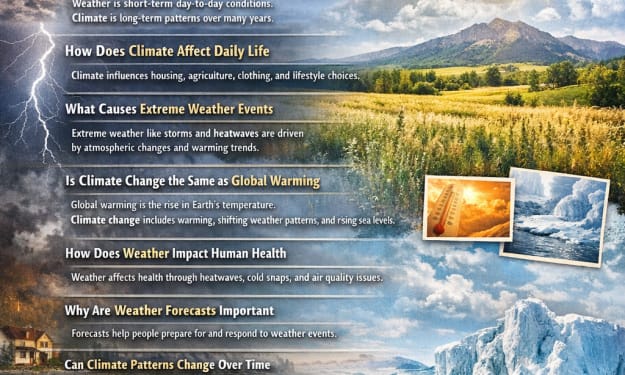
Weather and Climate Understanding the Forces That Shape Our Daily Lives
Weather and Climate Understanding the Forces That Shape Our Daily Lives Weather and climate play a central role in how people live work travel and plan for the future. From daily temperature changes to long term climate patterns these natural systems influence agriculture health economies and even global stability. Understanding the difference between weather and climate and knowing how they affect human life has become more important than ever especially as the world experiences more extreme conditions.
By America today 3 days ago in Earth
Affection and Healing for Yourself
During the night of the last quarter moon, I gathered my ritual supplies. I carefully handled the chunk of black tourmaline that would protect me from your overall negative and narcissistic energy. I carefully walked the house with my stick of selenite in hand, asking the universe to cleanse our working space.
By Alisha Wilkins ✒️🦋🖋️7 days ago in Fiction



Comments
There are no comments for this story
Be the first to respond and start the conversation.