
Dividing Perennials: How to Multiply Your Plants for Fre
Dividing perennials is one of gardening's best magic tricks—turning one plant into several, revitalizing your garden's health, and filling empty spaces without a trip to the nursery. It’s the ultimate way to get more "bang for your buck" from the plants you already have and love.

This guide will walk you through the entire process, from knowing when a plant is ready to be divided to the step-by-step techniques that ensure success.
The Golden Rule of Timing: When to Divide
Timing is your first key to success. The goal is to divide when the plant is dormant or less active, giving it time to recover without the stress of extreme weather or peak growth. A good general rule is to divide in the opposite season of when the plant blooms. Early spring and autumn are the primary seasons for this task, as the weather is mild and plants can establish roots before summer heat or winter frost.
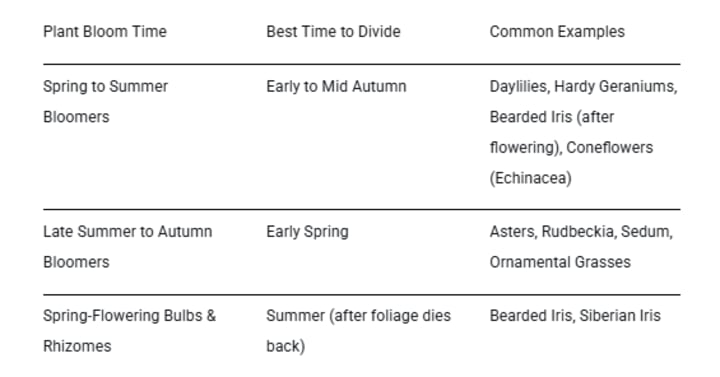
The following table summarizes the best times to divide common perennial types:
Key Exceptions and Tips:
- Tender Plants like Agapanthus and Anemones are best divided in spring so they have a full season to recover before winter.
- Avoid dividing during a plant's peak flowering period or during extreme summer heat or winter cold.
- If the soil is very wet in autumn, it’s often better to wait until spring to avoid compacting the soil and rotting the roots.
- The Doughnut Effect: The classic sign is a healthy ring of growth surrounding a dead, woody, or barren center.
- Reduced Vigor: The plant is producing noticeably fewer or smaller flowers than in previous years, or the overall clump seems weak and stunted.
- Overcrowding: The plant has simply outgrown its space, spilling over paths or smothering its neighbors.
- Daylilies (Hemerocallis): Tough and vigorous, often requiring division every 4-5 years.
- Hostas: Can often be pulled apart by hand or sliced with a spade.
- Ornamental Grasses: Spring division rejuvenates tired clumps.
- Hardy Geraniums, Asters, Coneflowers, Rudbeckia: All respond very well to division.
- Single Taproots: Plants like Baptisia (False Indigo), Lupins, and Oriental Poppies have a deep, central taproot that is easily damaged.
- Woody Crowns or Fragile Roots: Lavender, Russian Sage, Clematis, and Peonies (which can thrive for decades undivided) generally resent root disturbance and are better propagated by cuttings or seed if needed.
- Slow-Growing Clumpers: Some perennials, like Heuchera (Coral Bells) and Hellebores, form tight crowns and recover slowly from division; it's often best to leave them be.
- Water the plant thoroughly a day or two beforehand if the soil is dry. This reduces stress and makes digging easier.
- Gather your tools: A sharp spade or garden fork is essential. For tough roots, you may also need two back-to-back forks, a pruning saw, or an old bread knife. Have a tarp or wheelbarrow ready to hold the lifted plant.
- Prepare the new planting holes or pots in advance so divisions can be replanted immediately.
- Dig up the entire clump. Push your spade in a circle around the plant's drip line, then carefully work underneath to lift it from the ground. Shake or wash off excess soil to see the root structure clearly.
- Divide the clump. The method depends on the root type:
- Teasing Apart: For plants with loose, fibrous roots (like many Hostas), gently pull sections apart with your hands.
- The Back-to-Back Fork Method: For tough, matted roots (like Daylilies), insert two garden forks into the center of the clump, back to back, and lever the handles apart to split it.
- Cutting: For very dense or woody crowns (like ornamental grasses), use a sharp spade, knife, or even an axe to chop the clump into sections. Don't worry about cutting through some roots—plants are resilient.
- Discard the old, dead center of the clump to your compost heap, keeping the healthy outer sections. Each new division should have a good set of roots and at least 3-5 healthy shoots or "eyes".
- Replant immediately. Never let the roots dry out.
- Plant at the original depth in soil amended with compost. Water each division in deeply to settle the soil around the roots.
- Provide consistent aftercare. Keep the soil moist (but not soggy) for the first few weeks as the plant re-establishes. An application of a balanced, organic starter fertilizer can help reduce transplant shock. Avoid heavy fertilizing until the plant shows strong new growth.
- Bearded Iris: Divide in summer after flowering. You'll be separating thick, horizontal rhizomes. Cut them into sections, each with a fan of leaves and healthy roots. Trim the leaves back by about two-thirds and replant with the rhizome resting on the soil surface.
- Crocosmia & Dierama: These grow from chains of corms. Dig down deep (about 30cm/1ft) to avoid damaging them. You can replant individual corms or, for a quicker display, keep short chains intact.
- Ornamental Grasses: The best time is in spring as new growth begins. For large, tough clumps, you may need to use a sharp spade or even an axe. Replant only the vigorous outer sections.
How to Spot a Plant Ready for Division
How do you know which plant in your border is shouting to be divided? Look for these tell-tale signs:
Most clump-forming perennials benefit from being divided every 3 to 5 years to maintain their health and flower power.
Easy Dividers vs. Plants to Leave Alone
Not all perennials appreciate being split. Knowing which are which will save you time and heartache.
Easy-to-Divide, Clump-Forming Perennials:
These are the best candidates for beginners, often with fibrous root systems that are simple to separate:
Plants That Are Difficult or Should Not Be Divided:
Avoid dividing plants with these characteristics, as they may not recover well:
The Step-by-Step Division Process
With your target plant identified and the timing right, follow this process for success.
1. Prepare the Plant and Tools
2. Lift and Divide
3. Replant and Recover
A Few Special Cases
Some popular perennials have unique structures that require a slight variation in technique:
By following these principles, you can confidently multiply your garden's beauty, share plants with friends, and ensure your perennial borders remain healthy and vibrant for years to come.
About the Creator
Emma Wallace
Director of Research and Development at AI Plant Finder (Author)
Emma Wallace is an esteemed researcher and developer with a background in botany and data analytics.
Keep reading
More stories from Emma Wallace and writers in Earth and other communities.
The Right Plant, Right Place: The First Rule of a Thriving Garde
This principle is the cornerstone of sustainable, low-maintenance, and thriving gardens. It means choosing plants that are naturally adapted to the specific conditions of your garden, rather than constantly battling to change your garden to suit the plants. When you follow this rule, you work with nature, not against it, leading to a healthier ecosystem and more time enjoying your garden rather than nursing it.
By Emma Wallacea day ago in Earth
Cypro Banker Adversaries: How Cyber Threats Are Challenging Banks and Financial Systems
In the digital age, the banking sector has become a prime target for cyber adversaries — groups and individuals seeking to exploit vulnerabilities for financial gain, espionage, or disruption. Cypriot banks, despite their reputation as a stable financial hub, are not immune to these threats. The term “Cypro banker adversaries” captures the growing spectrum of cyber attacks, ranging from ransomware and malware campaigns to complex state-linked operations targeting banks in Cyprus and beyond.
By Ayesha Lashari6 days ago in Earth


Comments
There are no comments for this story
Be the first to respond and start the conversation.