
Dire Wolves Were Never True Wolves
New Genetic Research Reveals a Shocking Truth About the Ice Age Predator

Dire Wolves Were Never True Wolves
New Genetic Research Reveals a Shocking Truth About the Ice Age Predator
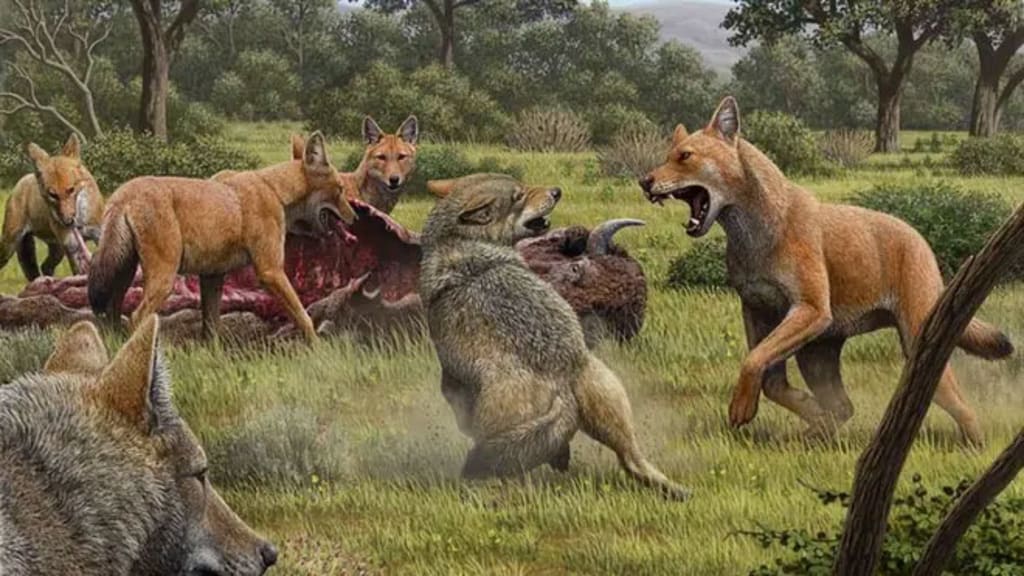
For decades, the Dire Wolf (Canis dirus) stood as one of the most iconic predators of the Ice Age. With its massive jaws and powerful build, it was believed to be a close relative of the modern gray wolf (Canis lupus), a dominant carnivore of today's wilderness. But recent breakthroughs in genetic research have upended everything scientists thought they knew about this ancient beast.
Published in the prestigious journal Nature, a new study has shaken the paleontological community by revealing that Dire Wolves were not close relatives of gray wolves at all. In fact, they diverged from the common ancestor of modern canids (dogs, wolves, coyotes, etc.) between 5 to 6 million years ago — so far back in evolutionary time that they may deserve a genus of their own.
Not a Wolf After All
Despite their physical similarities to wolves — massive skulls, sharp teeth, and a large, muscular build — Dire Wolves were not part of the Canis genus in the way previously assumed. For decades, paleontologists grouped them with wolves simply due to these superficial similarities. But DNA doesn’t lie. The genetic data now places Dire Wolves on an entirely different evolutionary branch from wolves, dogs, and coyotes.
“This is a game-changer,” said Dr. Kieren Mitchell from the University of Adelaide, one of the study’s lead authors. “For over 100 years, Dire Wolves were assumed to be true wolves. But our findings show that they were much more distantly related.”
The Ice Age Apex Predator
Dire Wolves roamed the plains of North America for hundreds of thousands of years, dominating the Pleistocene epoch. Fossil evidence, particularly from the famous La Brea Tar Pits in Los Angeles, has revealed more than 4,000 Dire Wolf specimens, indicating they were one of the most common predators of their time.
They hunted large prey such as bison, horses, and even young mammoths. Their robust bodies and powerful jaws made them formidable hunters, especially when working in packs. However, unlike modern wolves, their teeth and skulls suggest they may have relied more on bone-crushing than precision bites.
Despite their dominance, Dire Wolves vanished approximately 11,000 years ago during the Quaternary extinction event — the same time many other Ice Age giants like mammoths and saber-toothed cats disappeared.
DNA Breakthrough from Ancient Bones
Extracting DNA from ancient remains is always a challenge, particularly for fossils found in warm or humid climates where genetic material decays quickly. But the international research team painstakingly analyzed ancient Dire Wolf bones found across the U.S., successfully recovering usable DNA for the first time.
Their analysis showed that Dire Wolves are genetically distinct from all other modern canids. Their closest living relatives may be more akin to African wild dogs than to wolves, but even those relationships are distant.
In fact, the study suggests that Dire Wolves likely evolved in isolation in North America, developing their unique traits without interbreeding with other canine species that arrived later — including gray wolves and coyotes.
No Interbreeding with Wolves
One of the study's more fascinating findings is that even after gray wolves migrated from Eurasia into North America around 10,000 years ago, there is no genetic evidence of interbreeding with Dire Wolves. In contrast, gray wolves and coyotes, which are more closely related, are known to interbreed quite often, producing hybrid offspring.
This lack of interbreeding further supports the notion that Dire Wolves were genetically incompatible with other canids — their evolutionary paths were simply too divergent.
A New Genus?
The revelations from this study are so significant that they may require a reclassification of Dire Wolves into a completely new genus. While they were previously labeled Canis dirus, based on their assumed relationship to wolves, their genetic distinctiveness suggests they may not belong in the Canis genus at all.
Such a reclassification would be more than just a taxonomic change; it would represent a fundamental shift in how scientists understand the ecology and evolution of Ice Age predators.
A Symbol of Misunderstood History
The name “Dire Wolf” has long conjured images of fearsome wolf-like predators stalking the frozen tundras of prehistoric America. The popularity of Dire Wolves even exploded in recent years due to their fictional counterparts in Game of Thrones. But the real animals were something even more mysterious — evolutionary relics of a branch of the canine family tree that has now disappeared entirely.
Unlike modern wolves, which evolved and adapted alongside humans, Dire Wolves never had that chance. Their highly specialized hunting strategies and possible ecological competition with gray wolves may have contributed to their extinction.
Final Thoughts
The discovery that Dire Wolves are not closely related to gray wolves is a stark reminder of how much we still don’t know about prehistoric life. It also highlights the power of modern science, especially genetic research, in uncovering hidden truths buried in the fossil record.
Far from diminishing the legend of the Dire Wolf, this new understanding makes it even more fascinating. They were not just bigger versions of today's wolves — they were something altogether different, a unique and now-extinct lineage of apex predators that ruled ancient North America for millennia.
As researchers continue to decode ancient DNA and analyze fossil records, we can expect more surprises from the deep past — and perhaps, more stories that challenge what we think we know about life on Earth.
About the Creator
Eleanor Grace
"Dream big.Start small.Act now."
Keep reading
More stories from Eleanor Grace and writers in Earth and other communities.
The Power of Poop
The Smell of Manure: A Historical Mark and the Impact of Agriculture Thousands of years ago, when the first farmers realized the value of animal manure, they inadvertently laid the foundation for the long-term success of agriculture. These early farmers, with their observation and knowledge, discovered that manure was not just waste, but a valuable source of nutrients for the soil, aiding in plant growth. This, in turn, contributed to the development of human civilization.
By Eleanor Grace9 months ago in Earth
Japan Furniture Market Size and Forecast 2025–2033
Introduction Japan’s furniture industry stands at a unique intersection of tradition and innovation. Renowned worldwide for its craftsmanship, minimalist design, and functional aesthetics, Japanese furniture reflects the nation’s cultural emphasis on harmony, efficiency, and simplicity. Today, as Japan’s population becomes increasingly urban, digitally connected, and environmentally conscious, the furniture market is undergoing a quiet but significant transformation.
By Janine Root 6 days ago in Earth
Maryland to Get Its Own Smaller Version of the Las Vegas Sphere
Maryland is about to become home to a new entertainment icon. Inspired by the famous Sphere in Las Vegas, a smaller version of the massive immersive venue is planned for the state, promising to deliver a combination of live entertainment, cutting-edge technology, and a new tourist attraction. While the Las Vegas Sphere has already made headlines worldwide for its futuristic design and mind-blowing shows, Maryland’s version aims to bring a scaled-down but equally captivating experience to the East Coast.
By Muhammad Hassanabout 13 hours ago in Earth



Comments
There are no comments for this story
Be the first to respond and start the conversation.