
Crop Circles: Mysteries, Myths, and Artistic Masterpieces
The Rise of Crop Circles: From Ancient Legends to Modern Fascination


**The Mystery of Crop Circles: Art, Myths, and Reality**
Crop circles, those enigmatic patterns found in fields of wheat, barley, and corn, have puzzled and fascinated humanity for decades. They evoke questions about their origin, purpose, and meaning. Are they messages from extraterrestrial civilizations? Evidence of unknown natural phenomena? Or merely intricate works of human ingenuity?
The modern phenomenon of crop circles gained traction during the 1990s and early 2000s, with Southern England becoming a hotspot for these elaborate designs. During this period, reports of mysterious geometric patterns appearing overnight in fields captured global attention. While many speculated that these were messages from extraterrestrials, Hollywood amplified this narrative with blockbuster movies that played on humanity's collective curiosity about alien life. However, just as suddenly as crop circles became a global sensation, their frequency and prominence began to decline, leaving behind an enduring mystery.
### **Historical Context**
Although crop circles are often associated with modern times, their origins can be traced back centuries. In the 17th century, a woodcut pamphlet known as the "Mowing Devil" depicted a field with flattened crops in a circular pattern. While this account lacks scientific evidence, it reflects humanity's long-standing fascination with unexplained phenomena.
In the late 1960s, reports of unusual patterns in crops began surfacing in Australia and Wiltshire, England. These were initially dismissed as natural occurrences, with explanations ranging from localized whirlwinds and small tornadoes to peculiar animal behavior. Yet, the precision and complexity of these patterns made such theories difficult to sustain.
### **The Modern Crop Circle Era**
The modern crop circle craze began in the late 1970s, thanks to two Englishmen, Doug Bower and Dave Chorley. Armed with ropes, wooden planks, and a baseball cap outfitted with a wire for measuring precision, they embarked on a mission to create what they called "circular art." Their first creations appeared near Winchester, England, and initially went unnoticed. But as local farmers and media began reporting these unusual formations, the public’s imagination was ignited.
By the 1980s, crop circles were appearing across England with increasing frequency. While Bower and Chorley eventually admitted to their pranks, the phenomenon had already gained a life of its own. Believers, often referred to as “croppies,” were convinced that these patterns were evidence of extraterrestrial communication.
The designs grew more intricate over time, featuring mathematical precision and complex geometric patterns. This evolution led skeptics to question whether mere pranksters could achieve such sophistication. Nevertheless, many artists came forward, demonstrating their ability to replicate even the most elaborate designs using rudimentary tools and careful planning.
### **Commercialization and Pop Culture**
As crop circles gained fame, they also found a place in advertising and entertainment. During the 2012 London Olympics, farmers created a massive representation of the Olympic rings in a field, earning the title of the largest crop art. In 2013, NVIDIA, a technology company, commissioned a crop circle in California to promote a new computer chip. Before the company claimed responsibility, the formation sparked fresh rumors of alien involvement.
One of the most famous formations was the "Julia Set," which appeared near Stonehenge in 1996. A pilot flying over the area reported seeing nothing unusual, yet an hour later, intricate patterns spanning 600 feet were discovered. Initially hailed as proof of extraterrestrial activity, the design was later revealed to be the work of skilled human artists.
### **Artifacts and Unresolved Mysteries**
Despite widespread debunking, some mysteries persist. The "Roswell Rock," a small stone found in New Mexico, features a design identical to patterns seen in crop circles. Some believers cite it as evidence of alien influence, although scientific analysis suggests it was likely a human-made artifact.
Others point to unusual phenomena reported near crop circles, such as electromagnetic anomalies, strange lights, and mechanical malfunctions. While these claims are intriguing, they lack rigorous scientific validation.
### **Decline and Legacy**
In recent years, crop circles have become less common. Whether this decline is due to waning public interest, tighter security around farmlands, or the fading novelty of the phenomenon, their once-magnetic allure has diminished.
Today, crop circles are remembered as a cultural phenomenon that straddled the line between art and mystery. They symbolize humanity’s enduring curiosity about the unknown, whether that curiosity points to extraterrestrial life, unexplained natural forces, or the boundless creativity of human beings.
While skeptics view crop circles as elaborate hoaxes, believers continue to hold out hope that they are messages from another world. Regardless of their true origin, crop circles remain a fascinating chapter in the ongoing quest to understand our place in the universe.
About the Creator
Nora Ariana
Empowering through stories and sound igniting purpose, sparking growth, and awakening the power within.
Keep reading
More stories from Nora Ariana and writers in Earth and other communities.
A goal is a dream with a deadline
A goal is a dream with a deadline. This powerful quote reminds us that without action, dreams remain just that wishes floating in our imagination. But when we set a timeline and commit to achieving them, they evolve into goals, bringing clarity, direction, and purpose. Many people go through life holding on to dreams, hoping they will come true someday. But someday is not a day on the calendar. Dreams without structure often fade with time or get buried under the weight of daily responsibilities. Turning a dream into a goal is what separates those who achieve from those who continue to wish.
By Nora ArianaExclusive • 9 months ago
Microbiota, microbiome or microflora: how to speak correctly and why it is for health.
You've probably heard the phrase, "We are what we eat." But modern science says more precisely: we are also those who live in us. Until 2016, it was believed that there are many times more bacteria in our body than our own cells. The latest calculations by mathematicians show that we divide the body with our microorganisms by about 50/50: about 30 trillion of our cells versus 38 trillion bacterial ones.
By Yaroslav Gorohov2 days ago in Earth
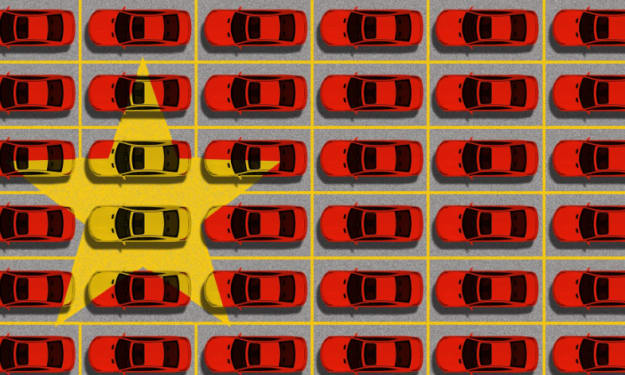
Chinese EVs Closing In on America After Canadian Tariffs Deal
The electric vehicle race is no longer just about climate goals or consumer choice — it has become a geopolitical contest. And in early 2026, a subtle but powerful move by Canada may have tilted the board. By agreeing to sharply reduce tariffs on Chinese electric vehicles, Canada has opened a door that the United States has worked hard to keep shut. While Chinese EVs are still largely barred from the American market, they are now edging closer than ever — not by crossing the border directly, but by entering through Canada. This development raises a pressing question: Are Chinese EVs closing in on America, and what does that mean for the future of North American auto markets? The Deal That Changed the Game Canada’s new agreement with China allows up to 49,000 Chinese-made electric vehicles per year to enter the Canadian market at a tariff rate of just over 6%, a dramatic drop from the previous 100% tariff that effectively blocked them. On paper, the quota seems small. In reality, it carries enormous symbolic and strategic weight. For years, both Canada and the United States aligned closely on keeping Chinese EVs out, citing concerns over unfair subsidies, national security, and the protection of domestic auto industries. This new deal marks a clear shift — and a divergence from U.S. policy. Canada didn’t make the decision in isolation. The EV tariff reduction was part of a broader trade reset with China, tied to agricultural exports such as canola and efforts to stabilize a strained economic relationship. Why Chinese EVs Matter So Much China is the undisputed leader of the global electric vehicle industry. Its manufacturers produce EVs at scale, often at prices Western automakers struggle to match. Brands like BYD, Nio, and Xpeng have already expanded aggressively into Europe, Southeast Asia, and parts of the Middle East. North America has remained one of the final fortified markets — until now. Chinese EVs are appealing not just because they’re cheaper, but because they’ve rapidly improved in quality, range, and technology. For consumers priced out of North American and European EV models, Chinese vehicles offer something rare: affordability without sacrificing features. Canada’s decision gives Chinese automakers their first legitimate foothold in North America — and footholds tend to grow. Why the U.S. Is Nervous The United States still enforces a 100% tariff on Chinese EV imports, making them effectively unsellable in the American market. But Canada’s move has triggered concern in Washington. U.S. officials argue that Chinese EVs entering Canada could indirectly pressure American markets, influence supply chains, and weaken Washington’s leverage in future trade negotiations. There’s also a political dimension. Both major U.S. parties have framed Chinese dominance in EVs as a strategic threat — not just to auto jobs, but to technological leadership. Modern EVs collect vast amounts of data, and lawmakers have raised concerns about cybersecurity and foreign data access. While Chinese EVs aren’t rolling onto American roads yet, their presence just across the border changes the conversation. Canada’s Risk — and Opportunity Inside Canada, the reaction has been mixed. Automotive hubs like Ontario worry that opening the market could undermine domestic manufacturing and strain relations with the U.S., Canada’s largest trading partner. Some leaders have called the deal “lopsided,” warning it could cost jobs if American retaliation follows. Others see opportunity. A more competitive EV market could lower prices for Canadian consumers and accelerate EV adoption. It may also attract Chinese investment into Canada itself — including factories, battery plants, and supply chain partnerships. If Chinese automakers choose to build in Canada rather than simply export to it, the country could position itself as a bridge between Chinese EV innovation and North American demand. That balancing act — between economic opportunity and political risk — defines Canada’s strategy. Are Chinese EVs Really ‘Closing In’ on America? For now, the answer is: not directly — but strategically, yes. Chinese EVs sold in Canada won’t automatically flood the U.S. market. Regulations, trade rules, and tariffs still stand in the way. But proximity matters. Supply chains overlap. Consumer awareness spreads. Manufacturing footprints expand. There’s also the possibility of a workaround: Chinese companies could eventually build EVs in North America to bypass tariffs altogether. This idea has already been floated — but it faces fierce resistance from U.S. lawmakers and unions. Still, history shows that once a global industry leader gains regional access, momentum often follows. What This Means for Consumers For Canadian buyers, the impact could be immediate: more choice and lower prices in an EV market that has long been criticized for being expensive and limited. For American consumers, the effect will be indirect — at least at first. But increased competition could eventually pressure U.S. automakers to reduce prices, improve features, and accelerate innovation. The larger question is whether North America wants competition or insulation — and how long insulation can realistically last in a globalized EV economy. The Bigger Picture: A Global EV Power Shift Canada’s tariff deal reflects a broader reality: China’s dominance in electric vehicles is reshaping global trade, whether governments like it or not. Europe is already grappling with an influx of Chinese EVs. Emerging markets are embracing them. And now, North America has its first real crack in the wall. This isn’t just about cars. It’s about who controls the future of clean transportation, supply chains, and industrial policy. Final Thoughts Chinese EVs aren’t driving down American highways yet — but after Canada’s tariff deal, they’re closer than ever. This move doesn’t spell immediate disruption, but it does signal a shift. One country has decided that economic pragmatism outweighs political alignment. And in doing so, Canada may have opened the door to a new phase of EV competition in North America. Whether that door swings wider — or slams shut — will depend on how the U.S., automakers, and consumers respond. One thing is certain: the EV race just entered a new chapter.
By Muhammad Hassanabout 14 hours ago in Earth



Comments
There are no comments for this story
Be the first to respond and start the conversation.