
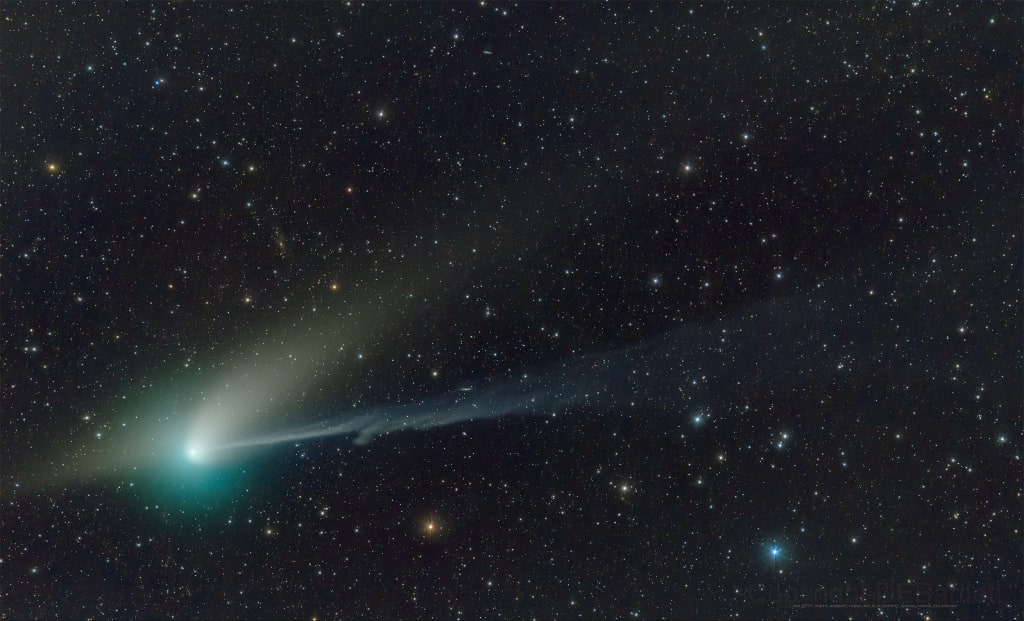
"Comets are small, icy celestial bodies that orbit the sun"
They are often referred to as "dirty snowballs" because they are comprised of a mixture of ice, dust, and rock.
The ice in a comet consists :
frozen water, carbon dioxide, nitrogen, and other volatile compounds.
The dust in a comet is made up of various small particles, such as silicates, metals, and organic compounds.
As a comet approaches the sun, the heat causes the ice on its surface to vaporize and release gas and dust into a glowing coma. The gas and dust create a bright, hazy atmosphere around the nucleus of the comet. The solar wind then pushes the gas and dust away from the sun, forming a long, visible tail that always points away from the sun.
Comets have highly elliptical orbits that bring them close to the sun only rarely. Some comets have orbits that take them far away from the sun and into the outer reaches of the solar system, where they can remain for thousands of years before returning. Others have more circular orbits that allow them to pass by the sun more frequently......
When comets pass close to the sun, they can provide important clues about the formation and evolution of the solar system.
For example: the composition of comets can give us information about the conditions in the early solar system and the types of materials that were available to form the planets.
In addition, the study of comets can help us to better understand the processes of planetary formation and the role that comets may have played in delivering water and other materials to the inner solar system.
HISTORY OF COMETS :
Some of the earliest recorded observations of comets date back to the Chinese and Babylonian civilizations over 2,000 years ago.
In more recent history, comets have been the subject of scientific study. The first systematic study of comets was conducted by the English astronomer Edmond Halley, who observed the return of the comet that now bears his name in 1682. This comet has since been observed on several subsequent returns and is one of the most famous comets in history.
In the 20th century, the study of comets was revolutionized by space missions such as the European Space Agency's Giotto mission, which flew close to Halley's Comet in 1986, and NASA's Deep Impact mission, which crashed a spacecraft into Comet Tempell 1 in 2005. These missions provided new insights into the structure and composition of comets, and helped to further our understanding of these mysterious objects.
Today, astronomers continue to study comets and new comets are regularly discovered using modern telescopes and spacecraft.
how can we see comets:
Comets are visible from Earth as they approach the sun and release gas and dust, creating a glowing coma and a tail. To see a comet, you typically need a clear, dark sky away from city lights. A comet may be visible to the naked eye as a faint, fuzzy object with a bright head and a tail that points away from the sun. Binoculars or a small telescope can also be used to see a comet and can provide a better view of its tail.
The best time to observe a comet is usually just before dawn or just after dusk, when the comet is highest in the sky and the background is darkest. Comets can be difficult to predict, as their brightness can vary greatly depending on their distance from the sun and their location in the sky.
If you are interested in observing comets, you can check websites or resources such as the International Astronomical Union's Minor Planet Center or Sky & Telescope magazine for information on the latest comets that are visible from Earth. You can also join a local astronomy club or attend a star party, where you can view comets and other celestial objects with other enthusiasts and learn more about the hobby.
Here is a list of some of the most well-known comets:
1.Halley's Comet
2.Comet Hyakutake
3.Comet Hale-Bopp
4.Comet McNaught
5.Comet Lovejoy
6.Comet West
7.Comet Wild 2
8.Comet Tempel 1
9.Comet 67P/Churyumov-Gerasimenko
10.Comet Hartley 2
This is by no means a comprehensive list, as there have been many comets discovered throughout history. Some comets are named after their discoverers, while others are named after the instruments or surveys that first detected them. In recent years, new comets are regularly discovered by astronomers and may receive a temporary designation until a permanent name is assigned by the International Astronomical Union's Minor Planet Center.
THANK YOU FOR READING THIS :)
About the Creator
China Cracks Down on Ships Using Starlink
A New Front in China’s Technology Control China has intensified its crackdown on ships using Starlink, the satellite internet service operated by Elon Musk’s SpaceX, signaling a sharp escalation in Beijing’s efforts to control information flows and foreign technology. Authorities have warned commercial vessels, fishing boats, and private operators against using unapproved satellite communication systems, citing national security and data sovereignty concerns.
By Aarif Lashari5 days ago in Earth



Comments
There are no comments for this story
Be the first to respond and start the conversation.