
Climate activists make their presence known at COP26
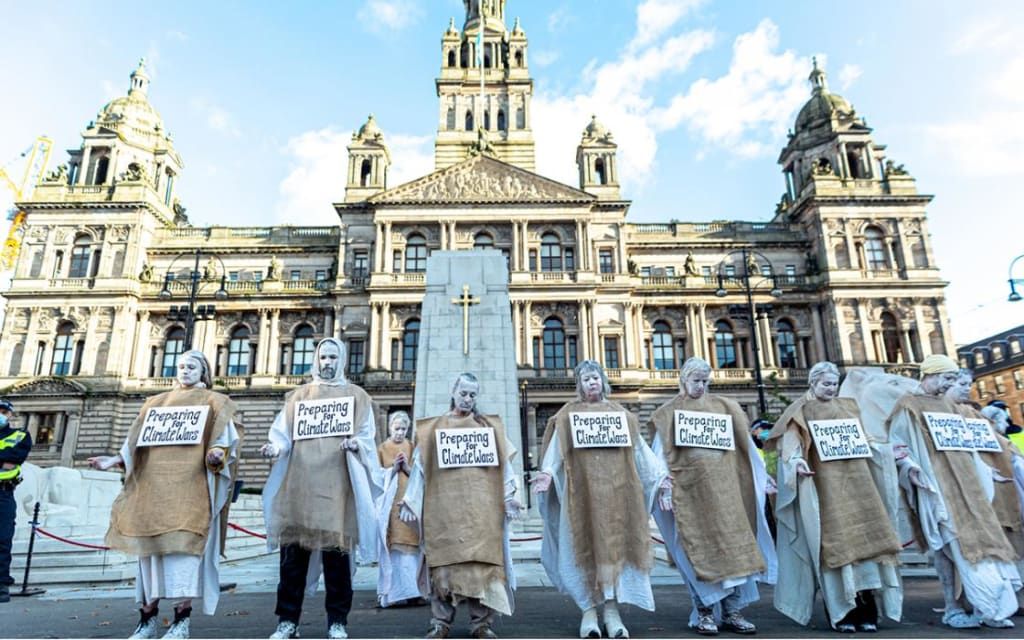
Activists gather outside Glasgow’s JPMorgan Chase bank, protesting the company’s financing of fossil fuels. Chalky, dehydrated “penitents” stand shoulder-to-shoulder with “Preparing for Climate Wars” signs around their necks. | Photo courtesy of Extinction Rebellion Scotland and Simone Rudolphi

The international COP26 climate conference, seen by many as the last chance to establish a climate agenda that will curb global temperature rise, is more than halfway over. Only a few days remain for the world’s most prominent political, economic, and environmental leaders to commit to transitioning the world away from fossil fuels.
Some agreements have been made. More than 100 countries pledged to end deforestation by 2030. At least 23 countries—including major coal users Poland, Chile, Indonesia, and Vietnam—signed on to phase out coal-fueled power. And India, the world’s third-highest greenhouse gas emitter, committed to reaching net-zero emissions by 2070. On Friday, the United States passed a $1 trillion infrastructure bill that includes $47 billion for communities to spend on climate resistance (a larger spending bill, which allots $555 billion for reducing carbon emissions and actively fighting climate change, remains on the floor).
But the conference remains heavily criticized for failing to meet the moment.
“This is a Global North greenwash festival,” Greta Thunberg wrote on Twitter.
“A two-week celebration of business as usual and blah blah blah,” Jamaican-born activist Mikaela Loach, who is suing the British government for unlawful gas and oil subsidies, said. “This is worse than hypocrisy. This is violence.”
In her speech at the summit’s opening ceremonies, Kenyan activist Elizabeth Wathuti held a moment of silence for the “billions of people who are not here today, whose stories are not being heard, whose suffering is not being felt.” “My truth will only land,” Wathuti told the summit’s delegates, “if you have the grace to fully listen.”
For over a week, more than 100,000 activists—many of them young people—from around the world have taken to the streets of Glasgow and summit hallways to express their frustration and demand that more drastic, immediate measures be taken: an end to the reliance on fossil fuels; accountability for the massive environmental impact of war and military action; reformations on unsustainable fishing practices; and reparations for the frontline communities experiencing climate change, particularly the world’s Indigenous tribes, protectors of 80 percent of global biodiversity.
Talia Woodin, a 22-year-old photographer and filmmaker who has spent the past week in Glasgow, left the COP26 Green Zone, where summit events are open to the public, after only an hour. “I felt uncomfortable inside the Green Zone, as it felt like a load of corporate greenwashing,” they say. “I quickly decided to spend my time taking part in fringe events and actions. That was a lot more meaningful.”
The demonstrations have been urgent, creative, and massive. The Fridays for Future March saw a crowd of tens of thousands of people. A similar number marched on Saturday’s Global Day of Action, led by Amazonian youths from Ecuador and Brazil. Among the thousands of homemade signs, one read, “43,500,000 square kilometers of land protected by Indigenous people.” “Climate justice without racial justice is the new colonialism,” read another, and, “Our normal kills people.”
On Sunday, leaders from Botswana and other southern African countries held a large demonstration demanding protections for the Okavango Delta, a biodiverse river basin threatened by Canadian company ReconAfrica’s oil and gas drilling. Supporters in the crowd held signs with the pictures and names of grassroots African activists in Senegal, Niger, Namibia, the Democratic Republic of the Congo, South Africa, and Uganda who couldn’t appear in person in Glasgow.
“The action passed the mic and allowed them to share the stories that should be the center of COP26 negotiations but are completely excluded from the conversations,” says Jasmin Rainero, a 26-year-old photographer who captured the event on camera. “Standing in solidarity with MAPA [Most Affected People and Areas] and telling the governments that we're watching them is more important than ever.”
Many other powerful demonstrations have been held: dehydrated “penitents” outside Glasgow’s JPMorgan Chase bank; a climate crime scene around demonstrators, drowned in oil; fish heads in suits, their innards spilling out and staining their briefcases red; a car, painted to look like Earth, beaten in with mallets.
“I think most of us don't have high hopes that COP26 will actually deliver,” Rainero says. “But it's been very powerful to unite with people who've traveled from all over the world to stand for climate justice.”
Woodin hopes that the energy brought to COP26 by activists, global media, and leaders alike will be sustained after the summit ends. “It’s always kind of easy to rally people to a march,” they say. “A specific day, one afternoon, and then the rest of the time people can get on with their lives.”
“But I think COP is similar to that. A lot of playing it safe. The movement is all too easily co-opted by fancy events and conferences that world leaders or big corporations put on. For as much as we see the hypocrisy, the greenwashing, the injustice of it, it still doesn’t feel like there’s been enough radical action.”
Here are some striking scenes from this week’s protests
About the Creator
Keep reading
More stories from lupu alexandra and writers in Earth and other communities.
This Is the Decade to Reduce Emissions
As the sun rose in Glasgow, over 20,000 people—delegates from individual nations, representatives of nongovernmental organizations, and activists—gathered in Scotland for the start of the United Nations’ two-week climate conference. Known as the Conference of the Parties, or COP26, it runs from Monday, November 1, to Friday, November 12, 2021.
By lupu alexandra4 years ago in Earth
The Fiery Circle: Understanding the Pacific Ring of Fire
The **Pacific Ring of Fire** is not a literal ring of flames, but it is undoubtedly the most geologically volatile region on Earth. Stretching approximately 40,000 kilometers (25,000 miles) in a massive horseshoe shape, it traces the coasts of the Pacific Ocean—from the southern tip of South America, up along the coast of North America, across the Bering Strait, down through Japan, and into Southeast Asia and New Zealand.
By Irshad Abbasi 6 days ago in Earth


Comments
There are no comments for this story
Be the first to respond and start the conversation.