
Circle of Life.
Examine the emotional cycle of life and death in the animal kingdom.

In the heart of a dense and ancient forest, a family of elephants thrived. Led by the wise and gentle matriarch, Amani, they moved together as one, sharing a bond that resonated through every fiber of their being.
Among the elephants was Kaya, a spirited young calf full of curiosity and wonder. She adored her mother, Amani, who guided her with love and taught her the ways of the forest. Together, they forged a bond that felt unbreakable.
One fateful day, tragedy struck the family when a ferocious storm tore through the forest, its powerful winds and raging waters threatening all in its path. In the chaos, a massive tree crashed down upon Amani, leaving her lifeless on the forest floor.
The forest fell silent as grief settled upon the elephant family. The once vibrant and joyous energy was replaced with a somber stillness. Kaya, now an orphaned calf, stood beside her fallen mother, her eyes filled with tears that mirrored the pain etched on the faces of the other elephants.
Days turned into nights, and the forest mourned the loss of its beloved matriarch. Kaya longed for her mother's comforting presence, for the gentle touch of her trunk and the sound of her reassuring rumble. The emptiness in her heart seemed insurmountable.
As the forest began to heal from the storm's devastation, Kaya found solace in the whispers of the wind. It carried the memories of her mother's wisdom and the love they had shared. In those whispers, she heard Amani's voice, urging her to find strength and embrace the circle of life.
With each passing day, Kaya's spirit grew resilient. She sought guidance from the elder elephants, who shared their wisdom and taught her the ancient ways of the forest. They told her stories of the generations that had come before, of the hardships they had endured, and how they found hope in the face of loss.
Though the pain of Amani's absence lingered, Kaya discovered that the forest was filled with kinship and love. She formed deep connections with the other elephants, who embraced her as their own. They comforted her during moments of longing, reminding her that the circle of life continued, and the forest's heartbeat remained strong.
In time, Kaya blossomed into a compassionate and wise elephant. She carried the spirit of her mother within her, guiding the herd with grace and love. She honored Amani's memory by teaching the younger generations about the importance of unity, resilience, and the delicate balance between life and death.
As the years passed, Kaya's wisdom echoed through the forest, touching the hearts of all who heard her story. The elephants, now a tight-knit family, celebrated the beauty of their existence, cherishing each moment as a gift. They understood that while loss was an inevitable part of life, the memories and love shared between companions never truly vanished.
And so, in the whispering wind that danced through the ancient trees, Amani's spirit lived on. Her presence, carried by the collective memory of the herd, reminded them that even in the depths of grief, the circle of life continued to spin, weaving together the threads of love, loss, and the eternal bond that connected them all.
Individual and government responsibility to wildlife is crucial for the preservation and conservation of our planet's diverse ecosystems and the incredible species that inhabit them. Both individuals and governments play vital roles in ensuring the well-being and protection of wildlife for current and future generations.
At the individual level, responsibility begins with awareness and education. By learning about wildlife and their habitats, individuals can understand the importance of biodiversity and the interconnectedness of all living beings. This knowledge can inspire a sense of stewardship and empathy towards wildlife, motivating individuals to take action.
One way individuals can contribute is by practicing responsible and sustainable behavior in their daily lives. This includes reducing the consumption of products that harm wildlife, such as illegal animal products, unsustainable palm oil, or products derived from endangered species. By making conscious choices, individuals can help curb demand for such products, thereby reducing threats to wildlife populations.
Another important individual responsibility is promoting conservation and raising awareness. People can engage in local conservation efforts, volunteer for wildlife organizations, and support sustainable ecotourism initiatives. Sharing knowledge and experiences with others can help raise awareness about the importance of wildlife conservation and inspire collective action.
While individual efforts are significant, government responsibility is paramount in creating and enforcing policies that protect wildlife. Governments must establish and maintain protected areas, national parks, and wildlife reserves, safeguarding crucial habitats from encroachment and exploitation. They should also enforce laws against poaching, illegal trade, and habitat destruction, ensuring that those who harm wildlife face appropriate consequences.
Governments can actively support scientific research and conservation initiatives by allocating funds, collaborating with conservation organizations, and implementing sustainable practices in resource management. This includes promoting sustainable land use, responsible fishing practices, and reducing pollution and habitat degradation.
Additionally, governments can play a crucial role in international collaborations and agreements to protect wildlife. By participating in treaties like the Convention on International Trade in Endangered Species (CITES) or the Paris Agreement on climate change, governments can work collectively to address global issues that impact wildlife and their habitats.
Public awareness campaigns and educational programs led by governments are instrumental in fostering a culture of conservation. By educating citizens about the value of wildlife and the importance of preserving ecosystems, governments can instill a sense of responsibility and empower individuals to take action.
Ultimately, individual and government responsibility to wildlife is an intertwined effort. Individuals must actively engage in responsible behavior and advocacy, while governments should enact and enforce legislation that protects wildlife and their habitats. By working together, we can safeguard the incredible biodiversity of our planet, ensuring a harmonious coexistence between humans and wildlife for generations to come.
About the Creator
Keep reading
More stories from writers in Earth and other communities.
I Never Imagined This!’ How KPop Demon Hunters Could Make History at the Grammys and the Oscars
When KPop Demon Hunters was first announced, even its creators likely did not expect it to spark serious awards-season conversations. Blending high-energy K-pop music, supernatural action, animation, and global storytelling, the project initially seemed like a bold experiment aimed at younger audiences and niche fandoms. Today, however, it is being discussed as a potential history-maker—one that could break barriers at both the Grammys and the Academy Awards.
By Aarif Lashariabout 9 hours ago in Earth
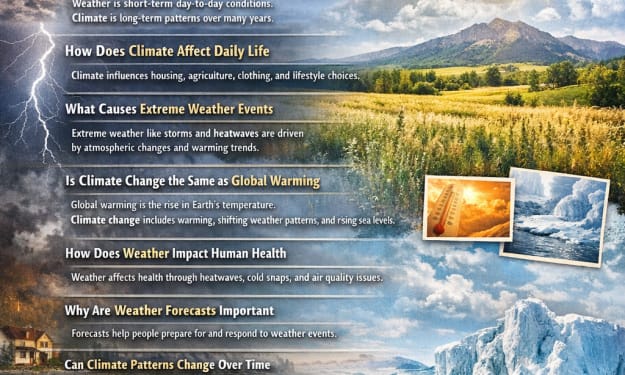
Weather and Climate Understanding the Forces That Shape Our Daily Lives
Weather and Climate Understanding the Forces That Shape Our Daily Lives Weather and climate play a central role in how people live work travel and plan for the future. From daily temperature changes to long term climate patterns these natural systems influence agriculture health economies and even global stability. Understanding the difference between weather and climate and knowing how they affect human life has become more important than ever especially as the world experiences more extreme conditions.
By America today 7 days ago in Earth



Comments
There are no comments for this story
Be the first to respond and start the conversation.