
Chasing the Elusive Lights: My Arctic Adventure in Norway.
The Science and Magic Behind Norway’s Aurora Borealis.

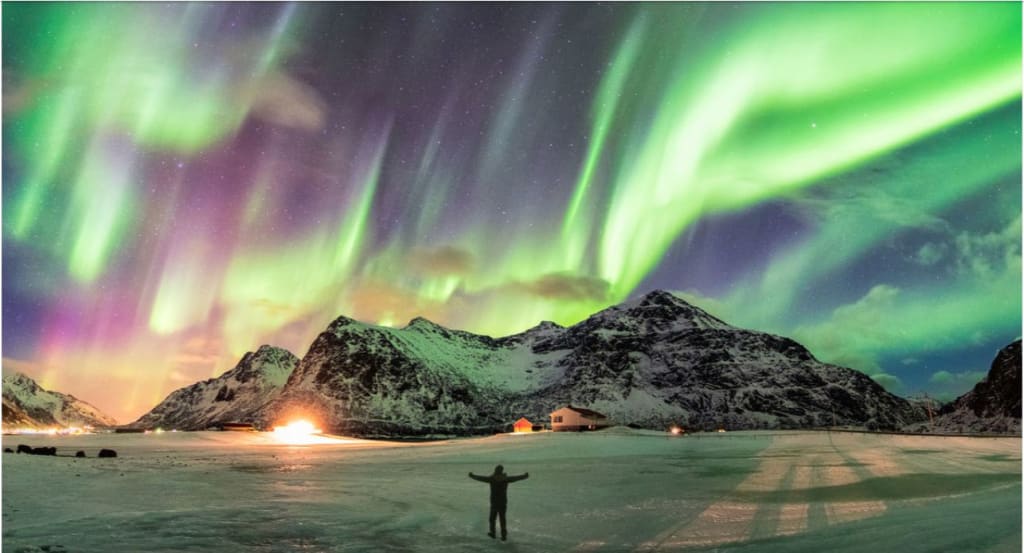
Northern Lights come, how they come, and the reasons for their popularity.
The Northern Lights in Norway: Nature’s Dazzling Light Show
The Northern Lights, or Aurora Borealis, are one of nature’s most breathtaking phenomena. Norway, with its pristine Arctic landscapes and long winter nights, is one of the best places in the world to witness this celestial spectacle. The dancing ribbons of green, pink, and purple light have fascinated humans for centuries, inspiring myths, scientific inquiry, and tourism. This essay explores why the Northern Lights occur, how they form, and the reasons behind their immense popularity.
Charged particles from the sun interact with Earth's atmosphere and magnetic field to create the Northern Lights.
1, Solar Wind and Earth’s Magnetosphere
The process begins with the sun, which constantly emits a stream of charged particles called the solar wind. When these particles approach Earth, they are guided by the planet’s magnetic field toward the polar regions. Most of these particles are deflected by the Earth's magnetosphere, but some get into the upper atmosphere near the poles.
2.Collision with Atmospheric Gases
When solar particles collide with oxygen and nitrogen molecules in the atmosphere, energy is released in the form of light. The color of the aurora depends on the type of gas and the altitude of the collision:
Green (most common) – Oxygen at lower altitudes (up to 240 km)
Red indicates oxygen at higher altitudes (greater than 240 km) Blue/Purple – Nitrogen at very high altitudes
3. Geomagnetic Activity
Solar activity influences the Northern Lights' intensity. During periods of high solar activity, such as solar flares or coronal mass ejections (CMEs), the auroras become brighter and more widespread. The best displays often occur during the solar maximum, an 11-year peak in the sun’s activity cycle.
Why Norway Is the Best Place to See the Northern Lights Norway’s geographical position within the Aurora Oval—a ring-shaped zone around the magnetic North Pole—makes it an ideal destination for aurora sightings. Key factors include:
High Latitude: Northern Norway, particularly , the Islands, and Svalbard, lies directly under the auroral zone.
Clear, Dark Skies: The prolonged darkness of the polar nights, which last from late September to March, improves visibility. Low Light Pollution: Remote Arctic regions offer minimal artificial light interference.
Stable Weather Conditions: Coastal areas like have relatively mild winters, reducing cloud cover.
The Attraction Attracted by the Northern Lights The Northern Lights attract thousands of visitors to Norway each year for several reasons:
1. Wonder and Beauty of Nature For many, the mesmerizing dance of the aurora borealis across the sky is a once-in-a-lifetime experience. The unpredictability and vivid colors make them a bucket-list phenomenon.
2. Relevance to Mythology and Culture The lights were regarded as either a gateway to the gods or the Valkyries' armor in Norse mythology. Indigenous Sami traditions held that the lights were the souls of the dead. The experience is further complicated by these myths. 3. Appeal in a Scientific and Photographic Way Scientists study auroras to understand solar-terrestrial interactions, while photographers flock to Norway to capture their beauty. Their fame has increased as a result of stunning images being shared worldwide on social media. 4. Impact on the Economy and Tourism Northern Lights tourism boosts Norway’s economy, with guided tours, glass igloos, and Arctic hotels catering to aurora hunters. Events like the Northern Lights Festival celebrate this natural wonder.
The Northern Lights in Norway are a stunning interplay of solar physics and Earth’s atmosphere. Their formation involves solar particles colliding with atmospheric gases, creating an otherworldly glow. Norway’s optimal location, combined with the auroras’ cultural and visual appeal, makes it a top destination for witnessing this phenomenon. Whether for science, photography, or sheer awe, the Northern Lights continue to captivate humanity, solidifying their place as one of nature’s greatest wonders.
About the Creator
cute writter
Knowledge-based writer on Vocal Media, passionate about delivering insightful, well-researched content that informs, inspires, and empowers readers across a range of topics.
Keep reading
More stories from writers in Earth and other communities.
Ancient Rocks Reveal Niobium Origins
On January 23, 2026, researchers from Curtin University announced a remarkable geological discovery hidden deep beneath central Australia. Rare rocks, formed more than 800 million years ago, have revealed the origin story of one of the world’s most promising niobium deposits. This critical metal, now essential for high-strength steel, electric vehicles, wind turbines, and advanced energy systems, owes its presence near Earth’s surface to powerful tectonic events that reshaped the planet during the breakup of an ancient supercontinent.
By USA daily update 7 days ago in Earth




Comments
There are no comments for this story
Be the first to respond and start the conversation.