
Black Holes: The Mysterious Giants of the Universe
Exploring Black Holes: Cosmic Mystery

Introduction :
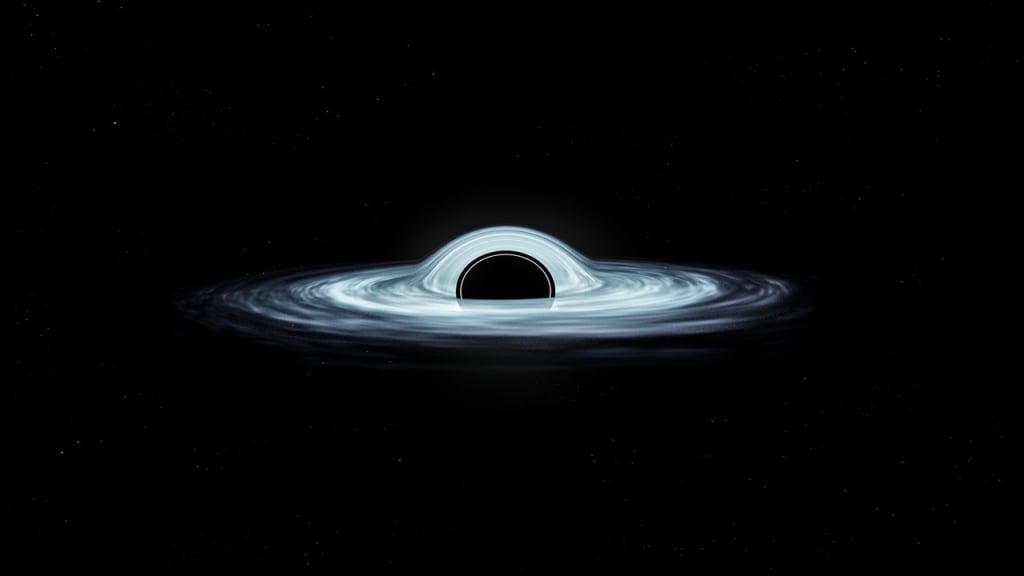
Black holes are some of the most fascinating and mysterious things in the cosmos. These cosmic occurrences, in which gravity is so strong that even light cannot escape, test our knowledge of physics and space-time. Scientists have studied them for decades, but they continue to astound us with their unusual qualities and enormous power. This page delves into what black holes are, how they arise, the various varieties, and their significance in the universe.
What Is a Black Hole?
A black hole is an area in space where the gravitational pull is so intense that nothing can escape, including particles and electromagnetic waves such as light. The event horizon is the border around a black hole that cannot be escaped. Once an object passes through this point, it is unavoidably drawn into the black hole's singularity—a point of infinite density where the laws of physics as we know them break down.
John Michell proposed the concept of black holes in the 18th century, and Albert Einstein developed it in 1915 with his theory of general relativity. However, it was not until the twentieth century that scientists discovered actual evidence of their existence.
How Do Black Holes Form?
Black holes are formed from the leftovers of enormous stars. When a star many times more massive than our Sun runs out of nuclear fuel, it collapses catastrophically. This process can occur in two primary ways:
1. Stellar Collapse: A huge star (at least 20-30 times the mass of the Sun) dies and explodes in a supernova. The remaining core falls under its own gravity, resulting in a stellar-mass black hole.
2. Supermassive Black Hole Formation: Most galaxies, including our Milky Way, contain supermassive black holes (SMBHs) that are millions or billions of times larger than the Sun. Their exact formation process is unknown, but they most likely expand by merging with other black holes and swallowing massive amounts of gas and stars over billions of years.
There are also intermediate-mass black holes, which span the gap between stellar-mass and supermassive black holes, however, their origins are unknown.
Types of Black Holes:
Black holes are classed according to their mass and attributes.
1. Stellar-Mass Black Holes (3 to 100 solar masses) result from collapsing huge stars.
2. Supermassive black holes (millions to billions of solar masses) are found in galactic cores.
3. Intermediate-Mass Black Holes (100–100,000 solar masses) are uncommon and poorly understood.
4. Primordial Black Holes (theoretical) are thought to have developed in the early universe due to high-density fluctuations.
Additionally, black holes can be distinguished by their spin (spinning vs. non-rotating) and electric charge, though the majority are believed to be electrically neutral.
What Happens Inside a Black Hole?
The interior of a black hole is one of science's greatest mysteries. At its heart is the singularity, a point where matter is crushed to infinite density and space-time curves eternally. General relativity states that the laws of physics no longer apply here, necessitating the use of a quantum gravity theory (such as string theory or loop quantum gravity) to adequately describe the situation.
The event horizon serves as the point of no return. When an object traverses it, it is stretched and crushed by tremendous tidal forces, a phenomenon known as spaghettification. However, due to time dilation, an outside observer would never see an object reach the event horizon—it would appear to freeze at the edge.
How Do We Detect Black Holes?
Because black holes cannot radiate light, they are discovered indirectly through their influence on nearby matter and space:
• Accretion disks: When a black hole absorbs gas and dust from surrounding stars, it heats up and generates X-rays that telescopes can detect.
• Gravitational Lensing: A black hole's gravity bends light from behind it, resulting in distorted or numerous images.
• Astronomers can detect black holes by monitoring stars orbiting invisible enormous objects, such as those at the heart of our galaxy.
• Observatories like LIGO and Virgo detect gravitational waves, which occur when two black holes combine.
In 2019, the Event Horizon Telescope (EHT) caught the first photograph of a black hole's shadow in the galaxy M87, confirming the existence of these cosmic giants.
Why Are Black Holes Important?
Black holes play an important function in the universe.
• Supermassive black holes regulate star formation, influencing galaxy evolution.
• Physicists use them to test Einstein's general relativity and unify quantum physics with gravity.
• Black holes play a role in cosmic recycling by consuming and ejecting matter, which helps to distribute elements for future stars and planets.
Conclusion:
Black holes are still one of the most mysterious and powerful things in the cosmos. From stellar leftovers to galaxy anchors, they alter the universe in ways that we are only beginning to understand. Future discoveries, like as Hawking radiation, wormholes, or quantum black holes, may further change our understanding of the universe. For the time being, black holes continue to captivate our imagination, signifying both the limitations of human understanding and the universe's limitless potential.
About the Creator
Sazid Rahman
Author and storyteller who focuses on human experience, feelings, and life. One narrative at a time, I firmly believe that words have the ability to uplift, unite, and ignite change.
Keep reading
More stories from Sazid Rahman and writers in Earth and other communities.
A Telescope's Powerful New Tool May Offer a Better Way to Forecast Solar Storms
A Telescope's Powerful New Tool May Offer a Better Way to Forecast Solar Storms Solar storms, which are large eruptions of charged particles from the Sun, can have catastrophic consequences for Earth's power networks, satellites, and communication systems. Scientists have long struggled to make more accurate predictions about severe storms. However, a breakthrough in telescope technology could soon change this. A new technique linked into modern solar telescopes is revealing unprecedented insights into the Sun's magnetic activity, with the potential to revolutionize how we forecast solar storms.
By Sazid Rahman 9 months ago in Earth
65% of Workers Are Interested in ‘Microshifting’ Their Schedules as an Alternative to the Strict 9-to-5
The traditional 9-to-5 workday has long been considered the standard, but recent research suggests that employees are seeking more flexibility than ever before. A striking 65% of workers report interest in ‘microshifting’ their schedules, a concept that allows them to adjust their work hours in smaller increments rather than sticking to a rigid daily routine. For many, this is more than just a scheduling preference — it’s a way to reclaim control over their time, reduce stress, and boost productivity.
By Muhammad Hassanabout 19 hours ago in Earth
How Much Do You Need in an ISA for a Passive Income That Beats the State Pension?
For many people in the UK, the State Pension is expected to form the backbone of retirement income. But with rising living costs and growing uncertainty about the future, more savers are asking a crucial question: Can I build a passive income that beats the State Pension — and how much would I need in an ISA to do it?
By Aarif Lashari2 days ago in Earth



Comments
There are no comments for this story
Be the first to respond and start the conversation.