
"Beyond the Myths: Discovering the Real Face of Each Planet in our Solar System"
"Beyond the Myths: Discovering the Real Face of Each Planet in our Solar System"

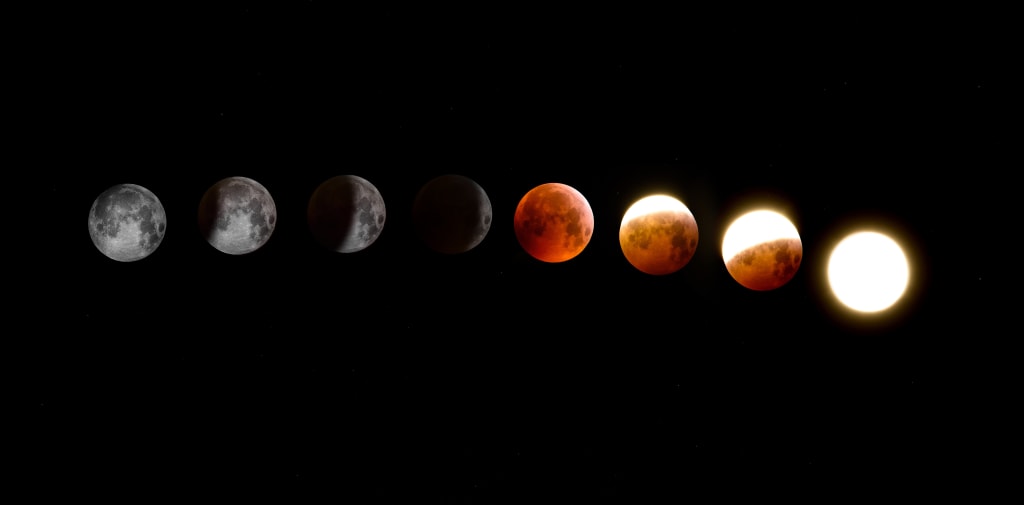
Mercury has a bit of a bad reputation for always being hot, but that's not entirely true. The planet lacks an atmosphere, so its temperature swings are quite extreme when it faces the sun. It can reach scorching temperatures of up to 800 degrees Fahrenheit, but when it's turned away, it drops to frigid minus 290 degrees. The reason for this is that Earth is fortunate to have a cozy atmosphere that regulates our temperatures. Mercury, on the other hand, lacks this luxury, and it's at the mercy of the sun's rays. Nevertheless, despite these challenges, Mercury is still worth exploring. Being close to the Sun, it offers an excellent opportunity to study how solar radiation affects planets, even though it's not exactly hospitable for life. There are still plenty of mysteries waiting to be unraveled.
Venus is often referred to as Earth's sister planet, and many people believe it to be as beautiful and lush as our home. However, they couldn't be more wrong. In reality, Venus is quite the diva. It possesses a thick atmosphere that traps heat, causing surface temperatures to soar up to a scorching 864 degrees Fahrenheit. I mean, Venus wants to stand out and be unique, but it has taken it to a whole new level. It's like that one friend who always has to one-up everyone else. "Oh, you think Earth is cool? Well, I'm the only planet that spins clockwise." But let's be real here, Venus is just trying too hard. It's shrouded in crazy sulfuric acid clouds that rain down on its surface, making it impossible for anything to survive. It's as if Venus is determined to hog all the attention for itself, ensuring no other life forms can exist. Moreover, its atmosphere is so thick and heavy that it would crush us like a grape. So, while Venus may appear pretty from afar with its bright yellowish glow, don't be fooled. It's a total drama queen who simply can't handle sharing the spotlight with anyone else.
Anyway, let's shift our focus to the real star of the show—Earth. We may not possess all the flashy features that Venus boasts, but at least we're hospitable and welcoming to all forms of life. Plus, we've got pizza, so who needs sulfuric acid clouds? Now, you might think that since we live on this planet, we know it inside out and there's no room for misconceptions. Well, sorry to burst your bubble, but Earth's shape isn't entirely round. While it may appear like a ball, it's not perfectly spherical due to its spinning action. The North and South Poles get slightly squished, making them somewhat flat. The Earth's wobbling and other factors actually cause it to change shape over time, but it still retains a roundish form.
Now, let's delve into Mars, the red planet that has captivated humans for centuries. I know we all have this idea that Mars is a habitable planet where we can simply pack our bags and relocate if Earth becomes uninhabitable. Well, that's not entirely true. One common misconception about Mars is its breathable atmosphere. While Mars does possess an atmosphere, it's much thinner than Earth's and consists mostly of carbon dioxide. This makes it unsuitable for human life without extensive life support systems. So, if you plan on taking a stroll on the Martian surface, you better pack your oxygen tanks. However, that doesn't mean we should abandon our dreams of colonizing Mars. Who knows,
Some people believe that Jupiter is a solid planet, but let me tell you, that's just a load of hot air, quite literally. In reality, Jupiter is a gas giant composed mostly of hydrogen and helium. It's so immense that it doesn't even have a solid surface. I mean, I thought my bed was soft, but floating on a cloud of gas sounds rather comfortable too. Jupiter's atmosphere gradually transitions into its interior, creating a perpetually lively environment. Speaking of fascinating features, Saturn's rings are among the most captivating aspects of the planet. However, there is a common misconception that Saturn's rings are solid. In truth, Saturn's rings consist of countless small particles of ice and rock orbiting the planet. They extend over 174,000 miles from the planet's surface but are only about 65 feet thick. These particles vary in size, ranging from tiny specks of dust to large boulders. Scientists believe that the rings were formed from leftover debris after the formation of Saturn and its moons. Over time, these particles were attracted by Saturn's gravity and shaped into the beautiful rings we observe today. Saturn's rings also exhibit remarkable features like gaps and divisions caused by the gravitational pull of nearby moons, as well as waves and spiral patterns resulting from gravitational interactions among the particles. Despite their splendor, Saturn's rings are in a constant state of change as the particles collide, creating new ones and breaking apart others. This means that the rings we admire today may appear significantly different in the future. So, the next time you gaze at Saturn and its rings, remember that you're witnessing a cosmic snow globe composed of billions of tiny particles floating around the planet.
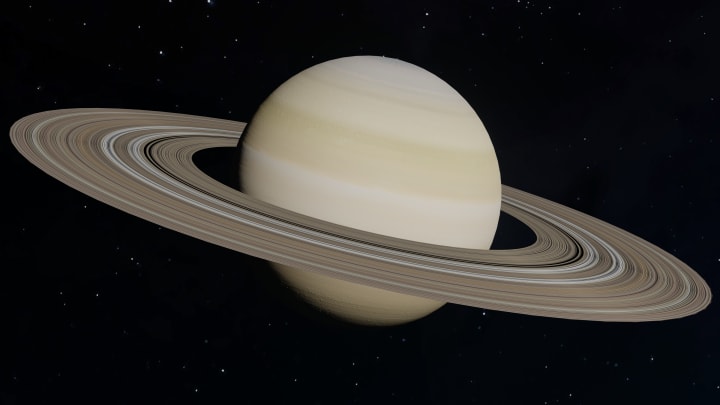
Now, let's address a common misconception about Uranus, the planet often thought of as a lazy entity that rolls around on its side all day long. However, that's not entirely accurate. Uranus does possess a tilted axis of rotation, but it still manages to spin in the same direction as most other planets in our solar system. It's like that one friend who consistently arrives late to the party but still manages to have a good time and fit in with the crowd. Let's be honest, Uranus is a bit of an oddball, being the only planet in our solar system that rotates to such a degree. Nonetheless, variety is indeed the spice of life, right? So, here's to Uranus, the planet that refuses to conform to anyone's expectations. Oh, how I wish I had the courage to be like that.
Have you ever heard someone say that Neptune is just a blue version of Jupiter or Saturn? Well, let me tell you, that's as far from the truth as saying a banana is merely a yellow version of cucumber. Neptune stands out from its gas-giant companions with its captivating blue hue, thanks to the presence of methane in its atmosphere. By the way, did you know that it's the farthest planet from the Sun? It's positioned so far out there that it takes almost 165 Earth years for Neptune to complete a single orbit around the Sun. Now, that's what I call taking your sweet time. And let's not forget about its entourage of 14 moons. Yes, Neptune has a whole entourage of moons trailing behind it like devoted fans at a concert. Perhaps they're hoping to catch a glimpse of Neptune's renowned blue glow. So, the next time someone tries to assert that Neptune is nothing more than a knockoff version of Jupiter or Saturn, You can confidently correct them and say, "Excuse me, but Neptune is its own unique gas giant with a fancy blue vibe."
Did you know that Pluto is no longer considered a planet? That's right, in 2006, the International Astronomical Union made the decision to reclassify Pluto as a dwarf planet. So, what exactly does that mean? Well, a dwarf planet is a celestial body that orbits the Sun and is large enough to be rounded by its own gravity. However, it hasn't cleared its orbit of other debris. It's a common misconception that Pluto is still considered a planet, but the truth is that it just didn't meet the criteria for classification as a planet. I'm sorry, Pluto, but don't worry, you're still adored by many. Plus, being a dwarf planet is pretty cool too. You get to hang out with other celestial misfits like Ceres and Haumea. So, keep on orbiting, Pluto. We still think you're out of this world.
About the Creator
Keep reading
More stories from writers in Earth and other communities.
Why Fruit Shell Biomass Is Perfect for Charcoal Making: A Property Analysis
When it comes to sustainable charcoal production, not all biomass materials are created equal. Among the various options—from wood chips to agricultural residues—fruit shell biomass (such as walnut shells, coconut shells, peanut shells, and almond shells) stands out as an ideal candidate. Its unique physical and chemical properties not only make the charcoal making process more efficient but also result in high-quality charcoal with versatile applications. In this post, we’ll break down the key properties that make fruit shell biomass a top choice for charcoal production, and touch on how these properties interact with charcoal making equipment to optimize outcomes.
By Bestonpyrolysis6 days ago in Earth
Handful of Sick and Wounded Palestinians Allowed Through Rafah Crossing on First Day
The partial reopening of the Rafah border crossing has allowed a small number of sick and wounded Palestinians to leave Gaza for medical treatment, marking a significant yet limited humanitarian development. While only a handful of individuals were permitted to cross on the first day, the move has sparked cautious optimism among humanitarian organizations, families awaiting medical care, and international observers.
By Aarif Lashari8 days ago in Earth
Our Song
Evening has given way to night. Gently, I settle next to you on the comfortable, old love seat and reach for your hand. You snatch it away, again. It cuts me to the quick, but I hide the pain, understanding that the reaction is but part of your demented state. Since the accident, your presence here in our cozy home has been clouded by a haze I can't see. Nevertheless, I feel the frigidity of your expressions and it serves as an excruciating reminder of the immeasurable distance between us.
By Dana Crandell6 days ago in Fiction
I've Just Realized
The President doesn't understand music. There. It felt very good to write that; it's some thing I just realized today. Oh , yes; he plays it. He TRUMPets it in rallies and meetings, pumps it across the airwaves when he gathers up our minutes waiting for his late arrival.
By Judey Kalchik about 21 hours ago in Beat


Comments
There are no comments for this story
Be the first to respond and start the conversation.