
BEESWAX
BEES ARE A LIVING SYMPHONY OF NATURE

Bees are a Living Symphony of Nature
If Bees disappear,
The pollination of flowers
Could be done I presume, by humans every year.
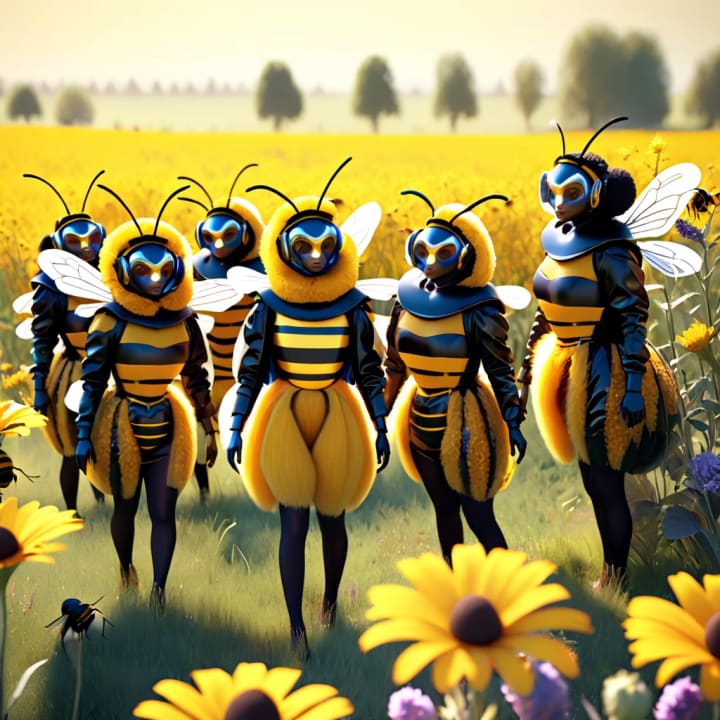
We could dress up in bee costumes as we tower
Over the beehives,
Buzzing with honeycombs.
Climate change continues to proliferate
Across the globe as we stay alive
As bees are still here to live among
We humans.
Pesticides proliferate
Crops, plant life, the environment today
Without bees
Wildflowers would wilt
To the ground
Eliminated
As the chain of sustaining life is profound
Up to the Bees
Who buzzed around
The globe
To help humans
I am told
Until,
We know science & education
Certain peeps hate
Climate change
Deny it
Scrap it
Swat it
As not important beeswax
Bees carry pollen across plants, flowers, and the environment
Of life as we know it
We would not exist
Bees pollinate 70% of the crops that feed 90% of the world
As the globe swirls around the sun
Without them,
We would lose food like almonds, apples, berries, and coffee
Fruit and caffeine in your coffee dies without bees pollinating
Bee extinction could trigger our planet to die an excruciating
Death to all and it would seem
To create a massive ecological and agricultural crisis
Of life.
Bees are tiny heroes
in the blossoming symphony of nature
for nature in its highs and lows
They work tirelessly,
carrying pollen from one bloom to the next one
under the sun,
as they weave threads together
of life as they spread
love to hold our ecosystem together
in all kinds of weather
Through their buzzing ballet,
they create abundance for all living species,
and the soil
We toil
To create life in a ballet dance
Of chardonnay
Wine
To dine
On fruits
Veggies
Bees pollinate
Subjugate
Their hard work for all
To not eliminate
But to proliferate
Our existence as we know
As we travel the roads of life
As we sow
Our seeds of growth of worth
As the bee’s ballet
across the globe
across the valley
the mountains we climb
to our adobe
where we lay our head
in our bed
of dreams
it seems
without bees
we would all be dead.
*********************************************************************
Voice Over materials as written by Vicki after researching for hours looking at those cute little creatures called bees.

Imagine a world without the soft hum of bees. No flowers bursting in vibrant colors. No sweet scent of orange blossoms in the air. No crisp apples to crunch into, no blueberries for your morning pancakes. It feels quiet and empty.
Bees are tiny heroes often overlooked in the grand symphony of nature. They work tirelessly, carrying pollen from one bloom to the next, weaving together threads that hold the ecosystem intact. Through their buzzing ballet, they create abundance feeding not just us, but birds, animals, and the soil itself.
The scary thought is that bees are disappearing. Climate change, pesticides, habitat destruction are taking their toll. Without bees, the chain breaks. Crops falter, Wildflowers wilt, and the balance tilts.
Bees have a sophisticated communication system that relies on a combination of methods:
1. Pheromones (Chemical Signals):
**These are chemical substances that bees release to communicate specific messages to other bees in the colony.
**Different pheromones can signal a variety of things, including:
**Queen Pheromone: Shows the presence and health of the queen, suppresses worker bee ovary development, and attracts drones for mating.
** Alarm Pheromones: Released by guard bees when the hive is threatened, alerting other bees to danger and triggering defensive behavior.
** Nasonov Pheromone: Released by worker bees to mark the entrance of their hive and attract returning foragers or swarming bees to a specific location. It has a distinctive lemony scent.
**Brood Pheromones: Signals from the developing larvae that influence worker bee behavior, such as feeding and care.
**Foraging Pheromones: Bees can leave scent trails on flowers to guide nestmates to good food sources.
2. The Waggle Dance (Mechanical Signals):
**This is perhaps the most famous form of bee communication, used by forager bees to communicate the location of food sources (nectar, pollen), water, or new potential hive sites to their nestmates.
** The dance is performed on the vertical comb inside the hive and involves a figure-eight pattern with a straight "waggle run" in the middle.
** Direction: The angle of the waggle run compared to the vertical comb indicates the direction of the resource compared to the sun. For example, if the bee waggles pointing straight up, the food source is directly towards the sun. If it's at a 60-degree angle to the left, the food is 60 degrees to the left of the sun.
**Distance: The duration of the waggle run shows the distance to the resource. A longer waggle run means a farther distance.
**Quality: The vigor of the waggle dance and the number of repetitions can show the quality and abundance of the resource. The dancing bee may also share a sample of the nectar she collected.
3. Other Dances and Signals:
**Round Dance: Used to show food sources are nearby (within about 50-100 meters of the hive). The bee simply runs in circles, occasionally reversing direction. It doesn't convey specific direction.
**Tremble Dance: Performed by returning foragers with large nectar loads, thought to encourage receiver bees to help with unloading the nectar.
**Shaking Signal (Dorsoventral Abdominal Vibration - DVAV): Used to stimulate inactive bees into foraging.
** Buzz Run: Associated with swarming, possibly indicating the colony is about to leave.
**Grooming Invitation: A bee will vibrate and present a specific body part to ask for grooming from another bee.
** Piping: Queen bees produce "tooting" and "quacking" sounds, and worker bees also make piping sounds, the meanings of which are still being researched but are likely involved in communication during swarming or queen emergence.
4. Touch and Taste (Trophallaxis):
**Bees also communicate through physical contact, such as antennation (touching with antennae), which can convey various signals.
**Trophallaxis is the direct transfer of liquid food (nectar or regurgitated honey) mouth-to-mouth between bees. This not only shares resources but also transmits chemical signals and possibly plays a role in social cohesion and sharing information about food quality.
By using this complex repertoire of chemical, mechanical, and tactile signals, bees can coordinate their activities within the colony with remarkable efficiency, ensuring the survival and success of the hive.
Resources from research are:
Wikipedia, Microsoft Copilot, Google, and MSN research.
I WROTE THIS!
Written by
Vicki Lawana Trusselli
Trusselli Art

About the Creator
Vicki Lawana Trusselli
Welcome to My Portal
I am a storyteller. This is where memory meets mysticism, music, multi-media, video, paranormal, rebellion, art, and life.
I nursing, business, & journalism in college. I worked in the film & music industry in LA, CA.
Reader insights
Outstanding
Excellent work. Looking forward to reading more!
Top insight
Expert insights and opinions
Arguments were carefully researched and presented
Keep reading
More stories from Vicki Lawana Trusselli and writers in Earth and other communities.
"HOMELESSNESS IN AMERICA"
Homelessness In America Living One Day at a Time I begin the story with a video I produced 15 years ago in Austin, Texas. "THE DISCARDED" was a project that I worked on about homeless veterans in South Austin, Texas. Excuse the typo in the title under the video description. The correct spelling is "The Discarded".
By Vicki Lawana Trusselli 2 years ago in Earth
Oil Market is Volatile Again: What It Means for Global Energy and Traders
Global energy markets are once again at the center of attention after the United States introduced a temporary waiver allowing the purchase of certain Russian oil shipments that were already stranded at sea. The move has sparked intense discussions across financial markets, energy sectors, and geopolitical circles.
By Daniel Reidabout 21 hours ago in Earth


Comments (3)
Bees are amazing
I read it and am blown away at your research and understanding. This a gem. I shared! —S.S.
Wonderful poem, and thanks for the information too, and the pictures are wonderful