

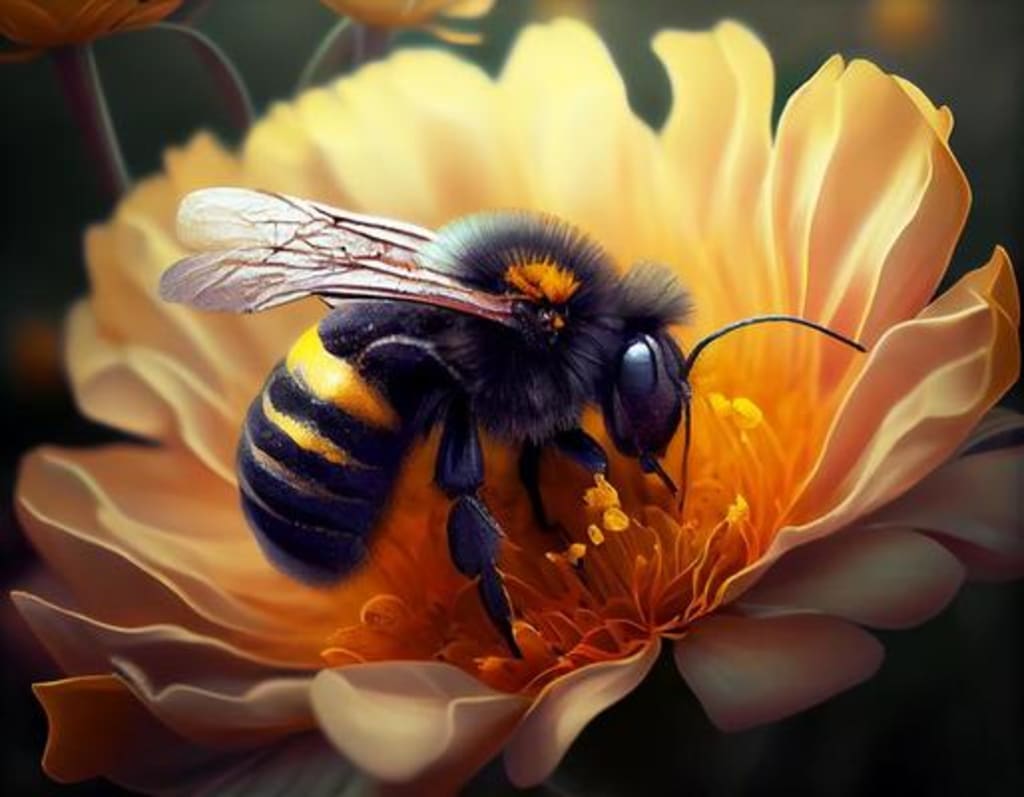
The life of a bee is a fascinating and intricate journey that begins with its birth and extends to its role within a well-organized hive. Bees, specifically honeybees, are crucial to the ecosystem as they are efficient pollinators, playing a vital role in the reproduction of flowering plants. The life of a bee can be divided into several stages, each with its own unique tasks and responsibilities.
The life cycle of a bee starts with the queen bee laying eggs. The queen bee, who is larger in size, has the primary responsibility of reproducing and maintaining the population of the hive. She can lay up to 2,000 eggs per day, which are deposited in the hexagonal cells of the honeycomb. These eggs hatch into larvae after a few days.
The larvae are cared for by worker bees, who are female bees with underdeveloped reproductive systems. The worker bees provide the larvae with food, called royal jelly, which is a highly nutritious secretion produced by glands in their heads. The larvae consume this royal jelly, growing rapidly and going through several molting stages. During this time, they are enclosed within a wax cell to protect them and ensure their development.
After a week or so, the larvae spin a cocoon around themselves and enter the pupal stage. Inside the cocoon, the larvae undergo a miraculous transformation. Their bodies reorganize, and they develop various body parts, including legs, wings, and compound eyes. This stage is akin to a bee's metamorphosis, similar to that of a butterfly or moth.
Once the transformation is complete, the fully developed adult bee chews its way out of the cocoon and emerges as an adult bee. At this point, it is ready to take on its responsibilities within the hive. The young adult bees are known as house bees and are assigned tasks such as cleaning the cells, feeding the larvae, and building and repairing the honeycomb.
As the house bees mature, they graduate to become foragers. Foraging bees are responsible for collecting nectar, pollen, and water from the surrounding environment. They are equipped with specialized body parts, such as a long proboscis to extract nectar from flowers and pollen baskets on their hind legs to carry pollen back to the hive. They tirelessly fly from flower to flower, gathering resources and pollinating plants in the process.
The life of a foraging bee is physically demanding and relatively short, typically lasting only a few weeks. During this time, they navigate using complex navigation systems, relying on landmarks, the position of the sun, and even a dance-like communication called the "waggle dance" to relay information about food sources to other bees.
As the bee ages, its wings become worn, and its ability to forage diminishes. At this stage, they transition into the role of guard bees, stationed at the entrance of the hive to protect it from intruders. These older bees also contribute to the hive by using their experience to mentor and guide younger bees.
The final stage in a bee's life is marked by a significant event—the swarming of the hive. Swarming occurs when the queen bee, accompanied by a large portion of the worker bees, leaves the hive in search of a new location. The swarming bees form a temporary cluster while scout bees search for a suitable new hive site. Once a suitable location is found, the swarm settles down, and the process of building a new hive begins.
In conclusion, the life of a bee is a marvel of nature's efficiency and interdependence. From the queen bee's egg-laying to the worker bees' various roles and responsibilities, each stage contributes to the overall survival and success of the hive. The collective efforts of bees in pollination and honey production are vital to maintaining the balance of ecosystem.
About the Creator
abdullah saleem
I LOVE NATURE.
I ALSO LOVE FICTION.
I AM SOFTWARE ENGINEER.
Keep reading
More stories from abdullah saleem and writers in Earth and other communities.
Industrial Deployment of Biochar in Modern Metal Smelting Systems
Biochar is increasingly examined as a functional carbonaceous material in high-temperature metallurgical operations. Traditionally dominated by fossil-derived coke and coal, metal smelting processes are under pressure to decarbonize while maintaining reductive efficiency and structural reliability. Biochar, when properly engineered, presents a technically viable supplementary reductant in the production of steel, silicon, and ferroalloy. Its application, however, requires stringent control of physicochemical properties and integration within existing furnace infrastructure.
By Wayne Shenabout 21 hours ago in Earth
"Scream 7" (2026): Running out of Fresh Screams
This is the seventh time we’ve had a Ghostface crisis. Scream 7 is the latest edition of the Scream franchise. Sydney Prescott and her family are under attack by another anonymous killer dressed in a Ghostface costume. While having issues with her daughter, Tatum, they run from the bloody murders, trying to determine who is behind it all.
By Marielle Sabbag3 days ago in Horror



Comments (1)
intersting