
Barnard's Star b: A Frozen Super-Earth Right Next Door
Could this icy world help unlock the secrets of the galaxy?


Astronomers have discovered evidence of an exoplanet orbiting Barnard’s Star, the closest single red dwarf to our Solar System, just 5.96 light-years away. The planet, named Barnard’s Star b, has a mass about 3.2 times that of Earth and completes one orbit every 233 days.
The discovery, led by Ignasi Ribas from the Institute of Space Sciences in Spain, was published in Nature. Using more than 700 observations collected over 20 years, the team employed the radial velocity method with a 99.2% certainty to detect the planet.
Although Barnard’s Star b is quite close to Earth in cosmic terms, its conditions are far from friendly. Orbiting well outside the habitable zone — at a distance five times beyond where liquid water could exist — the planet’s surface is estimated to have a frigid average temperature of -170°C, making it more of a “frozen hell” than a second Earth.
Even so, the discovery is significant. Barnard’s Star is a low-mass red dwarf, just 1/7 the mass of our Sun and emitting only 2% of its energy. These types of stars are common in the galaxy and have incredibly long lifespans, raising questions about whether other red dwarf systems might host more hospitable planets.
Currently, Barnard b is unlikely to support life as we know it. However, scientists suggest that over time, as the star cools and becomes less active, the planet’s atmosphere might stabilize, increasing its habitability — though humanity would have to wait a very, very long time to see that happen.
While the planet doesn’t transit its star from our point of view — making direct imaging difficult — researchers hope to study it further using powerful telescopes like Hubble and James Webb.
In addition to Barnard b, the team spotted signals suggesting up to three other potential exoplanets in the same system, though more data is needed for confirmation. According to researcher Alejandro Suárez Mascareño, the discovery highlights that the "neighborhood around Earth is full of small-mass planets."
Since the 1990s, over 5,700 exoplanets have been found, but only a few are within the habitable zone. While Barnard b itself might be frozen and barren, it represents a critical step toward understanding the diversity of planetary systems in the universe.
Perhaps most importantly, it reminds us that even icy worlds can hold clues about the origins of life — and that the search for our cosmic neighbors is far from over.
While Barnard’s Star b may not be the perfect candidate for life as we know it, its discovery plays a crucial role in expanding our understanding of planetary systems beyond our own. The fact that it orbits a red dwarf — the most common type of star in the Milky Way — gives astronomers insight into what the majority of planetary systems might look like in the galaxy.
In recent years, red dwarfs have become a major focus in the search for exoplanets. Their smaller size and lower brightness make it easier to detect the subtle wobbles caused by orbiting planets. However, red dwarfs also tend to be highly active in their early stages, emitting powerful solar flares that could strip atmospheres from nearby planets. This makes the study of older, quieter red dwarfs — like Barnard’s Star — even more important, as they may host planets with more stable conditions.
What makes Barnard’s Star b especially intriguing is its proximity. At just under 6 light-years away, it’s the second-closest known exoplanet to Earth, after Proxima b. This close distance makes it an ideal target for future observation. If humanity ever develops faster and more advanced spacecraft, Barnard b could one day be part of a real interstellar mission — even if just for robotic exploration.
In the meantime, astronomers are eager to learn more using the tools already available. Space telescopes like James Webb (JWST) are designed to peer deep into exoplanetary systems and potentially detect atmospheric signatures — such as water vapor, carbon dioxide, or even biosignatures like methane. Though Barnard b may not currently have an atmosphere, studying it can still teach us how planetary atmospheres are lost or evolve over time.
Some theories even speculate that Barnard b might have subsurface oceans, especially if it's geologically active. Just as Jupiter’s moon Europa has a thick icy crust hiding a liquid water ocean beneath, Barnard b might have a similar hidden layer. If so, it could be a candidate for hosting microbial life in environments shielded from the freezing surface and harsh cosmic radiation.
The broader implication of this discovery is philosophical as much as scientific: planets like Barnard b may be commonplace, not rare. The Milky Way could be teeming with rocky worlds, each at different stages of development, and some might be far more hospitable than we expect. Finding planets around stars like Barnard gives researchers valuable data points to refine models of planet formation, habitability, and even the potential longevity of planetary systems.
So, while Barnard’s Star b won’t be anyone’s dream vacation spot anytime soon — unless you enjoy -170°C and zero atmosphere — it helps lay the groundwork for a better understanding of our galactic neighborhood. Every new planet discovered brings us closer to answering one of humanity’s biggest questions: Are we alone?
And if we’re not — will the first signs of life be found on a planet just six light-years away?
Only time (and better telescopes) will tell.
About the Creator
Eleanor Grace
"Dream big.Start small.Act now."
Keep reading
More stories from Eleanor Grace and writers in Earth and other communities.
Why Deserts Like the Sahara Are Scorching by Day and Freezing by Night
Not many people know that temperatures in the Sahara Desert can drop by as much as 24°C (43°F) overnight. If you’re planning a day trip to the Sahara Desert in North Africa, you’ll want to pack plenty of water and sunscreen. But if you’re staying the night, you’ll also need a snug sleeping bag to keep warm — not something most people expect to bring into the desert.
By Eleanor Grace6 months ago in Earth
Tidal Barrier to Be 10m Shorter to Save Money
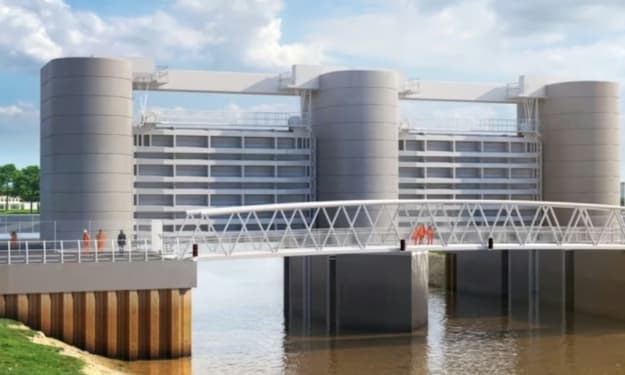
Rethinking Flood Protection in Somerset If you live near the coast, the threat of flooding isn’t just news — it’s a reality you can feel. That’s the situation in Bridgwater, Somerset, a historic market town near the Bristol Channel. For years, plans have been underway to build a tidal barrier to protect homes, businesses, and livelihoods from storm surges. Now, new updates reveal the barrier will be about 10 metres shorter than originally planned, a decision aimed at reducing costs while still keeping the town safe. This announcement has sparked conversations about engineering, budgets, and how communities adapt to climate challenges. Why the Barrier Is Being Shortened The Bridgwater Tidal Barrier was initially designed to be a high-profile flood defence, protecting thousands of properties from tidal surges that travel up the River Parrett. But after a recent design efficiency review, engineers concluded the barrier could be slightly shorter without compromising safety. Reducing the barrier by 10 metres lowers construction complexity, saves money, and reduces long-term maintenance costs. The Environment Agency and local authorities say this approach allows the project to move forward on time and on budget, ensuring the community gets protection sooner rather than later. The Cost Factor Public infrastructure projects like this don’t happen in a vacuum. Rising inflation, global supply chain disruptions, and labor shortages have increased costs for large-scale projects. Officials argue that the revised design is a responsible compromise: it balances cost savings with safety. Somerset Council leaders have welcomed the decision, noting that managing costs wisely helps the project reach completion without compromising protection for residents. Community Voices and Concerns Local engagement has been a key part of the project. Residents have attended consultations and drop-in sessions to see the updated plans and ask questions. Some community members appreciate the cost savings and faster timeline. Others worry whether a shorter barrier will be as effective against future extreme weather events. Questions include: Will the barrier remain strong against increasingly unpredictable storms? Does reducing the height limit future adaptability as climate impacts grow? What effect might it have on local ecosystems and fish habitats? These are valid concerns, reflecting how communities are increasingly involved in climate adaptation decisions. Engineering Flood Defence Today Tidal barriers are not new — Britain has relied on them for decades. London’s Thames Barrier, for instance, has protected the capital since the 1980s. But today, rising sea levels and more frequent storms mean engineers must balance safety, cost, and environmental impact carefully. In Bridgwater, officials say the revised barrier will still protect against 1-in-200-year tidal events. It’s designed to provide robust safety now while remaining adaptable for the future. The Human Side of Flood Protection It’s easy to get lost in numbers and metres, but behind the design decisions are real people. Residents depend on reliable flood protection to feel secure in their homes and communities. For families, businesses, and local services, knowing a barrier is being built — even a slightly shorter one — provides peace of mind. It’s not just a structure; it’s a symbol of resilience and preparedness. Next Steps for the Barrier The Bridgwater project is still under construction, with the revised design undergoing final refinements. Once completed, the tidal barrier will provide long-term protection for thousands of properties and critical infrastructure in Somerset. Officials emphasize that the shortened design does not compromise safety. If anything, staying on budget ensures the project is completed faster, meaning protection arrives sooner for the community. A Lesson in Climate Adaptation The story of the Bridgwater Tidal Barrier is more than engineering or economics. It’s about how communities respond to climate risks and how governments make tough choices balancing safety, cost, and sustainability. The barrier being 10 metres shorter may seem small on paper, but it reflects a larger truth: infrastructure planning today is as much about community engagement, adaptability, and long-term resilience as it is about concrete and steel. By keeping people involved and making informed, cost-effective decisions, Somerset shows how towns can adapt to climate change without sacrificing safety. Conclusion The Bridgwater Tidal Barrier demonstrates that infrastructure projects in the 21st century must adapt to multiple pressures: climate change, financial constraints, and community expectations. While the barrier is slightly shorter than originally planned, it remains a critical line of defence against flooding. More importantly, it highlights the importance of public involvement, transparency, and strategic planning in building a resilient community. For Bridgwater residents, the message is clear: the tide may rise, storms may come, but with smart planning and community engagement, the town will be ready
By Muhammad Hassan4 days ago in Earth
Red Ice Part 1
Northern Greenland, 1831 Anak finished loading the last of his equipment into his dog sled. All of his dogs were barking loudly with excitement. They knew what time it was, they knew what was about to happen. It's the middle of March and ice covers the entire region. Around this time of year, Anak and the other hunters head out for their seasonal walrus hunt. He checked his sled one final time to ensure he had everything they needed. Then he went to check on the other hunters to see of they were ready.
By Stonecreek2 days ago in Earth



Comments
There are no comments for this story
Be the first to respond and start the conversation.