
Antimatter: The Most Mysterious and Valuable Substance in the Universe
Antimatter is often described as the **most expensive, powerful, and mysterious substance known to science**. Unlike gold, diamonds, or rare metals found in the Earth’s crust, antimatter does not naturally exist in large quantities on our planet. It must be **created artificially** using advanced technology, making it extraordinarily rare and valuable. Beyond its price, antimatter challenges our understanding of physics, the origins of the universe, and the future of energy and space travel.

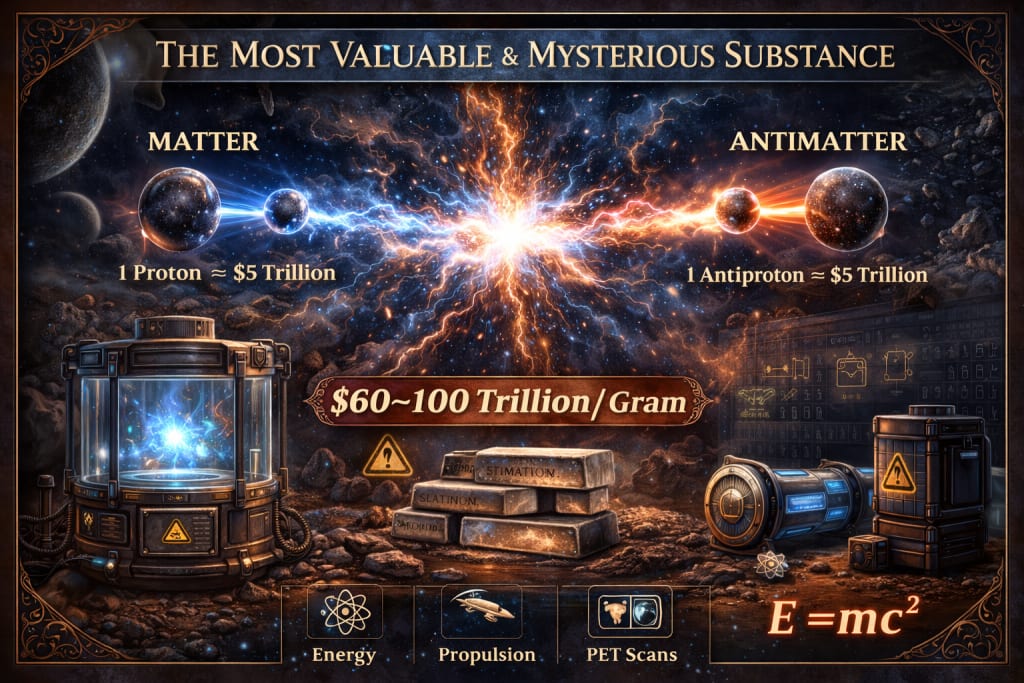
This article explores what antimatter is, how it was discovered, why it is so rare, and why scientists consider it one of the most important substances ever studied.
---
### What Is Antimatter?
Antimatter is made up of **antiparticles**, which are mirror opposites of normal matter particles. Every particle of matter has an antimatter counterpart:
* An **electron** has a **positron**
* A **proton** has an **antiproton**
* A **neutron** has an **antineutron**
These antiparticles have the same mass as their matter counterparts but **opposite electric charge and quantum properties**.
When matter and antimatter come into contact, they **annihilate each other**, converting their entire mass into pure energy according to Einstein’s famous equation:
**E = mc²**
This reaction releases an enormous amount of energy, far greater than chemical or nuclear reactions.
---
### Discovery of Antimatter
Antimatter was first predicted in **1928** by British physicist **Paul Dirac**, who developed equations describing electron behavior. His mathematics suggested the existence of particles identical to electrons but with positive charge.
In **1932**, the positron was experimentally discovered by Carl Anderson, confirming Dirac’s prediction. This marked the first direct evidence of antimatter.
Later discoveries of antiprotons and antineutrons further expanded scientific understanding, proving that antimatter is a real and fundamental part of nature.
---
### Why Is Antimatter So Rare?
According to the Big Bang theory, the universe should have produced **equal amounts of matter and antimatter**. However, the observable universe is dominated almost entirely by matter.
This mystery—known as **baryon asymmetry**—is one of the biggest unsolved problems in physics. Scientists believe that a tiny imbalance occurred shortly after the Big Bang, allowing matter to survive while antimatter largely disappeared.
Today, antimatter appears only:
* In high-energy cosmic events
* In small quantities during radioactive decay
* Artificially in particle accelerators
---
### How Is Antimatter Created?
Antimatter is produced in specialized facilities such as **particle accelerators**, where high-energy collisions create particle–antiparticle pairs.
The process is extremely inefficient:
* Enormous energy is required
* Only tiny amounts are produced
* Most antimatter is immediately destroyed on contact with matter
To store antimatter, scientists use **magnetic traps** that prevent it from touching physical surfaces.
---
### The Cost of Antimatter
Antimatter is often called **the most expensive substance on Earth**.
Estimated cost:
* **$60–100 trillion per gram** (theoretical)
* Some estimates go even higher
This astronomical price reflects:
* Energy costs of production
* Advanced equipment
* Storage challenges
* Extremely low yield
Even nanograms of antimatter represent years of work and massive financial investment.
---
### Scientific and Medical Uses
Despite its rarity, antimatter already has practical applications.
#### Medical Imaging
Positrons are used in **PET (Positron Emission Tomography) scans**, a powerful medical imaging technique for detecting cancer, brain disorders, and heart disease.
#### Physics Research
Antimatter helps scientists:
* Test fundamental laws of physics
* Study symmetry between matter and antimatter
* Understand gravity’s effect on antimatter
These experiments could reveal why the universe exists at all.
---
### Antimatter as an Energy Source
Antimatter has the **highest energy density** of any known substance. Complete matter–antimatter annihilation converts 100% of mass into energy.
Potential future uses include:
* Ultra-efficient power generation
* Interstellar spacecraft propulsion
* Advanced weapons (purely theoretical)
However, current technology makes large-scale antimatter energy use impractical and unsafe.
---
### Antimatter and Space Travel
NASA and other agencies have explored antimatter propulsion concepts. Even tiny amounts could dramatically reduce travel time to distant planets.
Benefits include:
* Extremely high thrust efficiency
* Reduced fuel mass
* Faster interplanetary missions
While promising, antimatter propulsion remains decades away due to production and storage limitations.
---
### Antimatter in Science Fiction and Popular Culture
Antimatter frequently appears in science fiction as:
* A powerful fuel source
* A devastating weapon
* A plot device symbolizing ultimate energy
While these portrayals exaggerate current capabilities, they are rooted in real scientific principles.
---
### Ethical and Safety Concerns
Because antimatter annihilation releases immense energy, its misuse could be catastrophic. This raises ethical questions about:
* Weaponization
* Safety controls
* International regulation
So far, antimatter research remains strictly scientific and medical.
---
### The Future of Antimatter Research
Modern facilities like **CERN** continue to study antimatter to answer fundamental questions:
* Why does matter dominate the universe?
* Does antimatter obey gravity?
* Can antimatter be stored longer?
Each discovery brings humanity closer to understanding the origins of existence itself.
---
### Conclusion
Antimatter stands at the intersection of science, mystery, and possibility. It is the rarest and most expensive substance ever studied, not because of greed or scarcity alone, but because it holds answers to the deepest questions about the universe.
From medical imaging to cosmic origins, antimatter represents both the limits of human technology and the boundless potential of scientific discovery.
---
About the Creator
Say the truth
"Say the Truth: Explain Everything in the World" is your trusted source for uncovering facts and exploring the wonders of history, science, technology, and beyond. We simplify complex ideas and reveal truths to inspire curiosity .
Keep reading
More stories from Say the truth and writers in Earth and other communities.
The Richest Impact Craters on Earth: How Asteroids Created Geological Wealth
1. Vredefort Crater – South Africa The Creator The Vredefort Crater was created about 2 billion years ago by an asteroid estimated to be 10–15 kilometers wide. The collision released energy greater than billions of nuclear bombs.
By Say the truth 9 days ago in Earth
“‘Our Minerals Could Be Used to Annex Us’: Why Canada Doesn’t Want U.S. Mining
When people in rural parts of Canada heard that a major mining project backed by the U.S. Pentagon was coming to their communities, the reaction wasn’t excitement—it was concern. And not just about the usual environmental issues like open‑pit mining or water contamination. Residents began asking a bigger question: could foreign involvement in extracting Canada’s critical minerals threaten their country’s sovereignty and long-term future? This striking idea—“our minerals could be used to annex us”—has become the lens through which many Canadians view U.S. investments in their mining sector. It’s not just local worries; it’s a national conversation about resources, control, and geopolitics. The Mine That Sparked a Debate The debate started in Quebec with Lomiko Metals’ proposal for a large graphite mine in La Petite‑Nation, an area known for its lakes, forests, and small-town charm. Locals feared the mine would disrupt the environment and their way of life. But the real spark came when news broke that the U.S. Department of Defense had invested millions in the project through the Defense Production Act Investment Program. Suddenly, this wasn’t just about jobs or local development—it was about strategic resource control. In August 2025, a referendum showed 95% of locals opposed the mine, highlighting how deeply the project clashed with community sentiment. Why Canada’s Minerals Are So Important Canada is a treasure trove of critical minerals like nickel, lithium, cobalt, copper, rare earth elements, and graphite—essential for electric vehicles, clean energy, and even military hardware. For the U.S., which wants to reduce reliance on China for these resources, Canada is a logical partner. Investments in Canadian mines are part of a broader strategy to secure a North American supply chain for critical minerals. Through the Canada–U.S. Joint Action Plan on Critical Minerals, both governments coordinate on mining projects and technology development. But even with official cooperation, many Canadians worry about how much influence a foreign power should have over their resources. Sovereignty and Historical Skepticism For many Canadians, the concern isn’t just economics or environment—it’s sovereignty. There’s long-standing unease about letting foreign governments, even allies, control natural resources that are vital to the nation’s economy and security. Past U.S. political statements about resource-rich regions, like Greenland, have fueled these fears. So when a Pentagon-backed project emerges in Canada, it can feel like more than a business deal—it can feel like a loss of control over national assets. Balancing Economics and Independence Canada exports huge amounts of minerals to the U.S.—a relationship worth tens of billions of dollars annually. These minerals feed industries like defense, advanced manufacturing, and clean energy. But Ottawa wants to make it clear: access for the U.S. is not guaranteed. Canada aims to diversify partnerships and retain autonomy over its resources. In other words, Canada wants to cooperate without becoming dependent. Local Resistance and Broader Implications The Quebec graphite mine is a microcosm of a bigger issue. Locals aren’t just worried about the land—they’re worried about who controls their resources and for whose benefit. Communities increasingly support sustainable economic models, eco-tourism, and local development instead of foreign-driven extraction projects. They argue that Canada’s natural wealth should benefit Canadians first, and not just serve international strategic needs. Collaboration or Conflict? As demand for critical minerals surges globally, Canada faces a choice: Partner closely with the U.S. to strengthen North American supply chains, or Push back and diversify its partnerships to protect sovereignty. Both paths carry risks. Collaboration could bring investment and jobs, but may deepen fears of foreign control. Resistance may protect autonomy, but could slow down economic development. Conclusion: More Than Just Minerals The phrase “‘our minerals could be used to annex us’” isn’t hyperbole—it captures a real anxiety about control, identity, and power. Canada’s minerals aren’t just economic assets—they’re national assets, shaping the country’s future, environment, and global standing. How Canada manages its resources in the coming years will reflect not only its economic strategy but also its values: sovereignty, sustainability, and self-determination in a rapidly changing world
By Muhammad Hassan7 days ago in Earth



Comments
There are no comments for this story
Be the first to respond and start the conversation.