
Annual Review of Climate change-- from Paris to Marrakech
Article | Global change Research Information Center?

Editor's note
On December 12, 2015, the 197 parties to the United Nations Framework Convention on Climate change (UNFCCC) unanimously agreed to adopt the Paris Agreement at the Paris Climate change Conference, promising to strengthen the response to the threat of global climate change, ensure that the global average temperature rise is less than 2 degrees Celsius above pre-industrial levels, and strive to limit the warming to less than 1.5 degrees Celsius.
Over the past year, the international community has formulated more ambitious policy actions and programmes to address climate change, made further progress in climate change science and technology, and actively promoted the ratification process of the Paris Agreement. On November 4, 2016, the Paris Agreement formally entered into force.
This paper collates the global climate change policy actions and scientific and technological progress in the past year after the Paris Climate Conference, and combs the milestones in the ratification process of the Paris Agreement and China's policy actions for reference.
Global climate change policies and actions
In order to deal with climate change, the international community has formulated more ambitious climate change action plans and programmes. At the level of international organizations, the United Nations has formulated an action plan to deal with El Ni ñ o, the World Bank has issued an action plan on global climate change, the International Renewable Energy Agency has issued an action plan for the development of renewable energy, the G7 summit issued a declaration on climate change, energy and resource use commitments, the World Resources Institute proposed key elements to promote the Paris Agreement, and international attention to the carbon pricing mechanism is on the rise. At the national or regional level, North American countries focus on energy strategies and emission reduction policies. The United States has issued an offshore wind power strategy, an "innovation mission" development plan, signed a memo on climate change and energy cooperation, and formulated relevant standards for reducing greenhouse gas emissions. Canada has also issued a provincial five-year climate action plan. The EU has launched the second phase of the Global change Alliance and funded projects related to climate change adaptation.
International organization
March sixteenth
International Renewable Energy Development Action Plan 2030
April 7th
World Bank Climate change Action Plan
May
The development momentum of global carbon pricing is increasing after the Paris Conference.
May 19th
The World Resources Institute proposes key elements for advancing the Paris Agreement.
May 26th
G7 Summit makes commitments on climate change, energy and resource utilization
July
United Nations response to the 2015-2016 El Ni ñ o Action Plan
North American countries
February sixth
American "Innovation Mission" Development Plan
February twelfth
Three North American countries sign a memo on cooperation on climate change and energy
March 30th
Methane Challenge Program of the United States
June eighth
Five-year Climate Action Plan of Ontario, Canada
August sixteenth
New greenhouse Gas Emission Standard for medium and heavy vehicles in the United States
September eighth
The United States funds research to reduce methane emissions from natural gas infrastructure
September ninth
Us National Offshore Wind Power Strategy
EU and its member states
January fifteenth
The British government subsidizes 75 million pounds to carry out low-carbon technology research and development in the automotive industry.
April twenty _ seventh
EU invests 28 million euros to finance climate change adaptation projects
October
EU launches the second phase of the Global Climate change Alliance
Scientific and technological Progress in Global Climate change
one
Climate change facts
The past year has become an unprecedented year in the history of climate change, with temperature, carbon dioxide concentration, sea level, sea ice and other indicators setting records or becoming milestones. Much attention has been paid to the impact of sea ice change and ocean warming on climate change, and studies on stagnation of global warming, attribution of climate change and ancient floods have also triggered heated discussions.
two
Impact of climate change
Over the past year, climate change has affected many aspects of the world, including affecting water resources systems such as rivers and freshwater, endangering coastal areas and marine ecosystems, in addition to the impact on natural systems, climate change also increases risks to human health and has a negative impact on world heritage and tourism.
three
Climate change adaptation
In order to effectively deal with the risks brought by climate change, international organizations actively make suggestions for climate change adaptation, put forward countermeasures for food security in the context of climate change, and put forward reasonable water resources management suggestions for the pressure of water shortage. Scientists have also actively explored ways to adapt to climate change and discovered new technologies for sequestration of carbon dioxide, but also pointed out that there are risks in the exploration of climate geological engineering technology. Global efforts to adapt to climate change have been increasing over the past five years, with more than 25 billion climate funds approved.
four
Climate change mitigation
Global greenhouse gas emissions continued to grow in 2015, but at a slower pace, and global carbon emissions were decoupled from economic growth. The contribution of renewable energy plays an important role, and the global renewable energy develops rapidly and achieves remarkable results. A variety of potential ways to reduce emissions are being explored continuously. For China, the peak of coal consumption is likely to come ahead of time.
Financial trends of global climate change
The amount of global climate financing has reached a new high, and there is still a large gap in climate investment. According to the Climate Policy Center, global investment in climate initiatives such as renewable energy and adaptation reached US $391 billion in 2014, an increase of 18 per cent over 2013 and the largest year in history. East Asia and the Pacific remain the largest region for climate financing, with China alone accounting for 22 per cent of total climate financing. In 2015, the climate financing of six multilateral development banks reached US $25 billion, accounting for 31.04 per cent of the total global climate financing. Climate investment fund plays a significant role in solving the investment demand, but there is still a large investment gap in the future.
The ratification process of the Paris Agreement
On October 5, UN Secretary-General Ban Ki-moon announced that the Paris Agreement on climate change would enter into force on November 4, 2016. Less than a year after its adoption, the Paris Agreement is about to enter into force since its enactment in December 2015, making it one of the fastest international treaties in history. The following are milestones in the ratification of the Paris Agreement:
one
15 countries approved at the first signing ceremony-sending a positive signal
two
Sino-US Joint ratification-accelerating the entry into force of the Agreement as soon as possible
three
Approved by 31 countries at the deposit ceremony-one of the conditions for entry into force
four
Indian ratification-bringing the final conditions for entry into force closer
five
EU "rapid" ratification-all conditions for formal entry into force are met
As of November 4, a total of 97 parties around the world have ratified the Paris Agreement, accounting for more than 69.22% of global carbon emissions. ?
China's Policy Action and International feedback
Before the opening of the G20 summit, the leaders of China and t
About the Creator
The Reality of the Illusion of Time
Recently, as I strolled along the short stretch to my strength training session, I aimlessly took in the row of tatty shops and shabby buildings along the route and passed an off-street, in which one of my sisters used to live, around thirteen years ago.
By Chantal Christie Weiss4 days ago in Earth
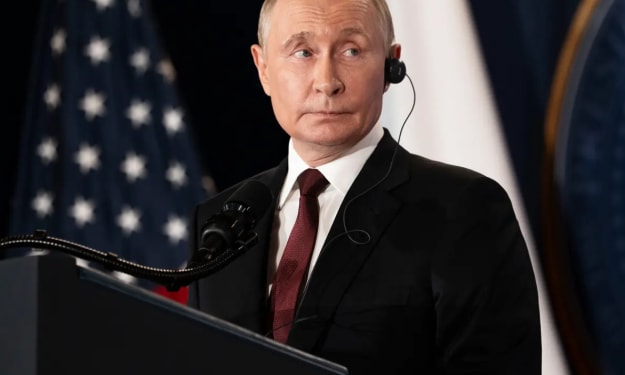
Why Putin Went Quiet When Challenged by Trump Over Venezuela
When U.S. forces captured Venezuelan President Nicolás Maduro in early January 2026, the world was stunned. Venezuela has long been a Russian ally, yet Russian President Vladimir Putin remained almost completely silent when challenged directly by U.S. President Donald Trump. Why would a leader so often outspoken on the world stage hold back in such a dramatic moment? Let’s unpack the story and explore what it means for global politics. A Bold Move That Shocked the World On January 3, U.S. forces executed a daring operation in Venezuela, taking Maduro into custody in New York to face charges including drug trafficking and narco‑terrorism. The operation was framed by the U.S. as a step to enforce justice, but critics saw it as an extraordinary overreach of power. Venezuela is no ordinary country for Russia. Since the days of Hugo Chávez, Moscow has cultivated close ties with Caracas, offering military support, energy deals, and diplomatic backing on the global stage. Past actions included Russian bombers visiting Venezuela and high-profile defense agreements. Given this history, many expected a fiery response from Putin. Yet, the Kremlin remained calm, issuing measured statements rather than sharp threats. Why Silence Was Strategic Experts suggest there are several reasons for Putin’s muted reaction, each revealing the careful calculation behind the Kremlin’s foreign policy. 1. Focus on the War in Ukraine Russia’s primary priority remains Ukraine. Engaged in a high-stakes military and diplomatic battle, Putin cannot afford distractions or new confrontations far from home. Escalating tensions with the United States over Venezuela could jeopardize Moscow’s position in Europe. A New York Times report highlighted that Russia is “subordinating all other interests to the war in Ukraine,” suggesting that even a high-profile ally like Venezuela takes a back seat to Moscow’s strategic goals. 2. Limited Military Options While Russia’s alliance with Venezuela is longstanding, much of the support has been symbolic rather than operational. Defense systems and military cooperation exist on paper, but Russia lacks the immediate ability to counter a U.S. operation thousands of miles away. Putin may have recognized that responding aggressively would be both ineffective and costly, potentially risking military and economic consequences that Moscow cannot afford. 3. Maintaining Diplomatic Channels with Washington With Donald Trump back in the White House since 2025, there has been cautious optimism in Moscow about recalibrating U.S.–Russia relations. Avoiding a dramatic confrontation over Venezuela keeps diplomatic channels open, allowing Russia to negotiate on other high-priority issues like Ukraine and sanctions relief. In other words, silence can be a calculated strategy, signaling restraint rather than weakness. 4. Russia’s Global Influence Is Waning The Maduro episode also highlights a broader geopolitical reality: Russia’s global reach has limits. Since the 2022 invasion of Ukraine, Moscow’s influence in regions like the Middle East and parts of the former Soviet Union has weakened. Venezuela remains one of its few high-profile allies outside Europe, but even there, Russia’s power is largely symbolic. By not escalating, Putin is acknowledging a practical truth: Russia cannot be everywhere at once, and some battles are not worth fighting. 5. Choosing Battles Wisely Some analysts emphasize that Putin’s quiet response is more about strategic prioritization than capitulation. In a world dominated by nuclear powers and volatile global politics, direct confrontation with the United States over Venezuela could spiral into a far larger crisis. By staying silent, the Kremlin may be signaling that it picks its battles carefully, focusing resources on Ukraine, where the stakes are highest. What This Means for the World Putin’s silence sends several messages: Russia is currently stretched, economically and militarily. Moscow is prioritizing Ukraine over symbolic allies. Strategic restraint is sometimes more powerful than public confrontation. The limits of Russian influence are becoming more visible to the world. This episode reflects a new reality in geopolitics: power is as much about choosing when not to act as when to assert force. The Bigger Picture The capture of Maduro is a defining moment not just for Venezuela, but for global politics. It shows the United States asserting power in a way not seen for decades, while Russia’s quiet reaction underscores its current limits and priorities. For observers, Putin’s silence is a lesson in modern geopolitics: even the most assertive leaders exercise restraint when stakes are high and risks are global. In the end, the Maduro affair reminds us that in today’s world, the loudest response is not always the most effective one — sometimes, quiet calculation speaks volumes. Sources and Further Reading The US capture of Maduro reveals Russia’s weakness – Atlantic Council ‘It sends a horrible signal’: US politicians react to capture of Nicolás Maduro – The Guardian Russia slams 'neocolonial threats' against Venezuela – Reuters
By Muhammad Hassan7 days ago in Earth
How to Succeed at the Benson Directory®
Congratulations and welcome to the Benson Directory® employee #22391! As our newest call handler, you will have the privilege of speaking with dozens of unique and interesting people on a daily basis as well as the opportunity to earn bonuses for high performance. Contained within this handbook you will find a set of ease to follow instructions designed to help you settle in to your new role and begin paving the way to success.
By S. A. Crawfordabout 16 hours ago in Fiction



Comments
There are no comments for this story
Be the first to respond and start the conversation.