
Anaconda: The Ultimate Guide to the World’s Largest Snake
Discover the secrets of the world’s largest snake—the anaconda! Dive into its Amazon habitat, fascinating behavior, and legendary status as a powerful predator in this ultimate guide.

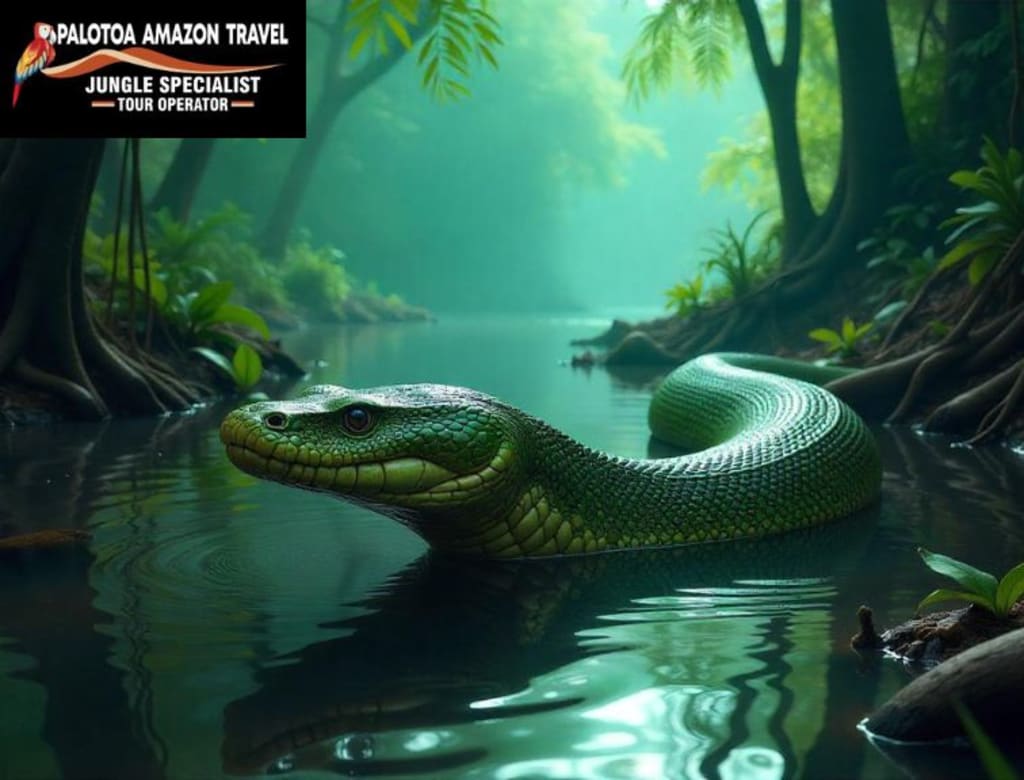
Among the most amazing creatures found in the Amazon rainforest, few animals arouse the imagination as much as the anaconda. The world's largest snake, the anaconda, is a symbol of power, mystery, and the South American wilderness. This thorough guide, offered by Palotoa Amazon Travel, will cover the species, habitat, diet, behaviour, adaptations, and myths surrounding this legendary giant snake. Whether you are interested in wildlife, want to travel to the Amazon, or are just curious, this in-depth article will give you all the information you need to comprehend the anaconda and why it is considered one of the most fascinating reptiles in the world.
Introduction to the Anaconda
The anaconda is a myth, not just a snake. This massive boa, the heaviest and longest snake on the planet, is equally feared and revered. The anaconda is a river snake that is mainly found in the lush waterways of South America. It is known for being a strong predator of rainforests. Eunectes, the scientific name for this genus, means "good swimmer," which is apt for a reptile that spends a large portion of its life in the water.
Meet the Anaconda Species
The green anaconda, the famous giant snake of the Amazon, is typically what most people think of when they picture a "anaconda." However, the genus Eunectes contains an intriguing group of large, aquatic boa constrictors that are referred to as "anacondas." Each of the four officially recognised anaconda species has distinct traits, a range, and an ecological niche in South America.
1. Green Anaconda (Eunectes murinus)
The largest and most well-known member of the Eunectes genus is the green anaconda. Often called the "Amazon rainforest snake" or the "giant anaconda," this species is the longest and heaviest snake in the world.
- Scientific Name: Eunectes murinus
- Range: River basins of the Amazon and Orinoco, which include Ecuador, Peru, Bolivia, Guyana, Venezuela, Colombia, and Brazil
- Maximum Length: 6–9 meters (19–29 feet), with some unverified reports of even larger individuals
- Habitat: The Amazon basin's marshes, flooded forests, slow-moving rivers, and swamps
- Description: Olive-green body with dark oval spots, thick and muscular, aquatic life-specific eyes and nostrils on top of the head
As a true predator of the rainforest, the green anaconda feeds on fish, deer, capybaras, and caimans. It is without a doubt the heavyweight of large constrictors due to its size and strength.
Anecdote:
A green anaconda that was over 8 meters long was caught and released by Venezuelan researchers in 2016, yielding important information about the species' maximum size and health markers.
2. Yellow Anaconda (Eunectes notaeus)
Despite being smaller and more slender than its green cousin, the yellow anaconda is still a remarkable river snake on its own.
- Scientific Name: Eunectes notaeus
- Range: Paraguay, northeastern Argentina, southern Brazil, and Bolivia—primarily in the wetlands and river systems of the Pantanal and Gran Chaco regions
- Maximum Length: 3–4.5 meters (10–15 feet)
- Habitat: Marshes, swamps, and slow-moving rivers
- Description: Yellowish-brown background color with black or dark brown blotches and streaks
Being highly aquatic, yellow anacondas spend a lot of time in the water. As carnivorous reptiles, they contribute significantly to their local ecosystems by consuming fish, birds, and small mammals.
Anecdote:
A biologist conducting a survey in the Pantanal shows how the yellow anaconda regulates local wildlife populations by snatching a waterbird.
3. Dark-Spotted Anaconda (Eunectes deschauenseei)
Of all the anaconda species, the dark-spotted anaconda is the rarest and least researched.
- Scientific Name: Eunectes deschauenseei
- Range: Northeastern South America, particularly in the Marajó Island region of Brazil and parts of French Guiana
- Maximum Length: Approximately 3 meters (about 10 feet)
- Habitat: Flooded forests and swamps
- Description: Olive or brownish color with distinctive dark spots along the body
The behaviour and ecology of the dark-spotted anaconda are poorly understood because of its remote and limited range. Its aquatic habits and diet, however, are thought to be similar to those of its relatives.
Example:
The first confirmed sighting of a dark-spotted anaconda in years is documented by a herpetologist researching isolated swamps in northern Brazil, highlighting the lack of knowledge about this uncommon species.
Bolivian Anaconda (Eunectes beniensis)
The Bolivian anaconda, which is unique to Bolivia, is the most recently described species in the Eunectes genus.
- Scientific Name: Eunectes beniensis
- Range: Wetlands and river systems of the Beni region in northern Bolivia
- Maximum Length: Up to 4 meters (about 13 feet)
- Habitat: Seasonally flooded savannas and slow-moving rivers
- Description: Physically similar to both the green and yellow anacondas, but with unique genetic and morphological features
The discovery of the Bolivian anaconda emphasises the Amazon basin's abundant biodiversity and the significance of ongoing studies in isolated habitats.
Case Study:
The significance of continuing research in understudied habitats is highlighted by a team of Bolivian scientists who find a new population of Bolivian anacondas in the Beni wetlands.
The Green Anaconda: The True Giant
The snake world's undisputed heavyweight champion is the green anaconda. It has been the focus of innumerable documentaries, books, and even films due to its enormous size, aquatic lifestyle, and predatory skills.
Anecdote:
In Brazil, a local fisherman tells of seeing a green anaconda so big it was thought to be a fallen tree. Although this story is probably over the top, it illustrates the wonder these snakes evoke in people who live near them.
Physical Description
- Coloration: Olive-green in colour with dark oval spots running the length of its back, it blends in well with murky water.
- Body: Built for power rather than speed, it is thick and muscular.
- Head: The snake can see and breathe while mostly submerged thanks to its relatively small head, which has eyes and nostrils on top.
Example:
The green anaconda's eyes and nostrils, which are situated atop its head, enable it to stay almost undetectable while pursuing prey from below the water's surface, according to a visiting scientist.
Record Holders
- The longest verified green anaconda measured was 8.43 meters (27.7 feet).
- Unverified reports claim that some people are over 10 meters, but these are usually exaggerated.
Case Study:
A group of zoologists measured the longest verified green anaconda, which measured 8.43 meters. They verified the record with multiple witnesses and photographic evidence.
Why So Big?
The size of the green anaconda is a result of its adaptation to its aquatic environment, where its enormous weight is supported by buoyancy. This enables it to outgrow any land-dwelling constrictor snake or arboreal boa.
Example:
Anacondas' enormous size is supported by aquatic habitats, much like whales' ability to support their weight through water allows them to grow larger than any land mammal.
Habitat: Where Do Anacondas Live?
The Amazon and Orinoco river basins are home to the iconic South American snake, the anaconda. Among their favoured habitats are:
- Marshes and Swamps: Ambush hunting is made possible by the shallow water and dense vegetation.
- Slow-Moving Rivers and Streams: Streams and rivers that move slowly are perfect for surprise attacks and covert movement.
- Flooded Forests: The Amazon basin floods during the rainy season, increasing the anaconda's hunting range.
Anecdote:
In order to demonstrate how these snakes take advantage of seasonal variations in their environment, a researcher follows a green anaconda during the rainy season as it travels from a receding creek into the recently flooded forest.
Range
- Countries: Brazil, Colombia, Venezuela, Peru, Bolivia, Ecuador, Guyana, and Paraguay (for yellow anacondas).
- Amazon Basin: The heart of the green anaconda’s range, home to the richest biodiversity on Earth.
Example:
Green anacondas predominate in the Amazon basin, while yellow anacondas are most prevalent in the Pantanal, according to a conservationist who maps anaconda sightings throughout South America.
Adaptations to Habitat
- Aquatic Lifestyle: Anacondas prefer the water to the land. They can stay underwater for up to ten minutes without coming to the surface because their bodies are streamlined for swimming.
- Camouflage: They are almost undetectable to predators and prey because of the way their colouring blends in with muddy water and aquatic vegetation.
Case Study:
Anacondas ambush capybaras by using their camouflage and aquatic adaptations to stay hidden until the very last second, according to a study conducted with underwater cameras.
Diet: What Do Anacondas Eat?
Anacondas are the top predators in their environment because they are carnivorous reptiles. Their diet is impressive and diverse.
Typical Prey
- Fish: A staple for juveniles and smaller adults.
- Birds: Waterfowl and other birds that visit the riverbanks.
- Mammals: Capybaras (the world’s largest rodent), deer, wild pigs, and even jaguars on rare occasions.
- Reptiles: Caimans (small crocodilians) and turtles.
Anecdote:
Stories of anacondas consuming prey as big as capybaras are told by locals in the Amazon, who are amazed at how the snake's body and jaws grow to accommodate such meals.
Hunting Technique
Traditional ambush predators are anacondas. Lying in wait for hours or even days, they rely on patience and stealth. The anaconda strikes with lightning speed, grabbing the prey in its jaws and rapidly wrapping its strong body around it. Being a constrictor snake, it suffocates its victim by tightening its hold every time the victim exhales.
Case Study:
In order to illustrate the patience and accuracy needed for ambush hunting, researchers watch an anaconda lie still for hours before striking at a passing bird.
Eating Habits
- Swallowing Whole: Anacondas are able to swallow prey that is significantly larger than their heads because of their expandable bodies and flexible jaws.
- Digestive Process: Due to its sluggish metabolism, an anaconda may go weeks or even months without eating after a big meal.
Example:
Similar to how their wild counterparts can go months without eating following a large catch, a captive green anaconda will refuse food for a few weeks after consuming a large meal.
Behavior and Adaptations
Solitary Lifestyle
Typically solitary, anacondas only congregate during the breeding season. Despite not being territorial, they will vie for the best hunting spots.
Anecdote:
The fact that anacondas are rarely spotted together outside of the breeding season, according to a field biologist, emphasises how solitary they are.
Aquatic Adaptations
- Eyes and Nostrils: Positioned on top of the head for breathing and seeing while submerged.
- Muscular Body: Built for both swimming and constriction.
- Skin: Tough and resistant to abrasions from underwater obstacles.
Example:
A young anaconda is seen scaling a shrub by the river, demonstrating how semi-arboreal juveniles can hunt for birds and evade predators.
Hunting Behavior
- Ambush Predator: Prefers to wait for prey rather than actively chase it.
- Heat-Sensing: Like many boas and pythons, anacondas have heat-sensitive pits along their jaws, allowing them to detect warm-blooded prey.
Case Study:
An essential adaptation for nocturnal hunting, thermal imaging shows how anacondas use heat-sensing pits to find warm-blooded prey in murky water.
Defensive Behavior
- Nonaggressive: Anacondas are not naturally aggressive toward humans and will usually retreat if threatened.
- Camouflage: Their best defense is remaining unseen.
Anecdote:
In order to dispel the myth that an anaconda is inherently dangerous, a herpetologist explains how, when threatened by humans, it stays still and uses its camouflage instead of aggression.
Snake Adaptation Highlights
- Breathing Underwater: Can stay submerged for up to 10 minutes.
- Climbing: While primarily aquatic, young anacondas can be semi-arboreal, climbing trees and shrubs along riverbanks.
Example:
Anacondas can avoid predators and prey by staying submerged for almost ten minutes, as demonstrated by a researcher.
Reproduction and Life Cycle
Anaconda reproduction is as fascinating as their hunting behavior.
Mating
- Season: Typically occurs during the rainy season (April–May).
- Mating Balls: Several males may compete for a single female, forming a “breeding ball” that can last for days.
Anecdote:
Local guides in the Amazon occasionally discover tangled clusters of anacondas during the rainy season; they refer to these as "love knots," a local term for the breeding ball phenomenon.
Gestation and Birth
- Ovoviviparous: Females give birth to live young rather than laying eggs.
- Gestation Period: 6–7 months.
- Litter Size: 20–40 live young, each about 60–80 cm (2–2.6 feet) long at birth.
Example:
The ovoviviparous reproduction of the species is demonstrated when a captive female anaconda gives birth to 25 live young, all of whom swim and hunt right away.
Juvenile Survival
- Independence: Newborn anacondas are independent from birth.
- Predation: Many fall prey to birds, fish, and larger mammals, but those that survive grow rapidly.
Case Study:
Less than half of newborn anacondas survive their first year because of predation, according to researchers using radio transmitters to track them. This highlights the difficulties of juvenile life.
Conservation and Threats
While the anaconda is not currently endangered, it faces several threats:
Habitat Loss
- Deforestation: Logging and agriculture reduce wetland habitats.
- Wetland Drainage: Alters the ecosystem and reduces prey availability.
Case Study:
Conservation action is prompted by satellite imagery that demonstrates how Bolivian wetland drainage for agriculture diminishes the amount of suitable habitat for the Bolivian anaconda.
Hunting and Persecution
- Skin Trade: Anacondas are sometimes hunted for their skins.
- Pet Trade: Juveniles are captured for sale, though they rarely survive in captivity.
- Fear and Misunderstanding: Locals may kill anacondas out of fear, despite their ecological importance.
Example:
Argentina's wildlife authorities seize the skins of illegally hunted yellow anacondas, underscoring the continued dangers posed by the skin trade.
Conservation Status
- IUCN Red List: Not listed as threatened, but populations are declining in some areas.
- Protection: Many countries protect anacondas under wildlife laws, but enforcement varies.
Anecdote:
Over the past ten years, there has been a discernible rise in local anaconda sightings due to the enforcement of protection laws, according to a wildlife ranger.
Importance in the Ecosystem
Anacondas are apex rainforest predators that contribute to the balance of the Amazon ecosystem by regulating the numbers of capybaras, caimans, and other animals.
Case Study:
According to ecologists, regions with robust anaconda populations have a balanced number of capybaras and caimans, which prevents overgrazing and preserves the health of the wetland.
Myths, Legends, and Facts
Myths
- Man-Eaters: Although anacondas can attack large animals, human attacks are incredibly uncommon.
- Unstoppable Murderers: Despite their strength, anacondas are vulnerable to threats from humans, caimans, and jaguars.
Facts
- Nonvenomous: Constriction, not venom, is how anacondas kill.
- Gentle Giants: They stay out of conflict and don't act aggressively unless provoked.
- Cultural Significance: The anaconda is frequently regarded as a guardian spirit or as a representation of strength and fertility in Amazonian folklore.
Frequently Asked Questions
1. Where can one find an anaconda and what is it?
The anaconda, which belongs to the genus Eunectes, is the longest and largest snake in the world by weight. The Amazon and Orinoco river basins in South America are home to the majority of anacondas, which thrive in marshes, swamps, and slowly flowing rivers.
2. How many anaconda species are there?
The Green Anaconda (Eunectes murinus), Yellow Anaconda (Eunectes notaeus), Dark-Spotted Anaconda (Eunectes deschauenseei), and Bolivian Anaconda (Eunectes beniensis) are the four recognised species of anacondas.
3. What is the maximum size of a green anaconda?
With a maximum weight of 250 kg (550 lbs) and a maximum length of 6 to 9 meters (19 to 29 feet), the Green Anaconda is the largest anaconda species. Unverified reports suggest even greater sizes.
4. What is the diet of anacondas?
As carnivorous reptiles, anacondas consume fish, birds, mammals (such as deer and capybaras), and reptiles like caimans. In their aquatic environments, they are apex predators.
5. Do anacondas pose a threat to people?
Anacondas rarely attack people because they are not inherently hostile. They defend themselves by camouflage and would rather avoid conflict.
6. How are prey hunted and killed by anacondas?
Anacondas hunt by ambush. They surprise their prey by moving stealthily, then suffocate it with their strong bodies before consuming it whole.
7. Where do wild anacondas reside?
The Amazon and Orinoco basins are home to wetlands, swamps, marshes, and slow-moving rivers. Green anacondas are most prevalent in the Amazon, while yellow anacondas are more prevalent in the Pantanal.
8. How do anacondas procreate?
Because anacondas are ovoviviparous, their females give birth to live offspring. Females can give birth to 20–40 children at a time during mating, which takes place during the rainy season.
9. Do anacondas face extinction?
Although some populations of anacondas are threatened by habitat loss, hunting, and the skin trade, they are not currently considered endangered. Their survival depends on conservation efforts.
10. What adaptations do anacondas make to their aquatic habitat?
Anacondas can stay underwater for up to ten minutes, have tough skin for protection, and eyes and nostrils on top of their heads for submerged hunting.
Conclusion
Beyond simply being the biggest snake in the world, the anaconda represents the wild beauty and ecological complexity of the Amazon. The anaconda continues to evoke wonder and curiosity due to its remarkable size, hunting skills, and crucial role as a predator in rainforests. You can contribute to the preservation of the Amazon's distinctive wildlife for future generations by learning about these amazing serpents and encouraging ethical ecotourism with Palotoa Amazon Travel.
Ready to encounter the legendary anaconda?
Book your Amazon adventure with Palotoa Amazon Travel and experience the wonders of the world’s greatest rainforest firsthand!
About the Creator
Palotoa Amazon Travel
Palotoa Amazon Travel is a specialized tour operator dedicated to providing unique experiences in the Peruvian Amazon. We offer eco-friendly tours to the remote Manu Reserve in Peru, one of the most biodiverse regions on the planet.
Keep reading
More stories from Palotoa Amazon Travel and writers in Earth and other communities.
Manu National Park Tours from Cusco: What to Expect on Your Adventure
Discover the heart of the Peruvian Amazon on a once-in-a-lifetime adventure with Manu National Park Tours departing from Cusco. Manu National Park, a UNESCO World Heritage Site, is renowned for its remarkable biodiversity, unspoiled landscapes, and lively indigenous cultures. Palotoa Amazon Travel offers professionally guided tours that take you inside one of the world's most pristine rainforests, departing from Cusco, the entry point to the Andes and Amazon. Your Amazon rainforest adventure starts here, whether you're looking for wildlife encounters, jungle treks, or genuine cultural experiences.
By Palotoa Amazon Travel6 months ago in Earth


Comments
There are no comments for this story
Be the first to respond and start the conversation.