
After eating a planet, this star burped, but the planet was really asking for it.
Planetary Snacks Bite Back: Cosmic Karma
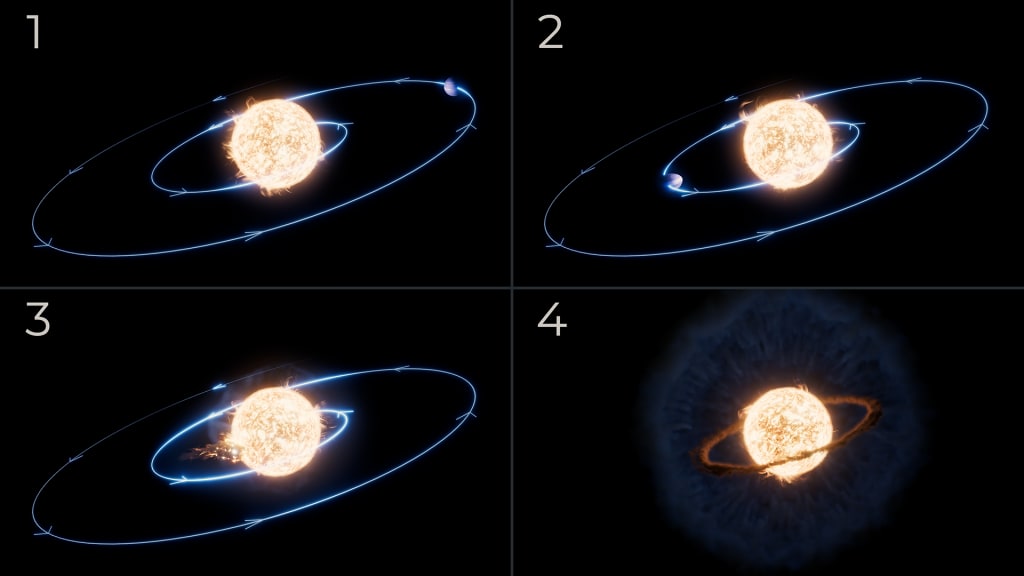
The James Webb Space Telescope (JWST) has been studying the scene of a dramatic collision between a star and its planet, but whereas astronomers had originally thought that the star was a red giant that engulfed the planet, the JWST has found a very different story: The planet crashed into the star.
In 2020, the Zwicky Transient Facility at Palomar Observatory in California spotted a distant star — that sits about 12,000 light-years away from us — suddenly brighten in the night sky. When looking back at the star in archival data from NASA's NEOWISE mission, astronomers found that the star, designated ZTF SLRN-2020, had been brightening in infrared light for a year before the optical flash.ZTF SLRN-2020, according to a 2023 study, was an evolved sun-like star known as a "red giant" that had expanded and engulfed a gas giant planet that was orbiting around it. The infrared brightening was thought to be caused by dust left over from the planet burning up in the red giant's atmosphere, similar to a giant meteor, and the flash of light was then interpreted as the planet being consumed by the expanding red giant. However, a team led by Ryan Lau of the National Science Foundation's NOIRLab in Tucson, Arizona, chose to take a closer look at ZTF SLRN-2020 using the JWST.
"Because this is such a novel event, we didn't quite know what to expect when we decided to point this telescope in its direction," said Lau in a statement. "With its high-resolution look in the infrared, we are learning valuable insights about the final fates of planetary systems, possibly including our own."
What Lau's team found was a surprise: The star wasn't bright enough to be a red giant. Instead, it had the appearance of a "regular" star with about 70% of our sun's mass. Naturally, this alters ZTF SLRN-2020's story. If the planet in this system wasn't consumed by a red giant, then the opposite is the only explanation: The planet must have crashed into the star instead.
How can this happen? Astronomers have been finding bizarre worlds known as hot Jupiters ever since the first exoplanets were discovered. These are gas giants that migrated inward after forming far from their star. Gravitational tides must have started to pull this particular planet inexorably toward its doom as it migrated so close to its parent star over time. "Eventually, the planet began to enter the star's atmosphere. Then it was a runaway process of falling in faster from that moment," said Morgan MacLeod of the Harvard–Smithsonian Center for Astrophysics and the Massachusetts Institute of Technology. "The planet, as it's falling in, started to sort of smear around the star."
The tidal forces began to stretch the planet in a vice-like grip, until finally the planet "splashed down" into the gases of the star, and as the star swallowed the planet it belched out a tidal wave of gas into space. This ejected plume cooled and condensed into a cloud of gas, instigating the infrared brightening seen by NEOWISE.
One more surprise, however. The JWST's Near-Infrared Spectrometer, on the other hand, discovered a molecular gas disk encircling the star in close proximity, rather than the amorphous cloud of gas that had initially been anticipated by astronomers. The disk looks for all the world like a miniature planet-forming disk.
Exoplanet astronomer Colette Salyk of Vassar College in New York made the following statement: "I could not have expected seeing what has the characteristics of a planet-forming region, even though planets are not forming here, in the aftermath of an engulfment."
About the Creator
Keep reading
More stories from Reehanul Islam and writers in Earth and other communities.
Scientists detect signature of life on a distant planet, study suggests
A team of astronomers have detected what they call the most promising signs to date of a possible biosignature, or signs of past or present life linked to biological activity, on an exoplanet named K2-18b. But the study authors, and other experts, remain cautious and have not declared a definitive discovery of life beyond our planet.
By Reehanul Islam9 months ago in Fiction
When Immigration Enforcement Crosses the Threshold: ICE’s Controversial 2025 Memo
In 2025, the U.S. Immigration and Customs Enforcement (ICE) agency released a new internal memo outlining updated guidelines for immigration enforcement. The memo, which has since become highly controversial, addresses the use of force, detention practices, and enforcement priorities, and has drawn scrutiny from lawmakers, human rights advocates, and legal experts alike.
By Aarif Lashari3 days ago in Earth
What We Know About the Winter Storm About to Hit the US—and What We Don’t
A major winter storm is barreling toward the United States, raising concerns from meteorologists, emergency officials, and residents alike. Across large portions of the country, from the southern plains to the Northeast, communities are preparing for heavy snow, ice, and gusty winds. Yet despite advanced forecasting technology, uncertainty remains about the storm’s timing, intensity, and ultimate impact. Understanding what we know—and what we don’t—can help families and local governments make better preparations for the potentially disruptive weather ahead.
By Muhammad Hassan3 days ago in Earth
Rachel Reviews: The Spiral Archive by Pieter Hendrik
It's difficult for me to know where to start with a review of this book as it was, for me, an entirely unique experience and one that I'll probably never have again. I don't want that to be interpreted as unenjoyable but it has left me scratching my head a little and ruminating on its content, its themes and its characters.
By Rachel Deeming7 days ago in BookClub


Comments
There are no comments for this story
Be the first to respond and start the conversation.