
Scientists detect signature of life on a distant planet, study suggests
Astronomers have detected dimethyl sulfide (DMS) and dimethyl disulfide (DMDS) in the atmosphere of exoplanet K2-18b, located 124 light-years from Earth.
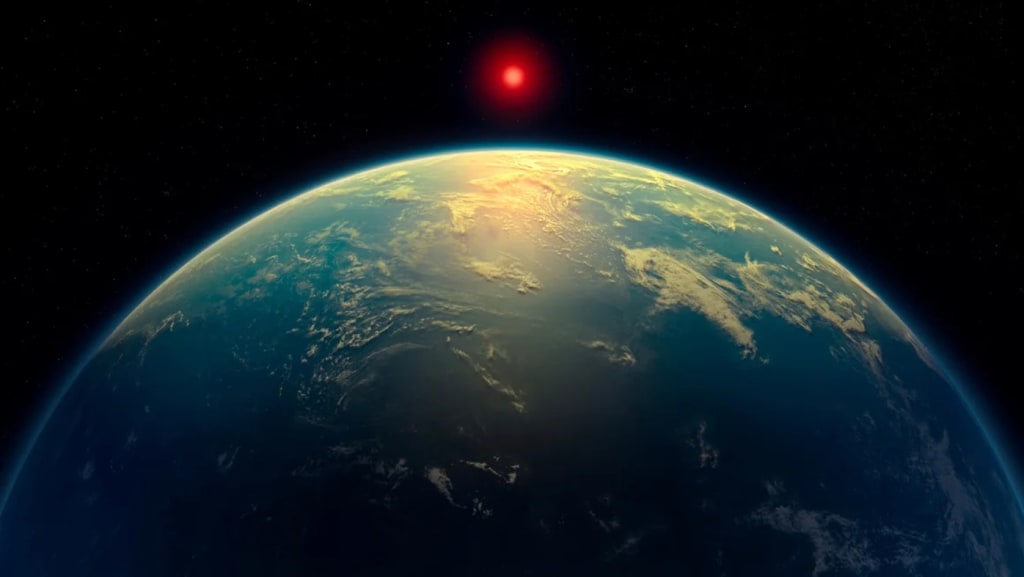
A team of astronomers have detected what they call the most promising signs to date of a possible biosignature, or signs of past or present life linked to biological activity, on an exoplanet named K2-18b. But the study authors, and other experts, remain cautious and have not declared a definitive discovery of life beyond our planet.
The team found chemical fingerprints in the atmosphere of K2-18b using the James Webb Space Telescope that point to the presence of dimethyl sulfide, or DMS, and possibly dimethyl disulfide, or DMDS. Only marine phytoplankton, a type of microbial life, can make both molecules on Earth.
A study detailing the findings was published Thursday in The Astrophysical Journal Letters.
According to lead study author Nikku Madhusudhan, professor of astrophysics and exoplanetary science at the University of Cambridge, K2-18b, which is located 124 light-years from Earth, may be a Hycean world—a planet with a hydrogen-rich atmosphere and complete coverage of liquid water.
In 2021, Madhusudhan and his colleagues discovered that there may be liquid water oceans on K2-18b, which led them to theorize for the first time the existence of Hycean worlds. The planet is in the habitable zone of its star, which means that it is at a temperature and distance from the star that are just right for it to have liquid water on its surface.
“Earlier theoretical work had predicted that high levels of sulfur-based gases like DMS and DMDS are possible on Hycean worlds,” Madhusudhan said in a statement. “And now we’ve observed it, in line with what was predicted. Given everything we know about this planet, a Hycean world with an ocean that is teeming with life is the scenario that best fits the data we have.”
Webb telescope detections
The molecules could have been made in another unidentified chemical process on Earth that does not require life. The latest findings build on earlier work by the same group of astronomers, who used Webb's Near-Infrared Imager, Slitless Spectrograph, and Near-Infrared Spectrograph instruments to find carbon dioxide and methane in the planet's atmosphere. The team used Webb's Mid-Infrared Instrument to make the new detection.
“This is an independent line of evidence, using a different instrument than we did before and a different wavelength range of light, where there is no overlap with the previous observations,” Madhusudhan said. “The signal came through strong and clear.”
But Madhusudhan and his coauthors acknowledge that more data is needed before claiming direct evidence of life on another world. The team believes between 16 and 24 hours follow-up observations using Webb will make that possible.
“It’s important that we’re deeply (skeptical) of our own results, because it’s only by testing and testing again that we will be able to reach the point where we’re confident in them,” Madhusudhan said. “That’s how science has to work.”
However, despite the results' excitement, other experts believe that it will take significantly more time and data to confirm the existence of life beyond Earth and even identify the type of exoplanet K2-18b. Sara Seager, an astrophysicist who teaches physics, planetary science, aeronautics, and astronautics at the Massachusetts Institute of Technology, said that independent teams have completely different views of the planet as a whole. The new research did not involve Seager.
“Some propose a Hycean world, others suggest a hot magma ocean — a planet with molten rock beneath a hydrogen-rich atmosphere, which is about as inhospitable as it gets — and still others see it as a mini-Neptune,” Seager said, referring to worlds that are larger than Earth but smaller than Neptune. For reference, K2-18b is 8.6 times as massive and 2.6 times as large as Earth.
Seager believes this finding, which suggests a candidate for a biosignature, “will remain in the candidate category indefinitely.”
“For nearly 100 years, astronomers have wrestled with the idea that certain gases in a planet’s atmosphere ‘don’t belong’ — that they’re so reactive they shouldn’t exist without being continually replenished, possibly by life,” Seager said via email. “This idea traces back to James Jeans in 1930, who first identified molecular oxygen in Earth’s atmosphere as a sign of life, and used similar logic to place limits on oxygen in Venus’ atmosphere. Now, with thousands of exoplanets in view, the temptation to overinterpret is strong — and some are jumping the gun. When it comes to K2-18 b, enthusiasm is outpacing evidence.”
An ‘exciting’ hint
When Madhusudhan and his team previously observed K2-18b, they detected a weak signal that might fit the hypothesis that the planet is a Hycean world.
“We didn’t know for sure whether the signal we saw last time was due to DMS, but just the hint of it was exciting enough for us to have another look with JWST using a different instrument,” he said.
Exoplanets, or planets outside our solar system, can be observed through the atmosphere using Webb's observational capabilities. From Earth's perspective, light moves through the atmospheres of exoplanets as they approach their host star, allowing Webb to identify the chemical signatures of the gases within. According to the study's authors, the characteristics of dimethyl sulfide and dimethyl disulfide, which are both members of the same chemical group, overlap. As a result, the results cannot definitively distinguish the two molecules; however, future observations may be able to do so. Dimethyl sulfide and dimethyl disulfide have volumetric concentrations typically below one part per billion on Earth. On the other hand, the team estimates that these molecules are thousands of times more prevalent on K2-18b. In a statement, study coauthor Subhajit Sarkar, a lecturer in the astronomy group at Cardiff University in Wales, said, "The inference of these biosignature molecules poses profound questions concerning the processes that might be producing them." “Somewhat skeptical but very intrigued and excited about what’s next” describes Eddie Schwieterman, an assistant professor of astrobiology at the University of California, Riverside. Schwieterman, who has previously investigated K2-18b, was not involved in the new study.
His group’s research found that in order to sustain the abundance of dimethyl sulfide in K2-18b’s atmosphere, “a production rate of about 20 times that of Earth’s DMS production is required.”
“This is a high bar, but plausible considering local areas in Earth’s oceans are far more productive than the global average,” he said. “This threshold also poses an obstacle to attributing potential DMS to abiotic (non-biological) sources, since those abiotic sources would have to be much larger than any known ones.” But Schwieterman said that first, scientists need to confirm that dimethyl sulfide is really present in the atmosphere of K2-18b, which will require validation from multiple independent groups who study the same data and analyze it for the chemical signature of the molecules. Madhusudhan said the data the study team analyzed will be released next week, so other astronomers can do just that.
“I do have at (least) one reason to be skeptical, which is that I’d anticipate the presence of ethane (C2H6) to accompany DMS/DMDS if those gases were present,” he said. “This is because UV rays from the star would break apart the DMS/DMDS into components we’d predict would react to form ethane. The absence of ethane makes me think we’ve missed something. Perhaps our models are wrong, or perhaps the DMS/DMDS isn’t there.”
Schwieterman believes there is a lot of work to be done to validate the finding and assess the biosignature hypothesis presented by the paper.
A threshold for life
The new paper's research team claims that the observations have reached the three-sigma level of significance, or a 0.3 percent chance that the detections were accidental. A scientific discovery requires that the observations meet a five-sigma threshold, or a probability of less than 0.00006 percent that they were accidental.
While the findings don’t represent a clear detection of dimethyl sulfide and dimethyl disulfide, “it is a step in the right direction,” said Dr. David Clements, an astrophysicist at Imperial College London. Clements was not involved in the research.
Madhusudhan believes his team’s finding is a “major landmark in our search for life” that ushers in a new era.
“In my mind, it is no longer a question of whether we will find life if such life exists,” he said. “We have demonstrated that we have the capability to do so with our initial current findings at reasonable significance. A bigger question in my mind is whether we as a species are prepared to find life as we don’t know it. We as a society, as a species, should come together and ask ourselves the question: What is it that constitutes life elsewhere?”
#collected
About the Creator
Keep reading
More stories from Reehanul Islam and writers in Fiction and other communities.
Nasa digs up new clue in search for life on Mars
Scientists studying soil samples from Nasa's Curiosity rover have discovered that a carbon cycle similar to the one that sustains life on Earth once played out on the red planet.While it's unclear whether Marsever supported life, its current harsh environment may be due to an "imbalanced" carbon cycle."Mars seems to have been habitable for its first billion years and that waned very quickly," Ben Tutolo, a space researcher at the University of Calgary, Canada, told DW.
By Reehanul Islam9 months ago in Fiction


Comments (1)
Nice sharing. Well written.