
Africa's Splitting Journey: Impacts and Preparations for a New Continent
Understanding the Geological Process and its Potential Implications

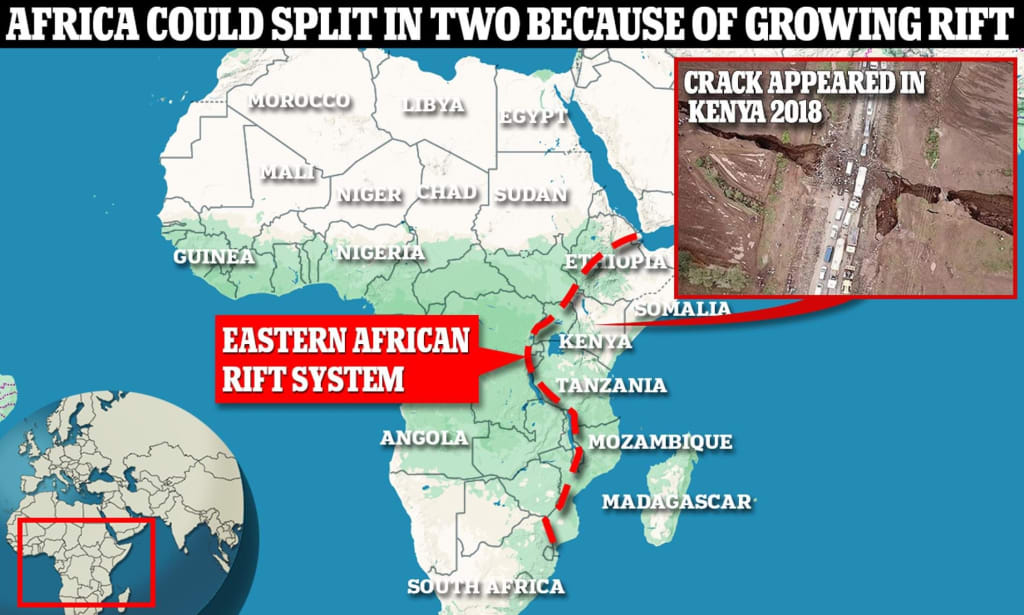
On April 28, 2023, a significant event took place in Nairobi, Kenya. Residents experienced an earthquake-like movement that resulted in a massive crack in the landmass. This event confirmed what scientists have been observing: Africa, the world's second-largest continent, is gradually splitting into two, potentially forming a new ocean and continent.
The Ongoing Geological Process:
The process of Africa splitting into two separate land masses is a result of the movement of tectonic plates beneath the Earth's surface. Specifically, the East African Rift system, a 35-mile-long crack that emerged in Ethiopia's desert in 2005, is responsible for this phenomenon. The East African Rift system extends from the Red Sea in the north to Mozambique in the south, crossing several countries like Ethiopia, Kenya, Tanzania, and Uganda.
As the African plate slowly separates into two, the land between them sinks, forming a rift valley. This gradual separation is caused by the movement of the African tectonic plates, and it may take millions of years to complete. The process is still ongoing, and its speed may vary over time due to factors like tectonic activity and volcanic eruptions.
Impacts on Ecology and Geography:
The potential splitting of Africa into two could have significant implications for the region's ecology, geography, and human populations:
Formation of a New Ocean: As the land masses move apart, a new ocean could form. This development might impact ocean currents, weather patterns, and marine life.
Biodiversity Loss: Plant and animal populations on either side of the rift valley may become isolated, leading to a decrease in biodiversity and potential local extinctions.
Climate Changes: The East African Rift system significantly influences the region's climate. The separation of Africa could alter ocean currents and wind patterns, leading to changes in precipitation and temperature. This may affect agriculture, water resources, and human settlements.
New Ecosystems: The formation of new landmasses could create unique habitats for species, leading to the development of new ecosystems.
Migration Disruption: The separation could disrupt the migration patterns of various species, making it challenging for animals to find resources for survival.
Human Population Impact: New political boundaries could form, potentially leading to conflicts over resources and territory. It may also affect regional trade, commerce, and access to water resources.
Preparation for Potential Impacts:
Scientists and policymakers must collaborate to prepare for the potential impacts of Africa's splitting:
Research and Monitoring: Continuous research and monitoring of the East African Rift system are essential to understand the geological processes better and detect any significant geological activity.
Ecological Planning: Policymakers can use scientific information to develop ecological plans, including protected areas and strategies to manage climate change and habitat loss.
Disaster Preparedness: Preparing disaster response plans for potential natural disasters, such as volcanic eruptions and earthquakes, is crucial.
Infrastructure Planning: Considering the creation of new infrastructure, such as roads and ports, to facilitate movement between the two land masses.
Community Engagement: Involving local communities in the preparation process ensures their needs and priorities are considered.
Conclusion: A Natural Process with Profound Implications
The potential splitting of Africa into two is a natural geological process that has been ongoing for millions of years. While the timeline for completion remains uncertain, understanding its potential implications is crucial for preparing for the changes ahead. A collaborative approach between scientists, policymakers, and local communities will help minimize negative impacts and maximize positive outcomes. As we witness this geological journey, we must remain conscious of the ecological, geographical, and human implications of this remarkable phenomenon.
About the Creator
Keep reading
More stories from Akinwande Johnson and writers in Earth and other communities.
The Green Plate: How Embracing a Vegan Diet Can Combat Climate Change
In an era where the consequences of climate change loom large, individuals are increasingly seeking ways to make a positive impact on the environment. One powerful solution lies on our plates - adopting a vegan diet. Beyond personal health benefits, a shift towards plant-based eating holds the potential to significantly mitigate climate change and foster a more sustainable future for our planet.
By Akinwande Johnson2 years ago in Earth
High-Speed Train Crash in Southern Spain Leaves at Least 21 Dead
A devastating high-speed train crash in southern Spain has left at least 21 people dead and dozens injured, shocking the nation and triggering a major emergency response. The incident, which occurred on a busy rail route connecting key southern cities, has reignited concerns over railway safety, infrastructure maintenance, and emergency preparedness in one of Europe’s most advanced rail networks.
By Aarif Lashariabout 15 hours ago in Earth
Icy Chaos in Central and Eastern Europe
Winter has unleashed its fury across central and eastern Europe, leaving travelers frustrated and transport networks struggling to keep up. Over the past few days, freezing rain and ice have wreaked havoc on airports, train stations, and highways — forcing flight diversions, delaying trains, and making roads treacherously slippery. From Vienna to Budapest, Prague to Bratislava, this icy grip has brought travel to a near standstill. Let’s take a closer look at what’s happening, how it’s affecting people on the move, and what it tells us about winter travel in Europe. A Sudden Winter Blow A sudden wave of freezing rain swept across the region, coating runways, rail tracks, and roads with a dangerous layer of ice. Major airports in Austria, Hungary, Slovakia, and the Czech Republic were particularly affected. At Vienna International Airport, operations were temporarily suspended when runways became too slick for flights to land safely. Travelers already in the air had to divert to alternative airports in Munich, Frankfurt, and Venice. Meanwhile, Budapest’s Ferenc Liszt International Airport paused all arrivals and departures, and Prague’s Václav Havel Airport continued operating but at limited capacity. Trains Crawling Through Ice Rail networks weren’t spared. Across Austria, Hungary, and the Czech Republic, ice on tracks and power lines caused delays and cancellations. Austria’s national rail operator, ÖBB, urged passengers to postpone non-essential journeys. In the Czech Republic, travelers at Prague’s main station faced long waits as trains struggled to maintain schedules. Hungary’s tram and suburban rail services were temporarily suspended due to ice buildup on power lines. This combination of black ice, frozen switches, and heavy snowfall has tested the limits of winter infrastructure in Europe. Roads Turn Into Skating Rinks The icy weather didn’t just affect public transport — roads became treacherous, too. Authorities in Slovakia and the Czech Republic warned residents to avoid non-essential travel as highways turned into slippery skating rinks. Accidents and minor collisions were reported, and emergency services were busy responding to dozens of injuries from slips and falls. Even schools weren’t immune: parts of Romania shifted to online learning, keeping children safe during the extreme temperatures, which dropped to around -13°C in some areas. Why This Weather Is So Disruptive Meteorologists point to several factors that made this storm particularly severe: Freezing rain on top of existing snow creates an icy layer that’s extremely hard to clear. Rapidly refreezing surfaces make conditions unpredictable. Temperatures hovering around freezing prevent efficient melting during the day. This “perfect storm” scenario underscores just how vulnerable transport systems are to extreme weather. Even well-prepared airports and rail networks can struggle when weather transitions from snow to freezing rain. Voices From the Ground Passengers took to social media to express their frustration: Crowded airports as travelers scrambled to rebook flights. Train stations packed with delayed commuters, unsure when the next train would depart. Warming centers opened to provide shelter and hot drinks for stranded travelers. For many, a simple trip turned into a test of patience and resilience. Tips for Traveling in Freezing Conditions If you must travel during winter storms, experts recommend: Check flight and train schedules regularly, as delays can change quickly. Allow extra time for travel to avoid missing connections. Consider travel insurance that covers weather-related disruptions. If driving, carry winter essentials: blankets, food, water, and check road conditions before departure. Most importantly, prioritize safety over schedules — icy conditions can change rapidly, making travel risky. A Reminder From Winter This recent chaos in central and eastern Europe serves as a stark reminder of how interconnected transport systems are, and how vulnerable they can be to extreme weather. Flights grounded, trains stalled, and highways turned icy show that winter can bring travel to a halt — sometimes with very little warning. As Europe continues to face volatile winter conditions, travelers and authorities alike are reminded: preparation and flexibility are key. Sometimes, the weather truly has the final say. ❄️🛫🚆
By Muhammad Hassan5 days ago in Earth
Center Stage with Paul Stewart
*** I'm keen to republish the interviews I did for my series with Vocal creators. It's been a few years and I thought it might be nice to revisit these wonderful conversations. I'll be releasing them one at a time for a few weeks/months.
By Heather Hubler4 days ago in Interview



Comments
There are no comments for this story
Be the first to respond and start the conversation.