
5 Unexplained Mysteries Under the Sea
Forget the Stars, We Still Have Worlds to Discover in Our Own Oceans

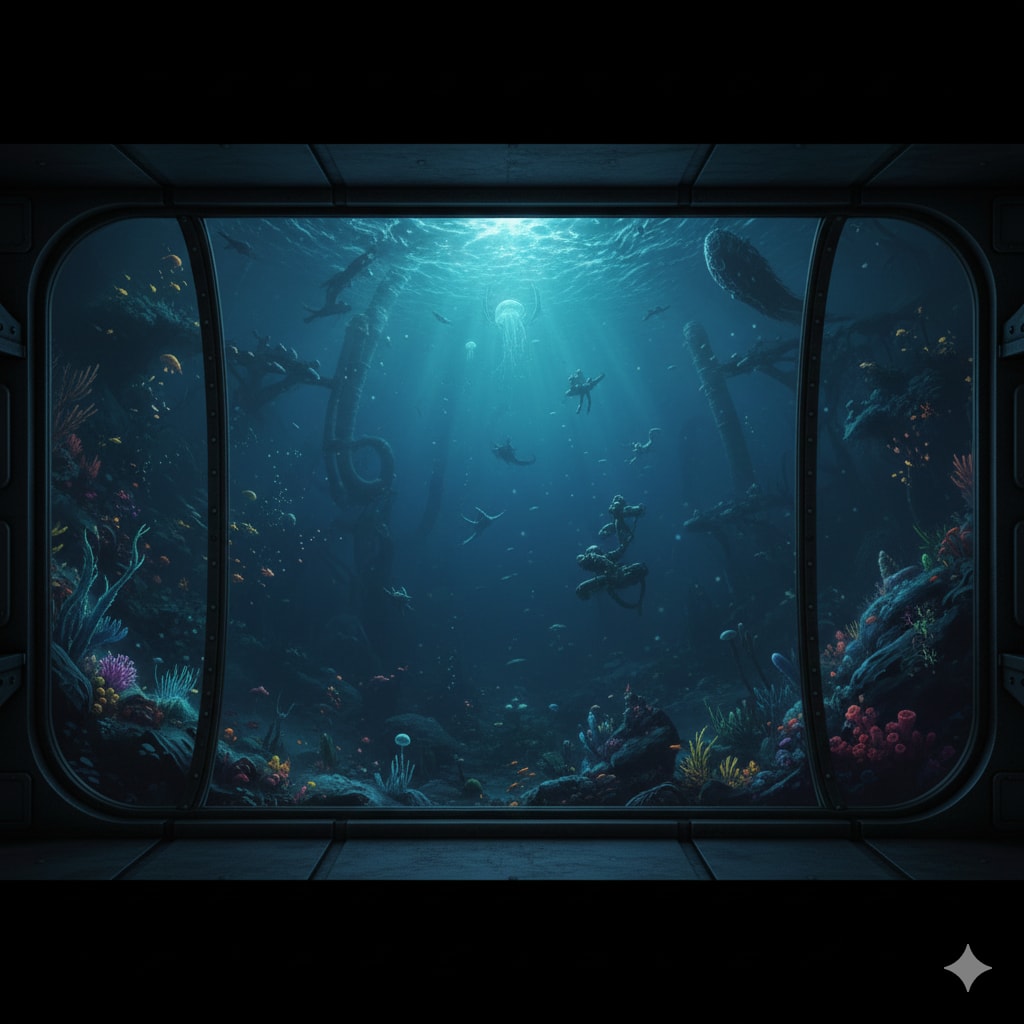
It’s easy to get caught up in the idea of exploring distant planets and galaxies. The universe feels like the last great frontier. But here’s a wild thought: we still have a mind-blowing amount of things to understand and explore right here on Earth, specifically in our oceans, rivers, and lakes. Think about this: over 95% of our waters remain completely unexplored! We talk about space exploration, but maybe we need to start something like "Ocean Trek," because a lot of the discoveries we've made within these waters are truly baffling and simply can't be explained by current science.
Here are five of the most compelling underwater anomalies that prove the deepest parts of our planet hold secrets more incredible than we can imagine.
1. The Baltic Sea Anomaly
Imagine searching for an old shipwreck and finding... this. In the summer of 2011, the Swedish Ocean X diving team discovered a 200-foot circular, rock-like formation sitting on the bottom of the Baltic Sea.
* The Look: Divers say the structure rests on a pillar and looks like a staircase leading into a dark hole. It has been described as resembling the Millennium Falcon.
* The Theories: Some speculate it could be an alien spaceship or a secret Nazi submarine base.
* The Evidence: Volker Bruchert, a geology professor, analyzed stone samples and believes it's just a rock. However, there are arguments: the object is missing the slit layer common on rocks that have sat for ages, it appears to be supported by a 26-foot-high pillar, and eerie construction lines seem to cover it. The biggest head-scratcher? When the Ocean X boat was directly above the anomaly, its electrical equipment ceased to work.
2. Japan’s Yonaguni Monument
In 1986, a diver near Yonaguni Jima, off the southern tip of Japan (near Okinawa), came across some absolutely strange structures about 80 feet below sea level.
* The Look: They appear to be stepped structures, complete with terraces and ramps. The largest formation is pyramid-shaped, 600 feet wide, 90 feet high, and has five separate levels of stone blocks.
* The Debate: Masaaki Kimura, a marine geologist who has been diving at the site for over 15 years, is convinced these are the ruins of a "Japanese Atlantis", an ancient city sunk by an earthquake about 2,000 years ago. Tool marks and carvings on the stones suggest construction, not nature.
* The Alternative: Others, like Professor Robert Schoch of Boston University, insist the structures are naturally formed geological formations. Some even believe it could be all that’s left of MU, a rumored ancient Pacific civilization.
3. Stone Mystery in the Sea of Galilee
Back in 2003, scientists surveying the bottom of the Sea of Galilee in Israel accidentally stumbled upon a massive, mysterious circular structure submerged about 30 feet below the surface.
* The Specs: This thing is huge; its diameter is greater than the length of a commercial jet. It's cone-shaped, made of basalt rocks, and weighs an estimated 60,000 tons. Measuring 230 feet at the base and 32 feet tall, it's twice the size of Stonehenge.
* The Age: It's estimated to be anywhere between 2,000 and 12,000 years old.
* The Purpose: This is the biggest mystery. Archaeologists are certain the monument was important to the people who built it, noting features similar to ancient communal burial grounds. But its sheer size and specific features are unlike anything they’ve ever seen. We simply don't know what it is.
4. Cuba's Underwater City
In 2001, an exploration team off the western coast of Cuba picked up a perplexing series of stone structures on their sonar equipment, sitting between 2,000 and 2,460 feet below the surface.
* The Look: The sonar images suggested organized stones reminiscent of urban development. There were large blocks (about 8x10 feet) resembling granite, some appearing deliberately stacked.
* The Timeline Conundrum: A senior researcher from Cuba's natural history museum estimated that it would have taken 50,000 years for structures like these to sink to that depth.
* The Skepticism: This estimate caused many researchers to conclude the structures must be naturally formed. Why? Based on our current understanding of history, 50,000 years ago, no known culture had the architectural capacity to build such complex structures.
5. The Bimini Road
Discovered during expeditions in the mid-2000s off the coast of North Bimini in the Bahamas, the Bimini Road is a half-mile-long submerged structure shaped like the letter 'J'.
* The Structure: It consists of about 50 stone piles, with huge rectangular and semi-rectangular blocks arranged in what look like perfect geometric patterns.
* The Age: The depth suggests they could be around 10,000 BC.
* The Question: While most scientists argue it's a natural formation, many others believe its scale and precision simply cannot be the work of nature. It's also been suggested as a potential site of the legendary lost city of Atlantis.
There are countless mysteries hidden in our oceans and lakes, and we've explored less than 5% of them. Ancient cities, unknown creatures, and even lost civilizations could be waiting to be discovered. Sometimes, we dismiss strange findings just because they don't fit what we think we know. But discoveries often challenge our assumptions. What do you think these underwater anomalies really are?
About the Creator
Areeba Umair
Writing stories that blend fiction and history, exploring the past with a touch of imagination.
Keep reading
More stories from Areeba Umair and writers in Earth and other communities.
The Earth's Secrets: Lost Worlds That Might Still Be Hidden
For centuries, people have been sharing incredible tales of lost worlds and civilizations. Back when the maps had huge, blank spaces, it was easy to believe that these mysterious lands might exist, tucked away somewhere. Nowadays? The whole idea of a "lost world" seems more like a punchline than a possibility. I think that's because many of us feel like we've charted every inch of the planet. We've got satellites everywhere, and photos of everything. But here’s the thing: those images can’t show you what lies at the bottom of the deep ocean trenches. They can’t see into the Earth’s complex cave systems. Even scientists admit that over 85% of Earth's species are still unknown! If we haven't found the life, how can we be sure we've found all the land? So, before we completely dismiss the idea, I’m encouraging everyone to keep an open mind about the following famous Lost Worlds. Some of them might just be waiting for the right person to stumble upon them.
By Areeba Umair2 months ago in Earth
Standing While Falling
Quotation from Friedrich Nietzsche "He who wrestles long with monsters should beware lest he himself become a monster. And if you gaze long into an abyss, the abyss also gazes into you. Man is not destroyed by suffering, but by the meaning he makes of it."
By LUCCIAN LAYTH6 days ago in Critique



Comments
There are no comments for this story
Be the first to respond and start the conversation.