
280 million kilometers away, after taking the last photo, the spacecraft with precious samples returned to Earth
Spaceship with precious samples returns to Earth

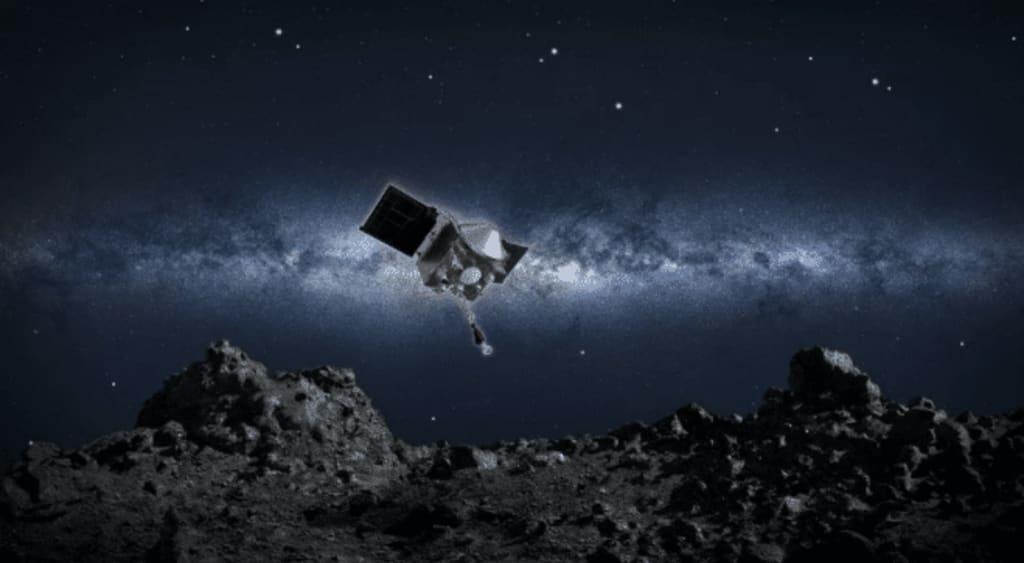
Speaking of asteroid sampling, you may still vaguely remember that at the end of 2020, Japan's Hayabusa-2 probe successfully returned to Earth with a sample of the "Ryugu" asteroid. From departure to landing on Earth, the flight mileage of the Hayabusa-2 probe Accumulated more than 5.2 billion kilometers. In addition to the Hayabusa2 probe, another unmanned spacecraft has also completed asteroid sampling, that is, the OSIRIS-Rex probe.
OSIRIS-Rex detector
Compared with Mars probes and lunar probes, the OSIRIS-Rex probe may be slightly less famous, and many friends may not know the existence of this probe. The OSIRIS-Rex probe is an asteroid probe launched by NASA in September 2016. Its mission is to complete asteroid sampling and return to Earth. After nearly 2 years of flight, it reached the vicinity of the Bennu asteroid in December 2018, and flew around the Bennu asteroid. On December 10, 2018, the OSIRIS-Rex probe found that there are traces of water on the surface of the Bennu asteroid , the water is bound to the clay of the Bennu asteroid.
Since the OSIRIS-Rex probe needs to sample the surface of the Bennu asteroid, the probe needs to complete the landing on the asteroid. Sampling the surface of an asteroid more than 100 million kilometers away from the earth is not an easy task. In addition, the Bennu asteroid is a special case. There are many small fragments on its surface, and these small fragments will fly out. Scientists Worrying that these scattered small debris may cause the OSIRIS-Rex probe to malfunction, so before landing, scientists selected multiple pre-selected landing areas for the OSIRIS-Rex probe, and the OSIRIS-Rex probe also made multiple landings Preview the simulation.
After many rehearsals, the Osiris-REx probe successfully reached the surface of the Bennu asteroid in October 2020, and its robotic arm collected some asteroid samples on the surface of the Bennu asteroid. Although the process from contacting the surface of the asteroid to grabbing the sample was relatively smooth, the robotic arm grabbed too many samples, and some rock samples were relatively large, which affected the sealing chamber to seal up the samples, but later some asteroid samples were scattered. into space, so this is not a big problem. NASA researchers estimate that the probe may have brought back 400 grams of samples, including some rocks.
After completing the sampling, the Osiris-REx probe did not return to Earth immediately, but continued to orbit the asteroid for a while. On May 10, 2021, the main engine of the OSIRIS-REx probe opened at full throttle for 7 minutes, leaving the Bennu asteroid at a speed of nearly 1,000 kilometers per hour, carrying precious samples from about 287 million to Earth. The Bennu asteroid, which is kilometers away, begins to return to the earth. It is expected to eject the sample capsule when it passes by the earth on September 24, 2023. The sample capsule will fall in the desert of Utah in the western United States. The entire return flight distance is expected to reach 2.3 billion kilometers. .
Some friends may find it a little strange. The distance between this asteroid and our earth is only about 300 million kilometers. Why does the spacecraft need to fly more than 2 billion kilometers to return to the earth? This is because the spacecraft does not fly in a straight line in space. The flight mileage of Hayabusa 2, which has successfully brought back samples of the "Ryugu" asteroid, has reached a total of 5.2 billion kilometers, and the distance between this asteroid and the earth is only 340 million kilometers.
Take one last photo before returning
The Osiris-REx probe has been flying with the Bennu asteroid for several years. The Osiris-REx probe has also taken pictures of the Bennu asteroid many times before. Before leaving the Bennu asteroid and starting to return to Earth, the Osiris-REx probe The Rees-REx probe took the last image of the Bennu asteroid. In this photo, the Bennu asteroid we see has a "crescent" shape, that is, one side looks brighter and the other side is dark.
Now the spacecraft is flying back toward the earth, and it will take more than 2 years to reach the earth. When the samples return to the earth, scientists will analyze these samples. The Bennu asteroid is more than 4 billion years old and contains materials from the early days of the solar system, so scientists hope to understand the planet formation process more than 4 billion years ago and the origin of life on Earth by studying the Bennu asteroid. It is believed that scientists are now very much looking forward to getting these precious rock samples as soon as possible.
About the Creator
crudden elle
Partagez un peu de science chaque jour
Keep reading
More stories from crudden elle and writers in Earth and other communities.
500,000 years ago, the Peking Man failed to climb to the top of the food chain, but became a demon that cannibalizes its peers
When it comes to "Peking Man", everyone is very excited, perhaps because it contains the word "Beijing", so many people mistakenly think that they are descendants of Peking Man! In fact, the Peking Ape has nothing to do with everyone. We are neither their descendants nor their transmitters!
By crudden elle3 years ago in Earth
The Dryads Are Calling
Deep within the heart of ancient forests, where sunlight filters through towering canopies and the air hums with life, there exists a world few humans truly understand. It is a world of dryads, the mythical tree spirits of folklore, silently observing, nurturing, and sometimes guiding the creatures that dwell among the trees. Today, their legend continues to captivate the imagination, blending myth, nature, and a touch of magic.
By Aarif Lashariabout 16 hours ago in Earth
Inside Trump's $11 Billion Health Plan to Replace “Neo-Colonial” USAID
In the landscape of global health aid, few proposals have stirred as much debate as former President Donald Trump’s ambitious plan to restructure American assistance abroad. Dubbed an $11 billion health initiative aimed at replacing USAID’s current framework, the plan seeks to pivot away from what Trump and his allies have criticized as the “neo-colonial” approach of U.S. foreign aid. While the plan promises greater efficiency and impact, experts are split on whether it is a practical solution or a politically driven gamble. Trump’s Critique of USAID The United States Agency for International Development (USAID) has long been a central pillar of American foreign assistance, distributing billions in aid annually to address health crises, food insecurity, and development challenges worldwide. However, Trump’s administration and its supporters have often described USAID’s approach as bureaucratic, inefficient, and reflective of a “neo-colonial” mindset. In public statements, Trump argued that the U.S. was spending taxpayer dollars on programs that benefited foreign governments or contractors more than the intended local communities. Critics of the plan say that while USAID has flaws—as any large bureaucracy does—its extensive networks and decades of experience provide an unmatched capacity to deliver aid efficiently and safely. The Core of the $11 Billion Proposal At the heart of Trump’s proposal is an $11 billion fund designed to consolidate, modernize, and streamline U.S. health aid. Unlike the traditional USAID model, which relies heavily on long-term partnerships with governments and NGOs, the new plan emphasizes: Direct Impact Funding: Allocating resources to frontline health workers and local initiatives rather than intermediaries. Data-Driven Investments: Using real-time health data to target outbreaks and crises more efficiently. Private Sector Partnerships: Leveraging U.S. pharmaceutical companies, tech firms, and healthcare startups to deliver vaccines, treatments, and medical infrastructure. Shorter Program Cycles: Moving away from multi-year funding commitments in favor of more flexible, results-oriented programs. Proponents argue that this approach could reduce bureaucratic overhead and ensure U.S. aid reaches communities faster. By “cutting out the middlemen,” Trump supporters claim, America can avoid the pitfalls of slow-moving aid programs that sometimes fail to adapt to crises. Reactions from the Global Health Community Global health experts, however, have expressed concern about both the logistics and philosophy of the plan. Dr. Melissa Ortega, a senior researcher at the Global Health Policy Institute, explained, “The idea of bypassing established structures like USAID may sound appealing on paper, but in practice, it risks undermining decades of institutional knowledge. Health systems are complex, and short-term projects cannot replace long-term capacity building.” Some critics have also questioned the characterization of USAID as “neo-colonial.” While U.S. foreign aid has historically been tied to geopolitical interests, many programs today are designed collaboratively with recipient countries and local organizations. Reducing oversight could unintentionally increase the risk of misuse, corruption, or health inequities. On the other hand, supporters of Trump’s plan point to examples of inefficiency in USAID programs, citing cases where aid was delayed or mismanaged. By introducing more direct funding models, they argue, U.S. taxpayer dollars could achieve a higher “return on health outcomes.” Political Implications Trump’s health aid overhaul proposal is not just about international development—it is also deeply political. Framing USAID as a “neo-colonial” institution resonates with a populist narrative that America should prioritize its own citizens and assert greater control over how taxpayer money is spent abroad. Domestically, the $11 billion plan faces scrutiny from Congress. Lawmakers from both parties have questioned whether dismantling USAID’s systems could destabilize ongoing health programs in countries where the U.S. has long-term commitments. The potential impact on global health security—including the fight against pandemics like COVID-19—adds another layer of concern. Internationally, U.S. allies and partner nations are watching closely. Sudden shifts in aid delivery could disrupt health programs in low- and middle-income countries, many of which rely on predictable funding cycles to maintain vaccination campaigns, maternal health services, and disease surveillance. Possible Benefits and Risks If executed carefully, the Trump-backed model could bring several benefits: Faster Response Times: Direct funding could accelerate delivery of vaccines, treatments, and emergency support. Innovation Boost: By partnering with private sector companies, the plan could accelerate development of new health technologies. Accountability: With performance-based metrics, the plan may better measure the impact of U.S. aid. However, the risks are equally significant: Disruption of Existing Programs: Abrupt changes could destabilize ongoing health projects. Loss of Expertise: USAID’s decades of experience in navigating local governance, supply chains, and community engagement may be hard to replace. Geopolitical Fallout: Allies accustomed to collaborating with USAID might see the move as destabilizing, reducing cooperation on global health initiatives. Looking Ahead As Trump and his allies continue to advocate for this $11 billion overhaul, the debate over the future of U.S. health aid is intensifying. Proponents view it as a necessary modernization of an outdated system, while critics fear it could undercut decades of carefully built infrastructure and global partnerships. Ultimately, the success of this plan will hinge on its ability to balance efficiency with stability, innovation with oversight, and political objectives with humanitarian needs. For now, the proposal remains controversial, representing a dramatic departure from traditional approaches to U.S. foreign aid. Whether it will reshape global health for the better—or simply create more uncertainty—remains to be seen. In the end, the Trump health plan is as much about ideology as it is about dollars. It challenges the conventional wisdom of international development and asks whether a more streamlined, results-focused approach can truly replace a system built over decades. As the world watches, the stakes could not be higher: the future of U.S. global health aid—and the lives it touches—hangs in the balance.
By Muhammad Hassan6 days ago in Earth


Comments
There are no comments for this story
Be the first to respond and start the conversation.