
1910 Halley's Comet
Comet Causes Panic in the Streets

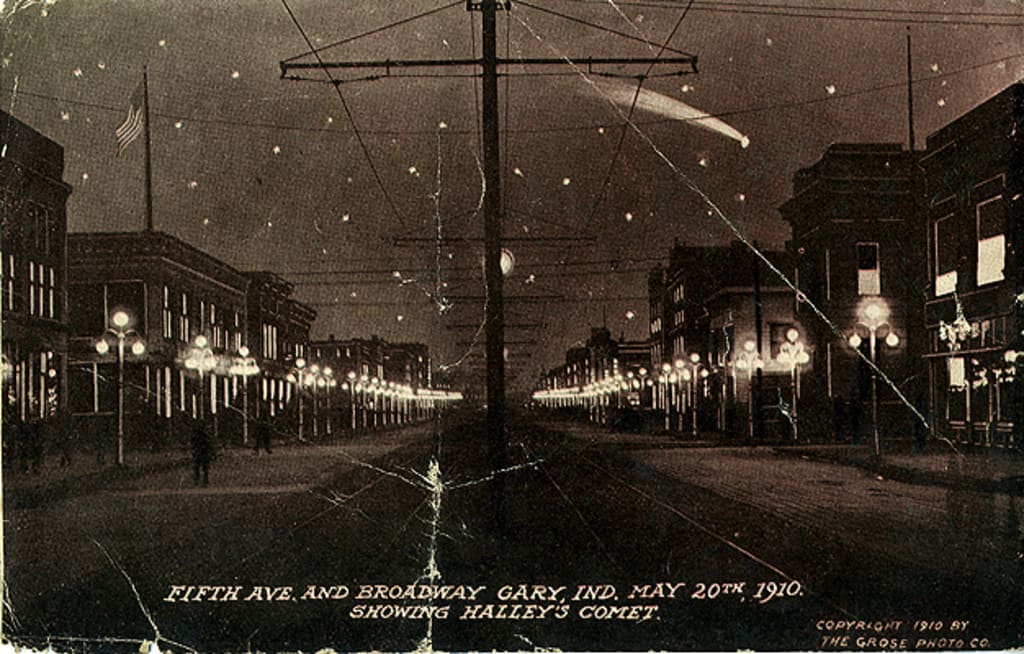
Named after astronomer Edmond Halley, Halley's Comet only passes by Earth every 76 years or so. When it buzzed our planet in 1910, it sparked a lot of interest — according to Wired.com, telescope sales skyrocketed as the comet neared. Hotels even offered special deals, so people could gather on top of their roofs to watch the meteor pass.
Of course, not everyone was pleased with the comet's appearance, as many believed the shooting star would end civilization. This crazy idea came courtesy of Camille Flammarion, a French astronomer who believed the comet's 24-million-mile long tail contained a poisonous cyanogen gas that "would impregnate the atmosphere and possibly snuff out all life on the planet."
Unfortunately, The New York Times did a piece on Flammarion's apocalyptic theory that encouraged some less-trustworthy newspapers to run wild with the story. So in addition to telescopes, people started ransacking stores for gas masks. Con men made a killing by selling anti-comet pills, and some people worried the comet would "cause the Pacific to change basins with the Atlantic" and turn the world into "one heterogeneous mass of chaotic confusion." Worried parishioners flocked to their churches, and according to science writer Matt Simon, people actually sealed up their keyholes to keep poison out of their homes.
Robert Ball, the director of the Cambridge Observatory, also weighed in with his own fun analogy, or rather his misguided interpretation of a statement by astronomer John Herschel. Ball quickly informed the public “the whole comet could be squeezed into a portmanteau”, a dated word for a suitcase. Apparently, if you weren’t English in 1910 you didn’t know what a portmanteau was either, so the New York Times graciously educated the public in a fantastic clapback to Ball’s statement. Not only did the Times explain what a portmanteau was, it went on in great detail to explain why putting a comet in one was a bad idea. In essence, the article said only women could possibly pack a comet properly, and if it were to be packed, it’d be completely ruined.
Herschel didn’t mean his statement literally of course, something Ball failed to convey when he re-uttered his variation of the statement. In reality, Herschel was just commenting on the ephemeral nature of the gaseous tail as Lowell and Hillig had.
The affect the comet would have on the Earth’s oceans also seemed to be a common focus among those convinced life as they knew it would be ending soon. A particularly concerned alarmist wrote to the Royal Observatory:
“The comet will cause the Pacific to change basins with the Atlantic, and the primeval forests of North and South America to be swept by the briny avalanche over the sandy plains of the great Sahara, tumbling over and over with houses, ships, sharks, whales and all sorts of living things in one heterogeneous mass of chaotic confusion”.
Obviously that didn’t happen, as we can tell by our perfectly intact oceans, and the notion itself was improbable. The idea that the comet would exert enough gravitational pull to change the seas was quickly called out as absurd. Believe it or not, gravity is actually the weakest force in the universe. We all know that gravity, specifically the moon’s, does affect the tides, but only minimally. Our moon is not only much closer than the head of the comet passed, but also larger, and it isn’t constantly threatening to reverse all of our oceans.
For every scientific doomsayer, there were several other scientists trying to calm everyone down. This certainly didn’t stop the public from preparing for the end of the world though, nor did it stop newspapers from publishing sensational headlines like the one below. Fraudulent “anti-comet” pills flew off the shelves as did gas masks. Citizens were advised to plug their keyholes, not unlike the advice given to Americans in 2003. There was one ray of light in the darkness though! Professor Edwin Booth of the University of California Chemistry department cheerily declared “We may have a chance to feel the sensations of the bugs and insects which are killed by the use of this deadly gas as an exterminator”.
We can’t really blame the people of 1910 for their reaction to the news, afterall, with headlines like “Halley’s Comet May Snuff Out Life on Earth” what are they supposed to think? Fear-based media has been used for decades to draw readers in. While this tactic is effective, it is also dangerous; sometimes it is not the threat being reported, but the public’s reaction to the news that we should fear. While it was made clear several times by experts that there was no threat, the headlines which spoke louder were those that provoked fear, not reassurance.
The passing of Halley’s Comet in 1910 wasn’t all bad though. For those that weren’t afraid the world would end, the comet turned out to be a source of great fun. Comet dinners were held throughout the city on the May night Halley’s comet passed. Songs were sung and poems were even written. The next morning the world was fine. Atlanta, GA thanked the cloud cover that saved them from being obliterated, and the rest of the world moved on, happy they didn’t die. If the world hasn’t ended by then, Halley’s Comet is coming back in 2061.
About the Creator
Tami Osburn
I am just a writer who loves to write. Please enjoy my stories and poems. You can also find me on Amazon.com as an indie writer. Look me up there as well.
Keep reading
More stories from Tami Osburn and writers in Earth and other communities.
Our Lady of Kazan, Russia
Our Lady of Kazan Russia Our Lady of Kazan, also called Mother-of-God of Kazan (Russian: Казанская Богоматерь tr. Kazanskaya Bogomater), was a holy icon of the highest stature within the Russian Orthodox Church, representing the Virgin Mary as the protector and patroness of the city of Kazan, and a palladium of all of Russia, known as the Holy Protectress of Russia.
By Tami Osburn5 years ago in Futurism
The Heat We Inherited
Long before satellites circled the Earth and scientists measured carbon in the sky, humanity lived closely with nature, reading its moods through wind, water, and fire. The changing of seasons guided harvests. The rhythm of rain shaped survival. Today, however, that rhythm is faltering. The planet’s climate—once steady enough to nurture civilizations—is shifting in ways both subtle and catastrophic. Global warming is no longer a distant warning whispered by experts; it is the defining story of our era.
By LUNA EDITHa day ago in Earth


Comments
There are no comments for this story
Be the first to respond and start the conversation.