
Why Women Understand Fight Club but Men Don’t Understand Little Women
Women will always understand Fight Club and American Psycho. But why will men never understand Little Women or Pride and Prejudice?


I suppose the idea that women can understand men’s issues or ideologies has always existed. Women have been the more nurturing, caring gender, the ones who have gone through their own moments of identity crisis and, therefore, can easily understand others when they eventually go through the same phases. However, as a writer and an avid reader, I’ve come to notice that men, in general, seem to lack this depth of empathy when it comes to understanding women’s perspectives through literature.
The majority of current bestsellers in fiction are dominated by female authors, whereas male authors are increasingly confined to non-fiction or self-help genres. This is a stark contrast to the past century when only 12% of the world could read and write, and men dominated the literary world. Most women were not only denied the right to write books but had to publish under male pseudonyms — names like the Brontë sisters, Elizabeth Gaskell, and Louisa May Alcott. Even then, any profits went to their husbands.
Though women can now openly publish under their birth-given names, some still choose to adopt male or unisex pen names. J.K. Rowling, whose real name is Joanne Rowling, chose initials to appeal to a wider readership, particularly young male readers. And when men do engage with books, it often feels like a performance — reading for status among peers or to gain attention from women.
I came across several TikToks where women made statements along the lines of, “Women will always understand [insert book from a male point of view], but men will never be able to understand [insert book from a female point of view].” As I watched these videos and saw the comments, likes, and shares, I couldn’t help but agree. It’s an interesting point — why do men struggle to understand books with a female point of view?
Why Don’t Men Even Try to Understand?
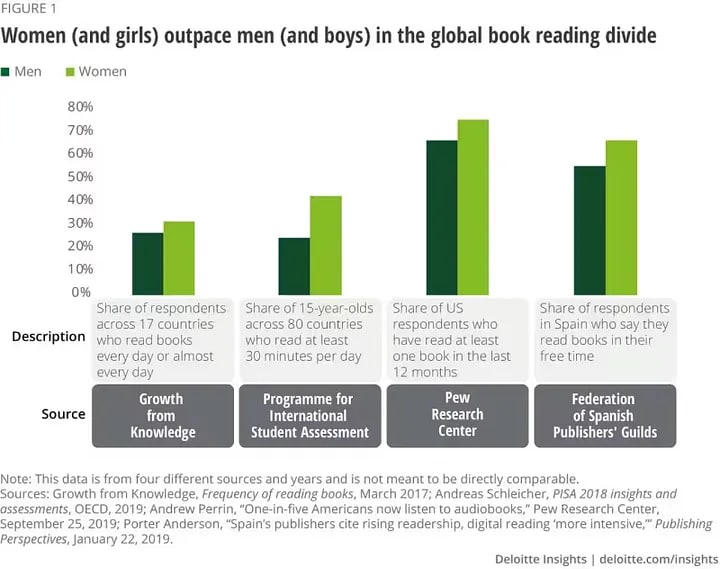
The first question to ask isn’t why men don’t understand women’s books — it’s why they don’t even try to. Women are generally more avid readers than men. According to a 2024 report by the Pew Research Center, 32% of American men reported not having read a book in the past year, compared to only 22% of American women. This trend is consistent worldwide, despite the fact that women globally are more likely to be illiterate than men.
In the UK, US, and Canada, women account for 80% of the book-buying market and 65% of all fiction purchases in the UK (according to Nielsen BookData). A Nielsen Book Research study found that the readership of the ten bestselling male authors was roughly evenly divided between genders (55% male readers, 45% female readers). In stark contrast, only 19% of readers of the ten bestselling female authors were male, compared to 81% female.
This points to a troubling trend: men aren’t just reading less, they are reading fewer books written by or about women. I don’t need to explain to anyone why reading is valuable, but it’s essential to understand how the lack of engagement with women’s voices contributes to the gender divide.
Why Don’t They Read — And Why Don’t They Read Fiction?
The question now is: why don’t men read, especially fiction? There are several reasons for this. Reading habits are formed early in life, and studies show that fathers are less likely to read themselves, meaning children are less exposed to male reading role models. Fathers are also less likely to read to their sons compared to daughters. This lack of male reading role models in childhood has lasting effects, as men and teenage boys are more likely to choose other forms of entertainment, like gaming, over reading.
There is also an underlying cultural belief that reading is a “female hobby,” especially since most bestsellers among female readers are in the romance genre. Studies indicate that around 82% of romance readers are women. Men between the ages of 18 and 34 feel the most pressure to conform to stereotypically masculine behaviours, and so, reading is often associated with femininity. When men do pick up books, it’s often those written by other men — self-help books on how to get rich, manipulate women, or “improve” themselves, often authored by individuals whose wealth and success are questionable.
Realistically, if a man wants to understand women or attract them, he would probably benefit from reading books written by women rather than relying on these “self-improvement” books. But why do so many men avoid books with female protagonists or written by women in general?
The “Romance” Problem
One argument that’s often made is that male readers avoid books by women because they assume female authors only write romance. While it’s difficult to pinpoint an exact percentage, the Romance Writers of America estimate that fewer than 20% of romance novels are written by men. The romance genre has traditionally been targeted towards women, and it represents what’s known as “the female gaze” — a perspective that appeals to a woman’s idea of romance.
Over the past decade, however, the genre has grown exponentially. Books like Fifty Shades of Grey (which portrays a naïve virgin college girl meeting a billionaire who practices BDSM) have introduced mainstream audiences to themes of romance, power dynamics, and sexuality. Unfortunately, the portrayal of BDSM in Fifty Shades is often considered a misinformed and problematic depiction.
What’s more interesting is the shift in how romance is now portrayed in fiction. The female protagonist is no longer depicted as weak or passive. She’s loud, powerful, and complex. Smutty romance is being replaced by more nuanced, “behind closed doors” themes, and younger readers, especially Gen Z, are gravitating toward these more sophisticated representations of romance.
Young women are also looking for more diversity and inclusivity in their reading. A Booktok favourite like Normal People by Sally Rooney — which touches on men’s mental health, self-identity, social status, and young love — have become incredibly popular, especially among young women. These books offer a window into their own lives, providing them with guidance, solidarity, and a sense of connection.
Do Men Simply Not Want to Understand Women?
So why is it that men avoid literature written by women? Do they simply not want to understand the female point of view? Or is there something about the female perspective that they feel disconnected from?
According to Washington Post columnist Monica Hesse, many men actively avoid watching the 2019 film adaptation of Little Women because they fear being the only man in the cinema. She shares that numerous men have sent her emails expressing nervousness about attending the film without a female chaperone. It seems there’s a sense that a man’s presence in a predominantly female space is somehow strange, even though the themes of the story — sisterhood, personal growth, family — are universally human.
New York Times critic Janet Maslin commented “the Little Women problem with men is very real.” Maslin tweeted: “I don’t say that lightly and am very alarmed. In the past day have been told by 3 male friends who usually trust me that they either refuse to see it or probably won’t have time.”
But this issue isn’t confined to Little Women or Pride and Prejudice. It’s part of a larger cultural pattern where men avoid works by women, even when these books explore universal themes. Works like Frankenstein by Mary Shelley, The Bell Jar by Sylvia Plath, or The Handmaid’s Tale by Margaret Atwood all tackle important societal issues, yet they’re often disregarded by male readers, simply because they’re written by women.
Final Thoughts: It’s Time to Break the Stereotypes
What’s my point here? Men need to push themselves outside of outdated stereotypes and expand their understanding by engaging with books written by women — or, at the very least, books about women. This is not just a recommendation; it’s a challenge to broaden perspectives both as readers and as individuals.
And, here’s the thing — women love it when men read. A perfect example of this is the Instagram account @hotdudesreading, which has garnered over 1.1 million followers. It’s clear that there’s something appealing about a man who engages with literature, especially when that includes books written by women.
So, yes — men should be reading books by women. Not just for appearances, but for personal growth, understanding, and to break free from outdated gender norms. If you really want to understand women — or just become a more well-rounded human — reading books by female authors is a great place to start.
Links to evidence and further info: https://geediting.com/world-reading-habits-2020/ https://www2.deloitte.com/us/en/insights/industry/technology/technology-media-and-telecom-predictions/2022/gender-gap-in-reading.html https://www.dazeddigital.com/life-culture/article/63149/1/why-dont-straight-men-read-novels-fiction-masculinity-influencers-sigma https://thred.com/newsletters/gen-zers-are-causing-a-boom-in-romance/ https://www.theguardian.com/commentisfree/2020/jan/04/lit
About the Creator
Sasha Harding
I’m Sasha Harding, an 18-year-old author from Shropshire, UK. I write pieces inspired by personal experience and sharp cultural observation. As a relentless female reviewer, I deliver no-nonsense takes on books, films, and literature. .
Keep reading
More stories from Sasha Harding and writers in Critique and other communities.
Beauty and Brains: A Rare Ideal or a Misunderstood Reality?
This ideal, as elusive as a four-leaf clover, has fascinated and divided society for decades. It is often said you’ve “won the genetic lottery” if you have both, a concept rooted in a casual remark that society seems to have embraced: conventionally beautiful people are presumed less intelligent, while those with high IQs are not typically deemed attractive. For those who embody both traits, this stereotype can feel deeply offensive. Imagine being told, “You’re so beautiful — I didn’t expect you to be intelligent.” A backhanded compliment, if ever there was one.
By Sasha Harding9 months ago in Critique
Standing While Falling
Quotation from Friedrich Nietzsche "He who wrestles long with monsters should beware lest he himself become a monster. And if you gaze long into an abyss, the abyss also gazes into you. Man is not destroyed by suffering, but by the meaning he makes of it."
By LUCCIAN LAYTH13 days ago in Critique
The African Diaspora and History of Rhetoric: Learning to Learn
When studying the history of rhetoric, many groups were excluded from participating in power and were used, abused, and written off as inferior. Even today African nations have not recovered from being exploited by European powers.
By WILD WAYNE : The Dragon King5 days ago in Critique



Comments
There are no comments for this story
Be the first to respond and start the conversation.