
The "Trauma Plot": Have We Over-Therapized Our Stories?
The Line Between Depth and Diagnosis

THE "TRAUMA PLOT": HAVE WE OVER-THERAPIZED OUR STORIES?
WRITTEN BY: LEGANCY WORDS
I love a good character arc. I love seeing someone overcome their past, face their demons, and emerge stronger. But lately, I’ve noticed a pattern—one that’s become so common it’s almost a requirement for any story wanting to be taken seriously.
I call it the Trauma Plot.
It works like this: a character acts a certain way—maybe they’re closed off, or angry, or afraid of commitment. For seasons or chapters, we wonder why. Then, the big reveal: a flashback. A childhood accident. A tragic loss. A single, devastating event that explains everything. Ah-ha! the audience says. That’s why they are the way they are.
Shows like This Is Us built an entire empire on this structure. Every episode is a beautifully crafted puzzle piece linking present-day anxiety to past pain. Ted Lasso’s charming optimism is later explained by a deeply traumatic childhood event. It’s everywhere.
At first, this felt revolutionary. Finally, stories were taking mental health seriously! They were validating real pain and showing that behavior has roots. It felt empathetic and important.
But now, I’m starting to wonder. Have we traded complexity for a diagnosis?
There’s a difference between a character having trauma and a character being explained by trauma. One is human; the other is a plot device.
When every single action, quirk, and life choice is traced back to one event, it starts to feel less like real life and more like lazy writing. It’s a shortcut to depth. Instead of crafting a complex person with contradictions, quirks, and motivations that can’t be neatly labeled, writers just plug in a “Traumatic Backstory™” and call it a day.
It reduces people to puzzles to be solved. The complexity of a human being—shaped by countless small moments, books they’ve read, friendships they’ve had, random choices they’ve made—is flattened into a simple equation: Event X = Personality Y.
It also creates a strange hierarchy of pain. It subtly suggests that only those with a capital-T Trauma are worthy of a story, or that their pain is more valid or interesting. What about the person who is just… melancholic? Anxious for no clear reason? Joyful despite a difficult past? Humans are messy and contradictory. We don’t always come with a neat, flashback-ready reason for why we are the way we are.
This trend mirrors our real-world shift. Therapy language has gone mainstream, and for the most part, that’s a good thing. But we’ve started applying a clinical lens to every aspect of life. Someone who is tidy is “so OCD.” A person who needs time alone “has attachment issues.” We’re turning normal human idiosyncrasies into symptoms.
Stories have always held a mirror up to society. The danger of the Trauma Plot isn’t that it discusses trauma—it’s that it risks simplifying the vast, weird, and wonderful spectrum of human experience into a single, overused narrative.
I miss the characters who are just… people. People who are grumpy because they’re tired, or brave because they choose to be, or lonely because they haven’t found their tribe yet—not because of a single, defining, tragic event from chapter one.
This isn’t to say trauma doesn’t shape us. It profoundly does. But it is not the only thing that shapes us. By making it the universal key to every character’s soul, we haven’t expanded storytelling.
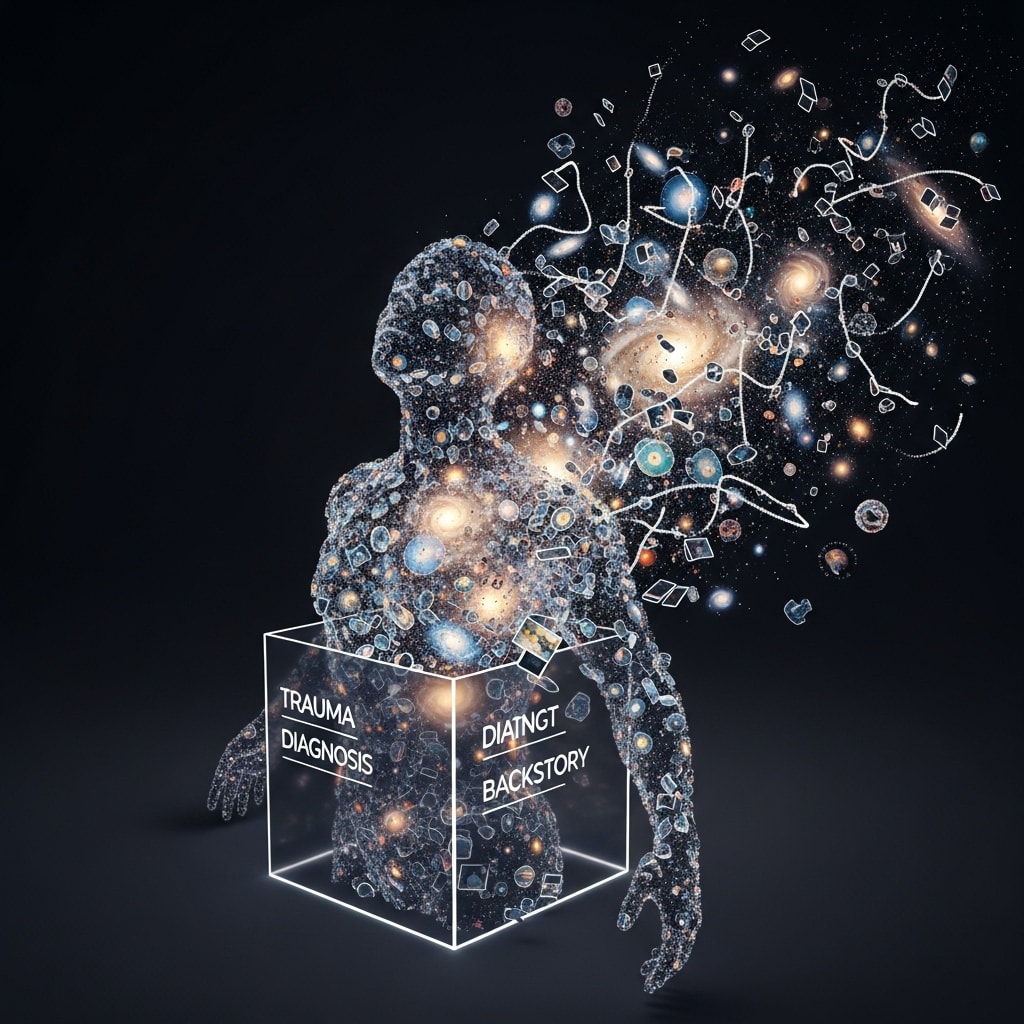
We’ve put it in a box. And the most interesting stories, like the most interesting people, can’t be contained.
I think of the characters who have stayed with me for years. They weren’t case studies. They were mysteries.
There’s a famous author who once said his greatest character was born from a simple image: a woman he saw from a train window, standing on a platform, grasping the hand of a child he knew was not her own. He never learned her story. He simply invented one, filled with choices and contradictions that could never be explained by a single event. She was kind because she chose to be. She was secretive because some hearts just are.
That’s the magic we’re losing.
The trauma plot doesn’t just simplify characters; it steals our curiosity. It replaces wonder with a diagnosis. Instead of asking, “I wonder why she did that?” we now wait for the episode where the childhood flashback explains it all. The mystery of human motivation is solved with a trigger warning.
But life isn’t that neat. We are not equations.
We are shaped by the forgotten Saturday afternoon, the song that was playing on the radio during a first kiss, the strange novel we found in a waiting room that changed how we saw the world. We are built from tiny, insignificant moments of joy and boredom and connection that leave no dramatic scar, but slowly, quietly, sculpt our souls.
This isn’t a call to abandon stories about pain. It’s a plea to stop letting pain be the only story.
Let’s have characters who are resilient for no reason. Let’s have heroes who are brave simply because it is the right thing to do. Let’s have villains who are cruel not because they were hurt, but because they choose to be. Let’s have people who are messy, inconsistent, and wonderfully unexplained.
Let’s break the box open. Let’s allow our stories—and the people within them—to be gloriously, unpredictably, and magnificently free. For in that uncharted territory, beyond the easy answer and the convenient flashback, is where we find not just truth, but wonder. And isn’t that why we started listening to stories in the first place?
About the Creator
LegacyWords
"Words have a Legancy all their own—I'm here to capture that flow. As a writer, I explore the melody of language, weaving stories, poetry, and insights that resonate. Join me as we discover the beats of life, one word at a time.
Keep reading
More stories from LegacyWords and writers in Critique and other communities.
The "Anti-Hustle" Culture: Are We Glorifying Laziness or Finally Living?
TITLE: THE "ANTI-HUSTLE" CULTURE: ARE WE GLORIFYING LAZINESS OR FINALLY LIVING? WRITTEN BY: LEGANCY WORDS My burnout didn’t arrive with a dramatic crash. It seeped in slowly, like cold through a window pane. For years, I wore my exhaustion like a badge of honor. “Rise and grind,” my phone lock screen cheered me on at 5 a.m. “Hustle harder,” I’d whisper, cancelling another dinner with friends to get ahead on a project.
By LegacyWords6 months ago in Critique
Cassie and Johnny
I’m the kind of dame you notice. I’m no femme fatale, but you can’t ignore me, at least not until I warn you about what’s coming, then everybody ignores me. Hell, they usually blame me afterwards and give Johnny all the credit for saving the day, but my Johnny couldn’t save a seat at the movies without my help. Sure, he’s brawny, but brainy? Not so much. Like that time I asked him to spot me five bucks, and he said he didn’t see it anywhere on me, and believe you me, he looked but good.
By Harper Lewis6 days ago in Critique
‘We have enough’: Godfrey renews call for Black entertainers to stop seeking white validation after BAFTAs, praises Image Awards
DEI must die. It’s been far too long for Foundational Black Americans (FBA) and tethers to come up and say things like #OscarsSoWhite. So what? NAACP Image awards are about RAH, Representation, Agency, and Honor. Black people have to stop crying about their snubs at award shows that often overlook them.
By Skyler Saundersabout 4 hours ago in Critique



Comments
There are no comments for this story
Be the first to respond and start the conversation.