
The Mirror That Lied
A Story About Self-Image, Growth, and the Voices That Shape Us
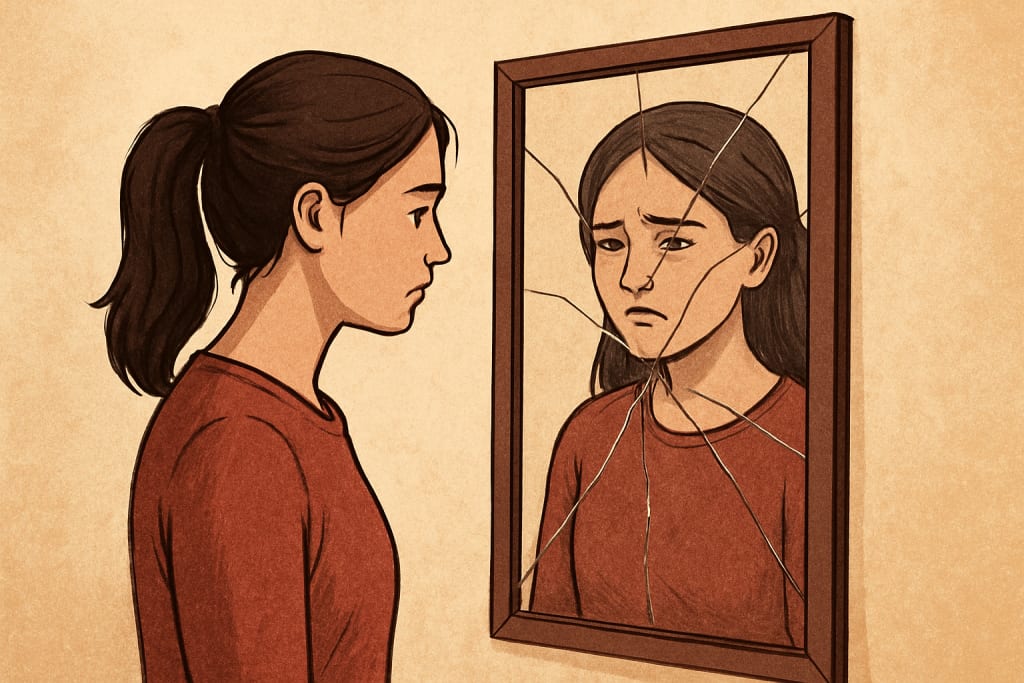
I used to believe mirrors told the truth.
That whatever reflection stared back at me was the unchangeable reality of who I was.
But over time, I learned that mirrors are liars. They reflect only surfaces, never the storm underneath. And worse, they amplify the whispers of insecurity that we already carry.
Chapter One: The First Crack in the Glass
I was thirteen the first time I started to question myself. Standing in front of the mirror, I didn’t see a child anymore. My face was changing, my body was shifting, and suddenly, comparison became my daily ritual.
In school, friends teased each other about weight, clothes, and who had the “right look.” I laughed with them, pretending their words didn’t sting. But at night, in front of the mirror, their voices echoed louder than my own.
The glass didn’t show me *me*. It showed me what I feared everyone else saw.
Chapter Two: The Silent Audience
Criticism is a strange thing. When spoken, it echoes for hours. When silent, it carves deeper.
I became my own critic.
No teacher, no peer, no family member needed to say a word. I carried an invisible audience in my head, always ready with disapproving claps.
“Not smart enough.”
“Not pretty enough.”
“Not strong enough.”
I thought critique was supposed to help you grow. But when it never stops, it doesn’t grow you — it cages you.
Chapter Three: The Day I Looked Away
It wasn’t until university that I discovered the power of looking away. One morning, while rushing to class, I skipped my usual stop in front of the mirror. I didn’t have time to judge myself.
That day, I laughed louder. I spoke up in class. I even joined a group of students for coffee. And only when I returned home did I realize — the absence of my ritual critique had freed me.
Sometimes the most radical thing you can do is refuse to look.
Chapter Four: Learning to Critique Differently
Years later, I still face the mirror. But now, I critique differently.
Instead of asking, *“Do I look good enough?”* I ask, *“Am I being kind to myself today?”*
Instead of comparing, I try to notice — the tired eyes that need rest, the curve of a smile that wasn’t there yesterday, the evidence of living that can’t be measured in perfection.
True critique, I’ve learned, isn’t about tearing apart. It’s about pointing toward growth.
A teacher once told me, *“The best critique isn’t about what’s wrong. It’s about what’s possible.”*
That stuck with me.
Chapter Five: The Mirror Today
The mirror still lies, sometimes. But I don’t always believe it.
On good days, I see someone who fought battles no one else could see. On bad days, I see the old cracks of insecurity trying to resurface. But now, I remind myself:
I am not a reflection. I am a story.
And stories are not defined by a single page, a single chapter, or a single cruel critique.
They are defined by the courage to keep writing.
Closing Reflection
We all live with critics — in our mirrors, in our minds, in the voices of others. But the question is:
Do we let critique chain us, or do we let it guide us toward something better?
The next time you face your own mirror — whether it’s glass, or people’s opinions, or your own inner voice — ask yourself:
Is this critique helping me grow, or is it holding me back?
Because you deserve more than the lie of a reflection. You deserve the truth of becoming.
About the Creator
Keep reading
More stories from noor ul amin and writers in Critique and other communities.
How to Automate Boring Tasks with Python
Look, I'm going to be honest with you. I used to spend entire afternoons renaming files. Hundreds of them. One by one. Click, type, enter. Click, type, enter. My back hurt, my eyes were tired, and I felt like I was slowly losing my mind.
By noor ul amin5 months ago in Lifehack
Standing While Falling
Quotation from Friedrich Nietzsche "He who wrestles long with monsters should beware lest he himself become a monster. And if you gaze long into an abyss, the abyss also gazes into you. Man is not destroyed by suffering, but by the meaning he makes of it."
By LUCCIAN LAYTH5 days ago in Critique
Words of Radiance
Words of Radiance by Brandon Sanderson And so we come to the yearly ovation for Mr. Sanderson. The man is a genius, his lecture series is one of the most important resources ever developed for writers, and I’m yet to pick up a Sando that’s scored below a 70. I have critiques that we’ll come to, but suffice to say I am a big supporter of Sanderson.
By Matthew J. Fromm7 days ago in Critique


Comments
There are no comments for this story
Be the first to respond and start the conversation.