
Review: 12 years a slave
Not for the tender and very delicate among you

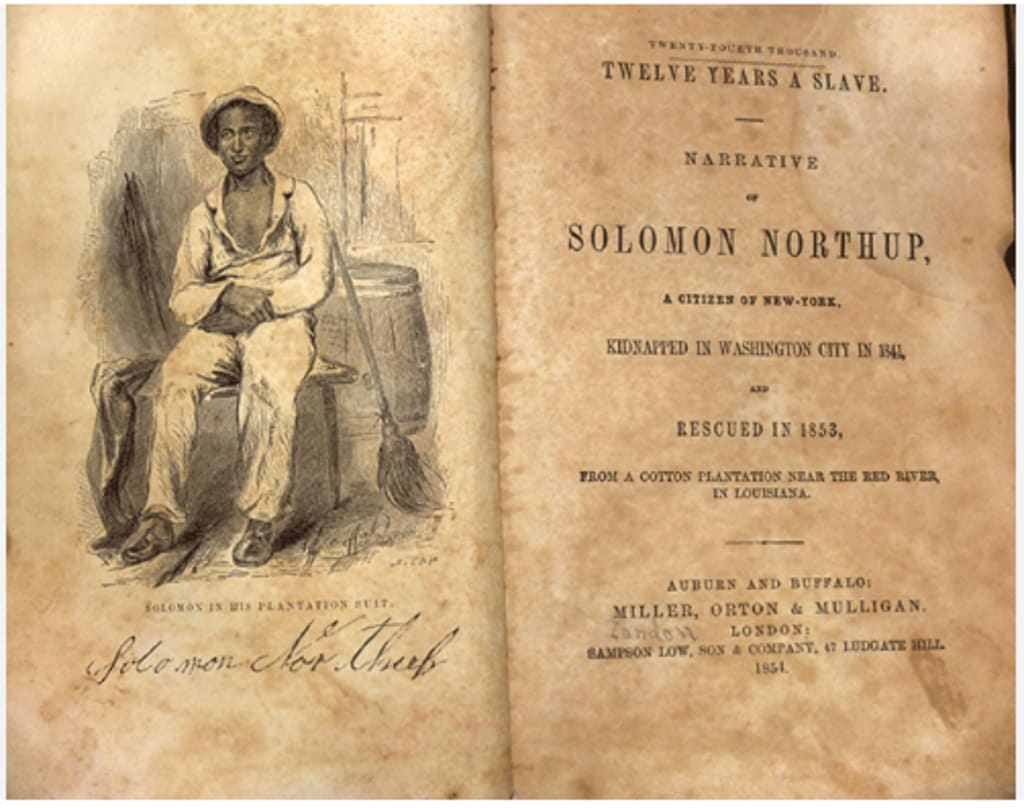
What a great premise for a story. “12 Years a Slave,” along with “The Travels of Dean Mahomet,” “Equianos Travels” and other slave memoirs of the late eighteenth and nineteenth century reached a high degree of popularity.
Today they are relegated to university reading lists in history colloquiums on slavery, colonialism, or in some aspect of minority studies where you would need to read self-portraits like this.
Because of their popularity, publishers of the time sought out these stories. Consequently there are a number of them out there but their authenticity remains suspect. Not so with “12 Years a Slave.”
A true story, corroborated by two PhD candidates in the 1960s concluded that the memoir was genuine. Even now stories like these still hold emotional and political meaning for us here in the 21st century. The reasons for this are the following.
Black people have always had it rough in this country as they so often like to remind all the rest of us. Their story is unique in that most did not come here out of a desire or need for a better life.
Since they were forced under unusually arduous circumstances to serve as slaves for hundreds of years, there is a feeling in the black community that they have not received their rightful slice of the American dream.
Of course, how you came to be American is not really relevant on what you do once you are here—as long as you are free.
For over 150 years since the end of American slavery they have had the opportunity to rectify that situation, and have failed to do so.
In the 20th century, other immigrant groups have continued to pass them by increasing their resentment, blaming racism, and not looking within their own community for answers.
While others have found their places in American society, Asians, Indians, Jews and others who have done much better than the African Americans, these groups have become targets of black activists along with the white community who many in the black community blame for their failure.
Is historical slavery the problem? Do they have a point? I don’t know, you decide. This review is not the place for that discussion.
But, as emotionally stirring as a real American drama “12 years a Slave” is, it unfortunately does not carry over to the film. There are major problems with it.
The story about a free black man living in Saratoga Springs, New York, is high jacked and taken surreptitiously back down south for sale on the slave market.
“12 years’” original narrative written by Soloman Northrop, the subject of the story, was brought to the screen in 2013 by a number of producers who included Brad Pitt and Steve McQueen, (The African American, not the white guy who played “Bullitt.” He died back in the ‘80s of cancer.) McQueen also directed which might explain the film’s failure to translate from the memoir to the screen.
The movie stars Chiwetel Ejiofor supported by Michael Fassbinder, Lupita Nyong’o, and Brad Pitt. Currently it can’t be seen on the small screen for free, but you can rent it from Amazon or buy it on DVD.
Ejiofor is an excellent actor but was only mediocre in this film. You would expect someone with his talent to be able to run away with a role like that. But, it didn’t happen. He seemed to walk through his scenes, say his lines and go home.
Lupita Nyongo’s over the top performance at McQueen’s direction was simply embarrassing. Every time she screamed and cried it was like running your fingernails on a blackboard.
Another ten minutes of that I would have puked right there in my living room. Fassbinder’s portrayal of Edwin Epps the slave owner made me laugh rather than anger at his cruelty.
He should have been an ugly figure radiating hate from the audience instead he came off like a comic book caricature of something evil, like a super hero villain. It was hard to watch.
Nevertheless, the film was recognized by the industry as being the best movie of that year. Being that the Academy is filled with bleeding hearts one has to believe that their motives for giving the film its most coveted awards, best picture, best director, best actor, and best supporting performance from an actress for Nyongo had to have been based on the memoir itself and not the film.
Maybe those cowards in Hollywood were afraid of the bullying and intimidation by American black activists if they did not recognize the achievement.
One only has to look at Will and Jada Pinket Smith’s campaign this past year to condemn the awards for not nominating any black artists for 2015, to understand the pressure and coercion from the black community and the academy’s reaction to their allegations. Perhaps in the future we will be giving Academy Awards based on affirmative action rather than merit.
Ejiofor has done a half dozen roles where he could have competed for best actor and won. I have always enjoyed his work until this film. Njongo has since done TV and some other work where her acting reached an excellence expected of professional actors.
And, Fassbinder has a long list of credits much more worthy than his work in this film. So I have to believe that “12 years’” failure was mostly due to McQueen’s direction.
An American drama about one of the more disgraceful parts of our history, McQueen did more than just give us a bad film. He had a chance to really set a high mark for films in Hollywood with this work and just failed on every level.
In addition he did not maintain the integrity and grant the reverence for the memoir that provided the world with this history. Rather, he tended to veer off of the actual narrative and built a fictitious story around it for “effect.” like the opening scene where Northrop is having sex with a woman who is not his wife.
The real Northrop probably would have been outraged that his image was used in such a manner to be unfaithful to his wife. I would submit there is no need to embellish a true story about the brutality of American slavery. Northrop’s memoir was quite clear on the viciousness and cruelty of his time in captivity.
It’s too bad that McQueen’s work on this film was so poor. I would like to say that this film should be remembered by America the way Germany should remember “Schindler’s List,” but unfortunately the movie so badly damaged the real story that it is just not possible. I would suggest reading the actual memoir for that reason. You just can’t trust Hollywood to get it right.
About the Creator
Larry hart
Older with a full life experience behind me. Grad work in history so you will find a lot of that, War, cultural and geographical. Sometimes I just tell a story. And please comment. I love having my ego massaged.
Keep reading
More stories from Larry hart and writers in Critique and other communities.
Cassie and Johnny
I’m the kind of dame you notice. I’m no femme fatale, but you can’t ignore me, at least not until I warn you about what’s coming, then everybody ignores me. Hell, they usually blame me afterwards and give Johnny all the credit for saving the day, but my Johnny couldn’t save a seat at the movies without my help. Sure, he’s brawny, but brainy? Not so much. Like that time I asked him to spot me five bucks, and he said he didn’t see it anywhere on me, and believe you me, he looked but good.
By Harper Lewis4 days ago in Critique
$5 CHICKEN EXPOSED Creepy AI Video Goes Viral Claiming To Reveal How Costco And Other Stores Keep Their Chicken At $5!
At least in some videos, you know that it is obviously AI. In this clip, a chicken explains the difference between “real” chicken and “modified” chicken. The grotesque figure with bulbous eyes, bruised skin, and decaying teeth walks down a processing plant lane to show the chickens that can be found at your neighborhood supermarket. The ones that are encased in plastic and ready to eat, this chicken claims is full of “GMOs.” Let’s stop right there; genetically modified organisms have been part of the diet for centuries starting chiefly with American Indians who used the process of altering the genes to produce more corn.
By Skyler Saunders5 days ago in Critique
Review of 'Man on the Run'
My wife and I saw Man on the Run, a nearly 2-hour documentary on Amazon Prime, about Wings, Paul McCartney's group that flew around the world from shortly after The Beatles broke up in early 1970 to shortly after John Lennon was murdered at the end of 1980, making a Beatles reunion forever impossible.
By Paul Levinson2 days ago in Beat




Comments
There are no comments for this story
Be the first to respond and start the conversation.