
Retro, Risqué, and Remarkably Relevant: Netflix’s "Aema" Makes History Sizzle
Netflix’s Aema revisits 1980s Korea through scandal, stardom, and feminist defiance, more than a remake, it’s a bold reimagining of a Korean Icon: Madame Aema.


Netflix threw us a curveball this summer. On August 22, 2025, the streamer dropped a gem... a historical comedy-drama rooted in one of Korea’s most controversial pop-culture relics: Madame Aema. For the uninitiated, Madame Aema was a wildly popular and scandalous series of erotic films that exploded in 1980s Korea, sparking debates on censorship, morality, and who gets to control women’s stories.
Aema isn’t a remake so much as a reimagining. It takes us inside the 1980s at the height of the franchise’s notoriety, where ambition and desire collided. But instead of gawking, this Netflix drama dares to ask: What did it cost the women who became the face of that phenomenon? And more importantly, what does that cost still teach us today?
Lights, Camera, Male Gaze
The series opens on Jung Hui-ran (played with sharp charisma by Lee Hanee), a megastar of her era who’s just starting to feel the spotlight dim. Enter Shin Joo-ae (newcomer Bang Hyo-rin), a nightclub dancer plucked into stardom overnight.
The industry positions them as rivals, but the real antagonist isn’t each other; it’s the machine that thrives on women being replaceable, disposable, and marketable only as long as they remain desirable.
That’s the genius of Aema: it’s not about who gets the part, it’s about who pays the price.
Craft that Cracks and Sparkles
- Writing & Dialogue: The script doesn’t tiptoe. Lines like, “Real actresses sweat; stars sparkle” stick because they’re funny and cutting all at once. At times, though, the script’s barbs feel so self-aware they risk breaking immersion. It’s a reminder that the industry never cared about the sweat. It only cared about the shine.
- Direction & Cinematography: Director Lee Hae-young knows how to stage excess. Neon-lit 1980s Seoul clashes with smoky club grit. Camera close-ups linger on Hui-ran’s fear, on Joo-ae’s trembling ambition, forcing us to see the humanity blurred by patriarchal cinema.
- Performances: Lee Hanee is a revelation. She embodies teal-suited confidence, but her vulnerability sneaks out in cracked smiles and half-held tears. Bang Hyo-rin, by contrast, is a whirlwind, messy, raw, and magnetic. Together, they ignite every shared scene.
- Editing & Score: Cuts between fake teaser reels and rehearsal breakdowns feel like cultural whiplash. The synth-laced soundtrack, equal parts kitsch and cool, winks at the '80s while keeping us emotionally hooked.
Feminist Heat Beneath the Glam
Where Aema truly flexes is in its feminist undercurrent. This isn’t nostalgia for sleaze; it’s reclamation. The show insists that women’s sexuality onscreen is not shameful, nor is it only valuable when dictated by men. By centering Hui-ran and Joo-ae’s perspectives, Aema reframes “scandal” as a story of self-determination.
In one mid-season scene, Hui-ran voices a brutal truth: women are celebrated only until they’re no longer “marketable,” then swiftly replaced. Joo-ae’s response isn’t resignation but defiance; it's a refusal to shrink under that inevitability.
It’s a back-and-forth that distills the show’s message: visibility can be both a burden and a weapon. It’s a moment that feels as modern as it does retro resistance dressed in sequins.
Verdict
By its final episode, Aema leaves you buzzing. It has the historical bite of Mad Men, the female solidarity of Bombshell, and the unapologetic sass of a retro mixtape. Yes, some mid-season pacing sags under melodrama, but it’s a small price for a drama this daring.
It’s a mandatory binge if you believe women’s stories deserve more than the objectifying spotlight and if you like your commentary served with a side of neon.
Netflix didn’t just revive a relic; it retooled it into something resonant. Aema is proof that the past isn’t dusty; it’s a mirror, a lens for what we still need to fight for.
And if you dare to look closely, you’ll see how much of today is still reflected there, every glittering high, every crushing low, every reminder that progress is never linear but always worth the struggle.
You may also like review about: Night Always Comes, My Oxford Year, The Handmaid’s Tale, Workin’ Moms, and 5 must-watch K-Dramas.
More Reviews HERE & Trailer Below!
About the Creator
Sara Yahia
Sara Yahia writes fearless takes on film, TV, and the HR truths no one dares to say. More Here: Website | HR Insight | All Film & TV Reviews | Romance
Keep reading
More stories from Sara Yahia and writers in Critique and other communities.
The Shaped Self: Images Without History
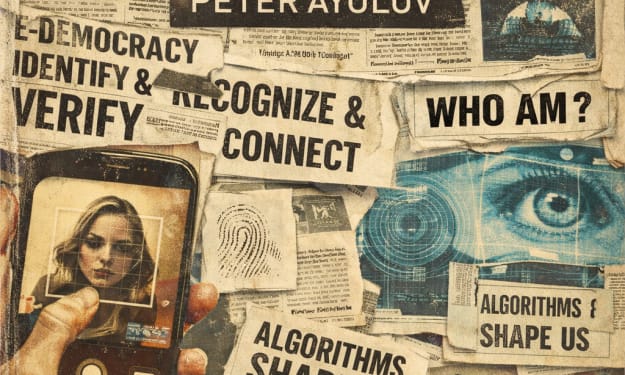
The Shaped Self: Images Without History Peter Ayolov, Sofia University “St. Kliment Ohridski”, 2026 Abstract E-democracy is not a technical upgrade of representative government. It is a transformation of citizenship inside a regime of visual formatting. Drawing on Žarko Paić’s analysis of video-centrism and the world-picture, this article argues that contemporary political life unfolds in an environment where images no longer reflect history but organise reality in advance. In this condition, the citizen does not merely participate; the citizen appears through an interface. Political agency becomes inseparable from visibility, recognisability, and circulation. By placing Paić in dialogue with Marcel Duchamp, Jean Baudrillard, Tom Wolfe, and Jean-Luc Nancy, the article develops the concept of the shaped self as the central figure of e-democracy: an interface-formed subject structured by edges, templates, and repeatable visual patterns that enable identification but risk reducing agency to performance. The struggle for democracy becomes a struggle over representation itself: over ownership of likeness, transparency of distribution systems, and the capacity to distinguish voice from simulation in an environment saturated with images, metrics, and deepfakes. As the concluding work of the Mirror Selves Trilogy, this article presents the book The Shapes of the Self: Identity and Recognition in Visual Space (2026) that investigates how the self emerges not as an inner essence but as a shaped and formatted presence within contemporary visual space.
By Peter Ayolova day ago in Critique



Comments
There are no comments for this story
Be the first to respond and start the conversation.