

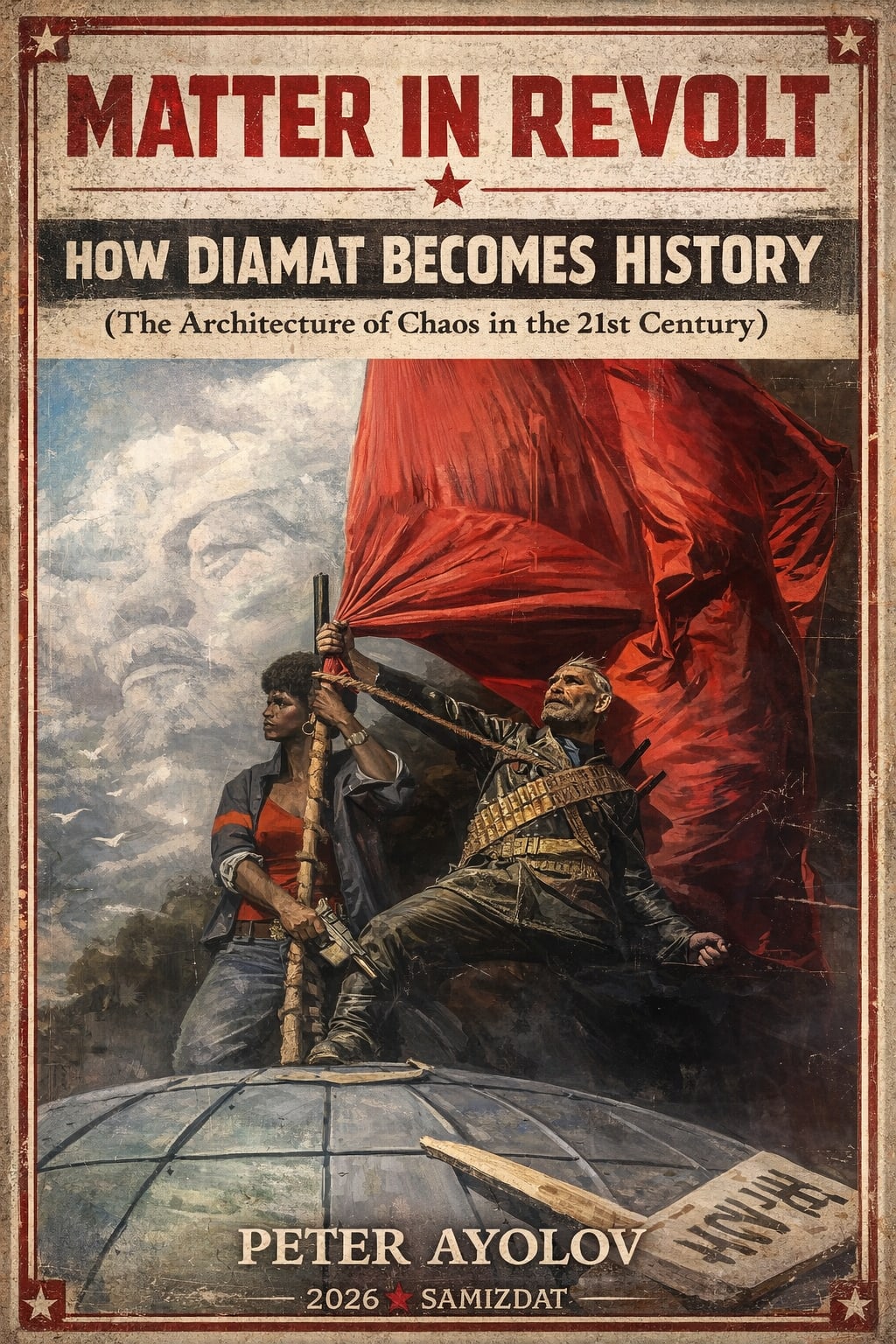
Matter in Revolt: How Diamat Becomes History
(The Architecture of Chaos in the 21st Century)
The twenty-first century does not suffer from chaos; it suffers from misunderstood structure. Climate breakdown, algorithmic governance, financial volatility, pandemics, digital feudalism—these are not isolated crises. They are converging contradictions. What appears fragmented is in fact systemic. What appears accidental is material. To read this moment properly, one requires a method that does not panic before complexity. That method is Diamat.
Diamat is the abbreviated form of Dialectical Materialism, the philosophical framework developed within the Marxist tradition to describe reality as matter in motion through contradiction. It holds that material conditions generate historical development, and that change occurs through internal tensions that eventually produce qualitative transformation.
This is not a slogan. It is an ontological claim. Matter moves. Matter collides with itself. Matter reorganises itself. History is not written by ideas floating above reality but by the structural tensions embedded within material life. The twenty-first century is not chaotic because human beings are confused; it is chaotic because the material foundations of the previous world order are destabilising.
Diamat begins with a simple assertion: matter is primary. Consciousness, law, morality, culture—these are not independent realms. They emerge from material conditions. This does not reduce human agency; it grounds it. The human mind is not a ghost hovering above substance. It is organised matter capable of reflection. Society is not an abstract contract. It is a network of bodies, infrastructures, resources, and production systems arranged in historically specific ways.
When those arrangements reach internal limits, they fracture.
The first classical principle of Diamat—the unity and struggle of opposites—describes this fracture. Every system contains tensions within itself. Capitalism contains capital and labour. The digital economy contains information abundance and material scarcity. Globalisation contains integration and fragmentation. These opposites do not coexist peacefully; they generate motion. The system advances through conflict.
The second principle—the transformation of quantity into quality—becomes visible in our century everywhere. Carbon accumulates incrementally for decades; then ecological systems cross thresholds. Data accumulates silently; then artificial intelligence shifts from tool to infrastructure. Debt accumulates; then currency regimes collapse. The leap appears sudden, but it was prepared quantitatively over time. Boiling water does not warn you at 99 degrees; it transforms at 100.
The third principle—negation of negation—suggests that development is not circular but spiral. Each stage overcomes the previous one while preserving elements of it. Feudalism becomes capitalism; capitalism generates forces that challenge its own foundations. The old order is negated, but its technical capacities remain within the new. Revolt does not erase matter; it reorganises it.
This is where the twenty-first century becomes legible. The apparent chaos of our time is not moral decline or civilisational fatigue. It is structural transition. The industrial order assumed endless growth powered by fossil energy. That material base is destabilising the biosphere. The digital order promised immaterial abundance, yet rests on rare earth minerals, lithium extraction, undersea fibre-optic cables, server farms consuming rivers of electricity. The cloud is not weightless; it is geological.
Digital capitalism reveals the paradox of modern materialism. We imagine ourselves in a post-material world of information flows, yet the infrastructure supporting those flows intensifies extraction. The smartphone contains metals mined under extreme labour conditions. The data centre consumes water and electricity at industrial scale. The algorithm is powered by coal, gas, hydroelectric dams.
Matter is not disappearing. It is overheating.
When ecological systems destabilise, when supply chains fracture, when energy grids strain, matter expresses limits. This is not mystical revenge. It is structural contradiction. An economic model built on infinite expansion collides with finite ecosystems. The collision is the revolt.
Diamat does not romanticise collapse. It describes necessity. When contradictions intensify beyond the capacity of institutions to absorb them, qualitative change follows. Political systems harden or shatter. States reconfigure. New alignments emerge. This is not ideology; it is pattern.
The term Diamat became controversial because of its association with Soviet orthodoxy. Under Stalin, it was codified as official doctrine. It became mandatory reading, rigid pedagogy, state worldview. Critics argued that this rigidity suffocated philosophical creativity. Yet to dismiss Diamat entirely because of its bureaucratic crystallisation is to confuse application with principle. A method can be misused without becoming false.
The deeper question is whether Diamat remains relevant in the age of AI, climate crisis, and digital imperialism. The answer lies in whether matter still determines history. Does infrastructure shape politics? Do production systems shape consciousness? Do material constraints shape possibility? The evidence suggests yes.
Artificial intelligence is often described as immaterial intelligence detached from physical limitation. Yet large language models require vast computational hardware, energy consumption, cooling systems, mineral supply chains. AI is not a ghost; it is organised silicon. The algorithm reflects the material conditions that produce it. Its biases, capabilities, and limits are shaped by training data extracted from human labour and by hardware constrained by physics.
The contradiction between digital abstraction and material dependence intensifies. Data flows freely, but electricity grids do not. Code scales infinitely; cobalt does not. The more the economy digitises, the more it depends on geological realities. The revolt of matter appears when extraction hits limits, when ecological backlash disrupts supply, when geopolitical competition over minerals escalates.
Diamat frames these tensions not as moral tragedies but as structural inevitabilities. When quantitative accumulation—carbon, debt, inequality, data—crosses thresholds, qualitative shifts follow. Revolutions are not emotional explosions; they are phase transitions.
This is why Diamat was historically described not only as philosophy but as a guide to action. It is a compass for navigating contradictions. It asks: where is the tension? What is accumulating? What threshold approaches? It shifts attention from surface spectacle to structural movement.
The twenty-first century’s “architecture of chaos” consists of overlapping contradictions. Ecological breakdown intersects with technological acceleration. Economic precarity intersects with algorithmic control. Political fragmentation intersects with digital surveillance. Each domain intensifies the others.
The revolt of matter is visible in climate migration, in energy crises, in food insecurity. It is visible in the physical exhaustion of labour under platform economies. It is visible in urban infrastructures designed for a previous century failing under new pressures. These are not symbolic events. They are material signals.
Diamat insists that history is not driven by narratives alone. Stories matter, but they do not override physics. Ideology cannot abolish thermodynamics. Markets cannot repeal ecological limits. Consciousness does not precede being; it reflects it.
Yet matter alone does not automatically produce justice. Dialectical Materialism does not guarantee utopia. It describes motion, not morality. The direction of transformation depends on organisation. Contradictions can produce authoritarian consolidation as easily as emancipatory synthesis. The leap is not inherently progressive. It is inherently transformative.
To speak of matter in revolt is not to celebrate destruction. It is to recognise that structures cannot indefinitely contain their own contradictions. The industrial fossil regime cannot indefinitely coexist with a stable climate. The globalised supply chain cannot indefinitely coexist with geopolitical fragmentation. The platform economy cannot indefinitely coexist with social cohesion.
History moves because matter moves.
In this sense, Diamat becomes history not when it is recited in textbooks but when its patterns become visible in lived reality. When quantitative pressure becomes qualitative rupture, when structural tension reorganises institutions, when infrastructure forces political realignment—that is Diamat enacted.
The twenty-first century demands sobriety. The architecture of chaos is not irrational. It is structured instability. To interpret it requires abandoning the illusion that ideas float freely above material conditions. It requires returning to the recognition that society rests on production, energy, labour, and ecological metabolism.
Diamat offers no comfort. It offers orientation. It teaches that contradiction is not failure but engine. That crisis is not anomaly but transition. That revolt is not necessarily moral rebellion but structural reconfiguration.
Matter is not a silent stage. It is the protagonist.
When it revolts, history changes form.
About the Creator
Peter Ayolov
Peter Ayolov’s key contribution to media theory is the development of the "Propaganda 2.0" or the "manufacture of dissent" model, which he details in his 2024 book, The Economic Policy of Online Media: Manufacture of Dissent.
Keep reading
More stories from Peter Ayolov and writers in Critique and other communities.
Just Thinkering
Just Thinkering: Talking about Thinking Philosophy begins with a strange upgrade to ordinary speech. Instead of talking about things, people start talking about the talking itself, then about the thinking behind the talking, then about the words used to name the thinking. This second level of language feels noble, even heroic: reflection, critique, self-awareness, ‘the examined life’. But it also carries a quieter risk. Once speech turns back on itself, it can become a room full of mirrors. The sound continues, yet nothing moves forward. There is talk about words, talk about thinking, talk about talk, and soon the whole performance becomes a kind of verbal tinkling: elegant, repetitive, self-pleasing noise.
By Peter Ayolov3 days ago in Critique
Cassie and Johnny
I’m the kind of dame you notice. I’m no femme fatale, but you can’t ignore me, at least not until I warn you about what’s coming, then everybody ignores me. Hell, they usually blame me afterwards and give Johnny all the credit for saving the day, but my Johnny couldn’t save a seat at the movies without my help. Sure, he’s brawny, but brainy? Not so much. Like that time I asked him to spot me five bucks, and he said he didn’t see it anywhere on me, and believe you me, he looked but good.
By Harper Lewis4 days ago in Critique
WELL DAMN Joe Budden Says He's Happy That J.Cole's Honda Civic Broke Down! "Tired Of The Fake Humble Gimmick"
If pride is the crown of all virtues, humility is the shabby little garbage swirling the gutters of the world. To J Cole, this bit of humble display cost him a hiccough in his roll out to his latest opus. In a nineties edition Honda Civic, he chose to go across the country and show off his modesty as a gimmick to hock his discount CDs.
By Skyler Saunders4 days ago in Critique



Comments
There are no comments for this story
Be the first to respond and start the conversation.