
Managing Your Figure
A visualized shortcut to success

The sign of a successful person is whether they can “manage their figure.”
Everything that is unrestrained will be excessive, and everything that is excessive will manifest itself on a physical level, that said, figure.
1) Your figure is the result of your habits
Your figure is almost a manifestation of your “mental state” because your figure is a result of your long-term habits.
In Atomic Habits, it says, “Your body is a manifestation of your habits. Eat 300 calories more every day, and after a year, you will gain nearly 30 pounds.”
Binge eating, disregarding whether food is clean or easy to digest, and indulging solely in its taste and appearance, while consuming far more than one can metabolize, yet refusing to increase one's “energy expenditure” through exercise or other means, leads to “energy blockage” in the body. The body cannot digest such a large amount of nutrients or filter out the waste, may eventually fail to eliminate it due to insufficient motivation.
This “accumulation” is like a hoarder who doesn't consider the cleanliness size of a room, but simply fills it to the brim. Eventually, cockroaches and maggots thrive, and what's left is a filthy, stinking “shack.”
The body is the “house” of the soul, and it can't endure constant garbage accumulation.
2) Posture reflects one's mindset
Bessel van der Kolk states in *The Body Keeps the Score*: “Trauma alters a person's posture. A hunched posture is an external manifestation of psychological defense, while an upright posture can rebuild a sense of safety.”
I once read a book called *Restoring My True Self*, written by a couple of PhDs, Sai Anci and Wu Zhiqing.
The book states that negative emotions we have experienced in the past, if left unresolved, can accumulate over time and influence a person's posture.
Therefore, the way we look today is a result of the trauma we have experienced.
The book details five personality types resulting from trauma, including how each type manifests in trauma, the lower self, the image self, defense mechanisms, the mask self, and the higher self. It also explains physical characteristics, energy body characteristics, and reveals the lessons of this lifetime.
Therefore, a person with poor posture is one has not addressed the underlying issues in their mindset. It is like a high-performance sports car that has been severely damaged by a tree. You can either continue driving the damaged car or repair it and start anew. However, the condition of the car will influence your mindset, behavior, and even the outcome of your journey.
This is also a form of “emotional accumulation.”
3) The essence of excess is uncontrolled desire
The more you lack, the more you want. The more you have, the more at ease you are.
Kelly McGonigal wrote in “The Willpower Instinct: Why We Do What We Do and How to Change It” that “the essence of managing your figure is managing your desires. People who can delay gratification are more likely to succeed in their careers and interpersonal relationships.”
Your figure is an external manifestation of your “self-management ability,” which in turn affects your psychological state.
In “Scarcity,” it says, “When people are in a state of psychological scarcity (e.g., anxiety, poverty), they focus excessively on short-term gratification (e.g., eating junk food) and neglect long-term health.”
Have you noticed that the less money you have, the hungrier you feel and the more you want to eat? But once you have a large sum of money, you immediately feel refreshed and can go without eating.
I once saw a quote that put it perfectly: “Dear, you're eating food, not love.”
Scarcity amplifies desire, while abundance tames instincts.
When there is a lack, one becomes greedy; when there is abundance, one becomes indifferent.
4) Live as a conduit, not a container
Actually, the body has already told us how to live this life through its operational logic.
The body obtains nutrients through eating, then digests, filters, and excretes them, nourishing the spirit with food and the body with the spirit, in an endless cycle.
It's like a tunnel: cars enter, pass through, and leave.
But if it doesn't “leave,” or if there's too much traffic, congestion occurs, leading to suffocation and death.
Therefore, people should live as a “channel,” not a container.
Don't pour everything into your body. This “channel” has its own operational system. We need to observe and calculate its input and output to ensure the system doesn't malfunction.
However, this “management” is seen by most people as “automatic” and does not require “special attention".
In their eyes, the ‘body’ system is likely unrelated to themselves. It seems as though the body can solve all problems on its own, and all one needs to do is follow the “hedonistic flattery” dictated by the brain.
Zhuangzi said, "My life is finite, but knowledge is infinite. To pursue the infinite with the finite is perilous. Trying to fill the infinite will inevitably lead to being trapped in the finite."
Laozi said, "The universe like a bellow, it is empty yet never runs dry."
The universe is like a bellows; the more it flows, the more it continues to exist.
Life and the body are the same; to gain something, you must give something up.
Knowledge deepens when shared; resources create new possibilities when exchanged; emotions enrich when given.
To achieve great wealth goals, we must also emphasize “fluidity,” which includes an understanding of stability and the frequency of value exchange.
Therefore, only by breaking “container thinking” can we manage the “figure of life” well.
The security of “container thinking” is an illusion, while the openness of “channel thinking” has a strong vitality, because the value of a person does not lie in how much they possess, but in how much they allow to flow through themselves and nourish the world.
About the Creator
Keep reading
More stories from Linda Yule and writers in Critique and other communities.
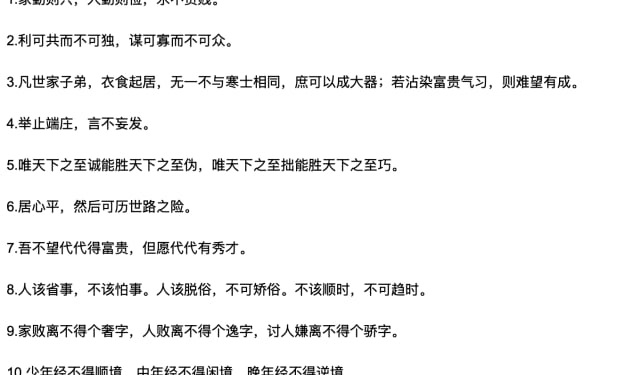
Zeng Guofan's Family Precepts
Zeng Guofan, the foremost of the Four Great Statesmen of the Late Qing Dynasty, is renowned for his family precepts, which have been highly praised by later generations. His principles on self-cultivation, family management, military discipline, and governance continue to exert a profound influence to this day. Let us revisit these classic sayings and experience the charm of the Zeng family precepts.
By Linda Yule7 months ago in History
Cassie and Johnny
I’m the kind of dame you notice. I’m no femme fatale, but you can’t ignore me, at least not until I warn you about what’s coming, then everybody ignores me. Hell, they usually blame me afterwards and give Johnny all the credit for saving the day, but my Johnny couldn’t save a seat at the movies without my help. Sure, he’s brawny, but brainy? Not so much. Like that time I asked him to spot me five bucks, and he said he didn’t see it anywhere on me, and believe you me, he looked but good.
By Harper Lewis6 days ago in Critique



Comments
There are no comments for this story
Be the first to respond and start the conversation.