
Indigenous Voices in the Age of AI
How technology threatens cultural survival—and how it can become a tool for preservation.

🌍 Introduction: A New Digital Frontier
In the twenty-first century, Artificial Intelligence (AI) has become the new frontier of human innovation. From self-driving cars to predictive healthcare, from facial recognition to generative art, AI has redefined how societies operate and how knowledge is stored, processed, and shared. Yet, while the promise of AI feels universal, its impact is not evenly distributed.
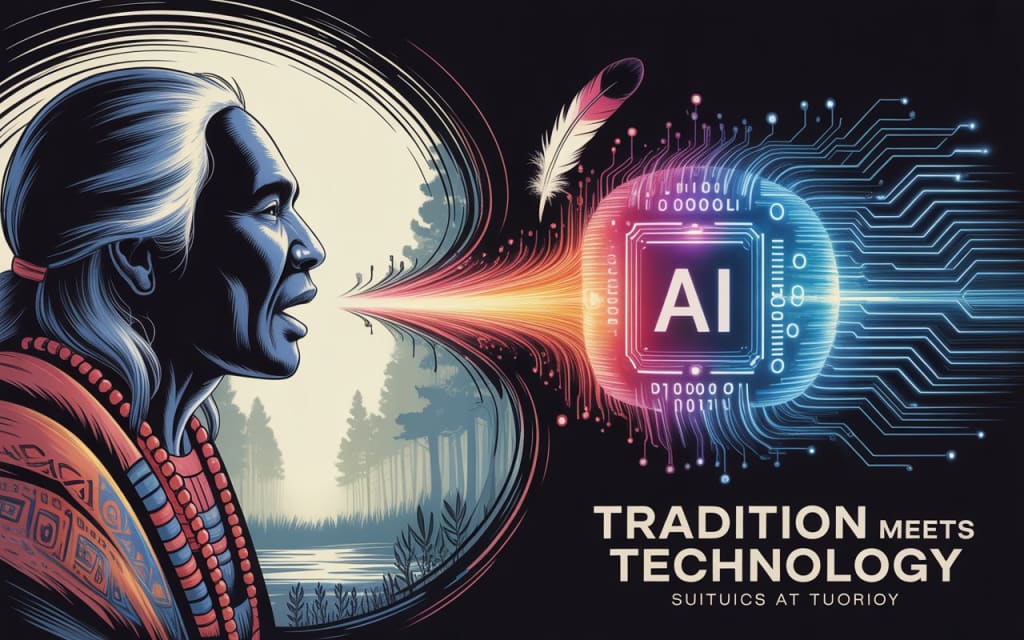
For Indigenous communities—custodians of some of the world’s oldest living cultures—the rise of AI is both a threat and an opportunity. On the one hand, algorithms risk distorting Indigenous knowledge, misrepresenting traditions, and appropriating cultural heritage without consent. On the other hand, AI can also serve as a powerful ally: a tool for language revitalization, digital archiving, and amplifying voices historically silenced by colonial systems.
This tension raises a pressing question: Will AI erase Indigenous voices, or will it finally help preserve them?
⚠️ The Threats of AI to Indigenous Cultures
AI systems are not neutral. They are built on datasets—massive collections of text, images, and recordings scraped from the internet. But the internet itself is biased toward dominant cultures, languages, and histories. As a result, when AI “learns,” it reflects these imbalances.
1. Cultural Misrepresentation
Imagine asking an AI tool to generate an image of a “traditional Indigenous ceremony.” The result may be a stereotypical, romanticized, or even fabricated image based on Western lenses of “tribal life.” Without Indigenous consultation, AI perpetuates caricatures rather than authentic representations.
2. Language Extinction Through Digital Neglect
Thousands of Indigenous languages are endangered. AI models rarely train on these languages because data is scarce. If a language is not part of the digital corpus, it risks being excluded from the “future internet,” accelerating its extinction.
3. Data Exploitation and Ownership
Many AI companies harvest cultural stories, art, and music without permission. For Indigenous communities, whose cultural heritage is collective and sacred, this constitutes a new wave of digital colonialism: their intellectual property is monetized without acknowledgment or benefit-sharing.
4. Decision-Making Without Consent
Governments and corporations increasingly use AI in policymaking, land management, and environmental planning. Without Indigenous representation in these processes, AI may recommend “efficient” solutions—such as repurposing ancestral lands—that disregard Indigenous rights and spiritual connections to the land.
🌱 The Opportunities of AI for Indigenous Communities
While the threats are real, AI can also serve as a lifeline for Indigenous survival, if applied ethically and collaboratively.
1. Language Revitalization
AI-driven tools like speech recognition and translation software can be customized to support endangered languages. Projects are already underway in Canada and New Zealand to teach AI how to “listen” and “speak” in Indigenous tongues. This makes learning accessible to younger generations and keeps languages alive.
2. Digital Archiving of Oral Traditions
Indigenous cultures often rely on oral storytelling. AI can help record, categorize, and preserve these stories, making them available in digital repositories accessible worldwide—without losing the nuances of voice, rhythm, and symbolism.
3. Education and Awareness
Imagine an AI-powered virtual classroom where Indigenous elders can co-create curriculum in local languages, combining ancient wisdom with modern science. Such platforms would allow students globally to learn directly from Indigenous perspectives, challenging the dominance of Western narratives.
4. Environmental Stewardship
Indigenous peoples have safeguarded ecosystems for centuries. AI-driven climate models that integrate Indigenous ecological knowledge with modern science could guide more sustainable policies for land and water protection.
🔍 Case Studies: Where AI Meets Indigenous Rights
New Zealand (Māori Language AI): AI tools have been developed to translate and generate Māori text, supporting language revitalization efforts. These projects were built with Māori community input, ensuring cultural accuracy.
Canada (First Nations Digital Archives): Partnerships between Indigenous councils and universities have led to AI-assisted archives of oral histories, photographs, and treaties—making them searchable without diluting cultural integrity.
Brazil (Amazonian Communities): Indigenous groups in the Amazon are exploring AI-powered drones and satellite mapping to monitor illegal logging on their lands, combining ancient knowledge of forests with modern surveillance.
These examples prove that AI can serve Indigenous futures—but only when Indigenous voices lead the process.
⚖️ The Balance: Technology with Consent
The heart of the debate is not AI itself, but who controls it. For Indigenous peoples, consent is central. Any AI system that touches their culture, knowledge, or land must operate under Free, Prior, and Informed Consent (FPIC)—a principle recognized by the United Nations Declaration on the Rights of Indigenous Peoples (UNDRIP).
Without FPIC, AI risks becoming a digital colonizer. With it, AI becomes a partner in cultural survival.
🌐 Global Solidarity and Responsibility
Non-Indigenous allies—researchers, technologists, and policymakers—have a responsibility to ensure that AI development is not extractive. That means:
Funding Indigenous-led AI initiatives.
Sharing intellectual property rights.
Designing ethical frameworks that center Indigenous values.
Including Indigenous communities at the policymaking table.
AI is often called a “mirror of humanity.” If that mirror excludes Indigenous reflections, it is incomplete—and unjust.
✊ Conclusion: Choosing the Future
We stand at a crossroads. AI can either replicate the injustices of colonization in digital form, or it can become a revolutionary tool for equity. The choice lies in whether Indigenous voices are sidelined or amplified.
Indigenous communities are not passive victims of technology; they are innovators, knowledge keepers, and guardians of the earth. Their wisdom, combined with the power of AI, could create a future where culture, ecology, and technology thrive together.
But only if the world listens.
The question is not whether AI will shape Indigenous futures—it already is. The real question is: Will Indigenous voices be erased, or will they finally lead the narrative?
About the Creator
Keep reading
More stories from Esther Sun and writers in Critique and other communities.
The Last Lamp of Delhi
The year was 1857, a time when the old world of India trembled beneath the boots of rebellion and empire. The Mughal capital, Delhi, stood not only as a city of bazaars, mosques, and minarets, but as the fading shadow of a once-mighty throne. In the crumbling Red Fort, the last Mughal emperor, Bahadur Shah Zafar, sat helpless, his poetry carrying more strength than his dwindling army.
By Esther Sun3 months ago in History
Standing While Falling
Quotation from Friedrich Nietzsche "He who wrestles long with monsters should beware lest he himself become a monster. And if you gaze long into an abyss, the abyss also gazes into you. Man is not destroyed by suffering, but by the meaning he makes of it."
By LUCCIAN LAYTH5 days ago in Critique
Understanding the P. Diddy Controversy and the 50 Cent Factor
For over three decades, the name Sean "Diddy" Combs was synonymous with the pinnacle of American success. From the glitz of the "White Parties" in the Hamptons to the chart-topping dominance of Bad Boy Records, Diddy wasn't just a mogul; he was a gatekeeper of culture. However, by 2025, the music industry’s most polished facade finally cracked. What followed was a legal and social collapse so comprehensive that it transformed a global icon into a cautionary tale of power, ego, and accountability.
By Teodor Monescu4 days ago in Critique
A Failed Artist, A Disillusioned Poet, An Underpaid Game Show Host
I took my son and niece to Gori, a small town in Georgia where Joseph Stalin was born. They talked me into visiting the Stalin's Museum, the largest in the post-Soviet space. I had resisted going there because I just can't stand the monster and know enough about him, or so I thought.
By Lana V Lynx6 days ago in FYI


Comments
There are no comments for this story
Be the first to respond and start the conversation.