
How Political Pressure is Redrawing the Lines of Press Freedom in Bangladesh
Bangladesh’s Press Freedom Under Threat

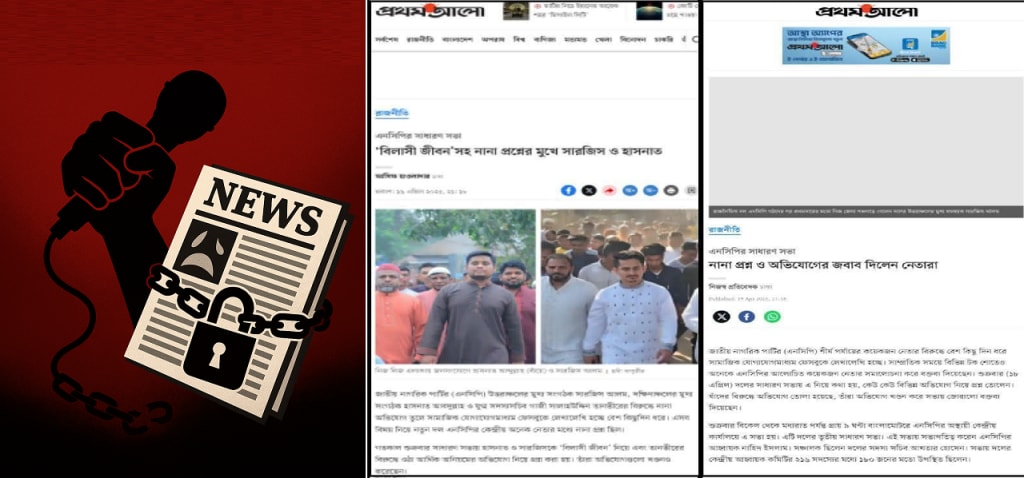
In the aftermath of Bangladesh’s political upheaval last August, the nation’s media faces an alarming erosion of its independence.
The rise of the National Citizen Party (NCP), born in the midst of a power vacuum, has sparked intense scrutiny over its leaders’ financial transparency and ethical standing. Allegations of financial misconduct surrounding NCP figures like Sarjis Alam, Hasnat Abdullah, and Gazi Salahuddin Tanvir have dominated public discourse, permeating social media and even the party’s own internal discussions.
‘Prothom Alo’, a leading national daily, initially confronted these issues head-on with a headline: “Sarjis and Hasnat’s Lavish Lifestyle Faces Scrutiny.” Yet, the story was quickly retracted and replaced with a diluted version titled: “NCP General Meeting: Leaders Address Queries.”
An editorial note vaguely attributed the change to “new information,” but the timing suggests otherwise. The swift revision points to political pressure rather than journalistic correction.
The catalyst appears to be a fiery Facebook post by NCP leader Hasnat Abdullah, who branded ‘Prothom Alo’ as perpetrators of “information terrorism” and accused them of orchestrating a smear campaign to derail NCP’s ascent. His rhetoric, far from fostering debate, carried an authoritarian undertone, warning of a continued battle against “traitors” and “Indian-backed conspirators.” The newspaper’s rapid capitulation raises concerns about coercion, especially given Hasnat’s history of leveraging influence to silence journalists, some of whom have faced job loss or censorship.
This incident isn’t isolated. Earlier, ‘Prothom Alo’ published an article titled “The Lavish Lifestyles of Awami League Leaders in Kolkata, London, and New York,” targeting exiled figures from the former ruling party. Unlike the NCP case, that piece faced backlash but no retraction, revealing a troubling inconsistency in how media outlets navigate political pressures.
Matiur Rahman Chowdhury, editor of ‘Manabjamin’, has decried the post-August 2024 media environment, arguing that press freedom is now contingent on alignment with those in power. His warnings are borne out by a pattern of stories being altered or erased from digital archives to appease the emerging elite.
The retreat of ‘Prothom Alo’, long a symbol of journalistic integrity, underscores a broader crisis. When a pillar of the press succumbs to intimidation, it signals a chilling reality: editorial independence is increasingly a myth. This capitulation reverberates beyond one outlet, discouraging scrutiny and emboldening those who seek to control narratives.
The stakes for Bangladesh’s democracy are profound. A muzzled press cannot fulfill its role as a watchdog, leaving society vulnerable to unchecked power. When truth is negotiated under threat, the loss is not just journalistic—it is a dimming of the public’s right to know.
About the Creator
Chowdhury Kabir
Meet Kabir — a Bangladeshi poet, journalist, and editor. His work blends lyrical depth with social insight, exploring themes of love, identity, and humanity across poetry and prose.
Keep reading
More stories from Chowdhury Kabir and writers in Critique and other communities.
From Power to Persecution: Awami League Under Siege in Bangladesh
The interim government led by Nobel Peace Prize winner Dr. Muhammad Yunus is allegedly pursuing political vengeance against the former ruling Awami League. They are filing cases, arresting, attacking with mobs, and even killing Awami League leaders and activists. Awami League members cannot stay in their homes, and their leaders are not allowed to remain in the country. False cases are being filed, and staged trials for genocide are being orchestrated. There is no media freedom in Bangladesh; no news can be published against the government-backed "King's Party," the National Citizen Party (NCP). The government has declared that Awami League members cannot hold processions or meetings, and anyone doing so will be arrested.
By Chowdhury Kabir9 months ago in Critique
Standing While Falling
Quotation from Friedrich Nietzsche "He who wrestles long with monsters should beware lest he himself become a monster. And if you gaze long into an abyss, the abyss also gazes into you. Man is not destroyed by suffering, but by the meaning he makes of it."
By LUCCIAN LAYTH5 days ago in Critique
The Lost City of Z
The Lost City of Z by David Grann Growing up I thought I wanted to be an archaeologist. Now that I’m a ripe 32, I realize what I really wanted to be was an adventurer–someone who dug deep into the dark and emerged with treasures unseen for millennia.
By Matthew J. Fromm5 days ago in Critique
A Failed Artist, A Disillusioned Poet, An Underpaid Game Show Host
I took my son and niece to Gori, a small town in Georgia where Joseph Stalin was born. They talked me into visiting the Stalin's Museum, the largest in the post-Soviet space. I had resisted going there because I just can't stand the monster and know enough about him, or so I thought.
By Lana V Lynx6 days ago in FYI


Comments (1)
bad practice