
For Glue: The Underdog Tale of a Forgotten Horse
One Horse’s Fight Against a Fate Sealed in Silence
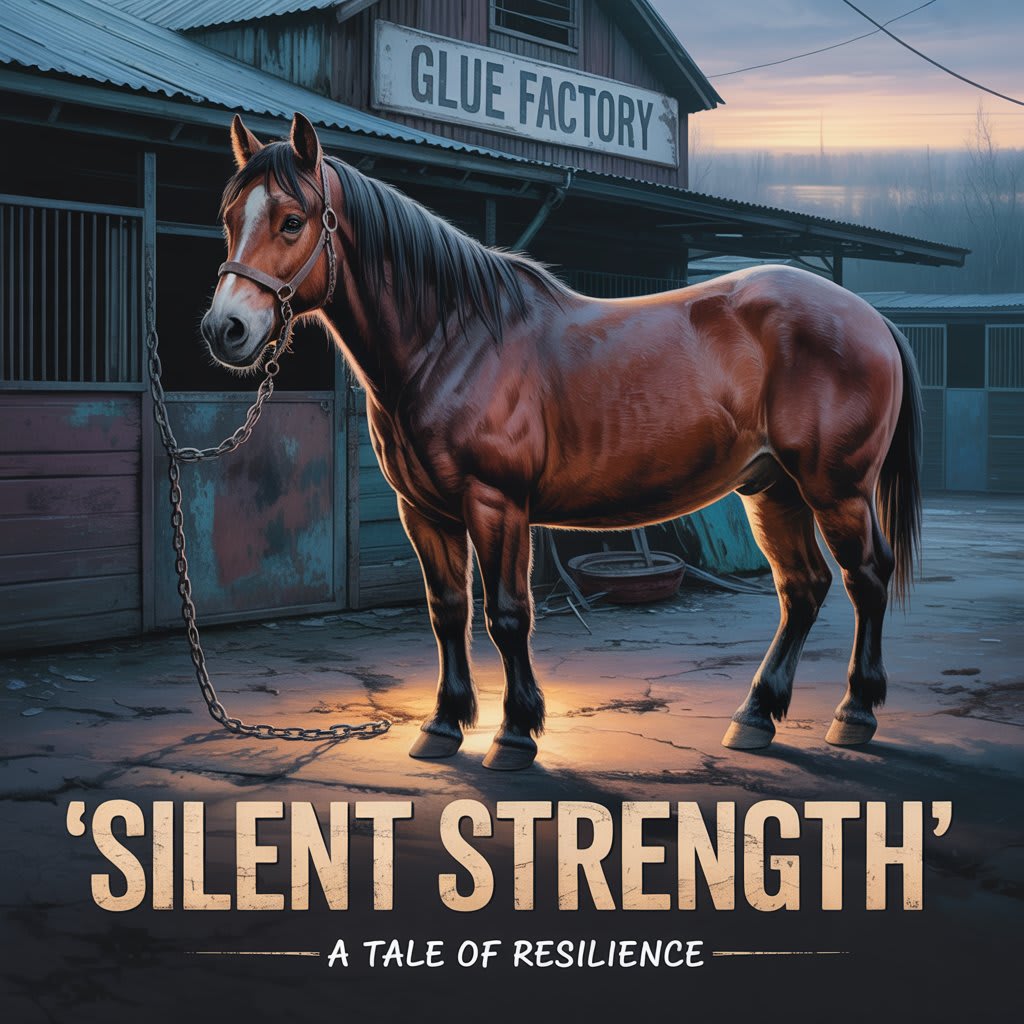
The first time they tried to load him onto the trailer, he didn’t move.
Rusty was a shell of what he'd once been — skin stretched tight over a weary frame, eyes dulled from years of labor and abandonment. Once a proud plow horse on a small Midwest farm, he'd been replaced by machines and left to wither behind a broken fence and an empty barn. For months, no one came. Then someone did.
Not someone kind.
They called it a “kill pen,” but everyone knew what it meant. Horses with no pedigree, no speed, no shine — they didn’t get second chances. They got tagged. Sold by weight. And eventually, they got turned into glue.
Rusty didn’t know the word. He didn’t understand "obsolete" or "economics." But he felt the finality in the way people looked at him now — not as a soul, but as a thing. Something to get rid of.
When they finally got him into the trailer, he didn’t fight. He didn’t have the strength.
The pen was loud, chaotic. Young colts kicked up dust in frustration. Old mares whimpered in corners. A chestnut thoroughbred paced like he was still on a racetrack, his eyes wide and lost.
Rusty stood motionless in the back, watching the world without blinking. He didn’t neigh, didn’t cry. He had accepted it — or at least, that’s what everyone thought.
Then came the girl.
Her name was Ellie. Twelve, skinny, stubborn, and too quiet for her age. Her father, Ron, was a horse trainer who moonlighted at the auction yards. He brought her to “learn the business.”
Ellie didn’t care about pedigree. She didn’t care about form. She liked the underdogs — the lame, the broken, the ones with haunted eyes.
That’s how she found Rusty.
“He’s no good,” her father muttered, glancing at the paperwork. “Old draft horse. Probably been out to pasture too long. Not worth the feed.”
Ellie stared at him, then walked to the fence. Rusty stood like a statue. Then, his ears twitched. Just barely.
That was all Ellie needed.
“I want him.”
Ron laughed. “You can’t ride him. You can’t train him. What do you want him for?”
Ellie turned back, fierce. “He looked at me.”
They brought Rusty home.
It wasn’t easy. He didn’t trust anyone, didn’t respond to food or touch. Ellie sat outside his paddock every day after school, just reading out loud. Sometimes fairy tales, sometimes history books. She told him about the world he’d missed while standing alone behind that barn.
Weeks passed. Slowly, Rusty changed.
One morning, Ellie held out a carrot — and he took it. The next week, he let her brush his mane. After a month, he followed her voice like it was a lantern in the dark.
Ron watched in silence.
Spring arrived, and with it, a small town festival. There was a “Rescue Ride” event — a showcase of saved horses, not for competition, but for honor. Ellie signed Rusty up.
“You sure?” Ron asked, gently. “He might not be ready.”
Ellie looked up. “He’s already won.”
The day of the festival, children giggled as ponies trotted around. Former racehorses showed off polished gaits. Rescue horses with fresh training dazzled crowds. And then there was Rusty.
He moved slowly, deliberately. Every step careful. His coat wasn’t glossy, and he wore no medals. But when he entered the ring, the crowd fell quiet.
Ellie didn’t ride him. She walked beside him, her hand resting lightly on his shoulder. Rusty held his head high, eyes clear and calm. He wasn’t fast. He wasn’t flashy.
But he was alive.
And for a horse who was supposed to be glue by now, that was nothing short of a miracle.
That night, after the applause and ribbons and soft words from strangers, Ron knelt beside his daughter as she brushed Rusty under the stars.
“You were right,” he said. “He looked at you.”
Ellie smiled. “He saw me. The way I saw him.”
Years later, the story of Rusty — the forgotten plow horse who was meant for slaughter but found a second life — would travel beyond their little town. Rescue groups would share his picture. Children would learn his name. And Ellie, grown now, would speak his story in shelters, farms, and schools.
Because sometimes, the ones deemed worthless are simply waiting for someone to listen.
And sometimes, what was meant for glue becomes a symbol of grace.
About the Creator
Keep reading
More stories from zaid ahmad and writers in Critique and other communities.
The Cat and Mouse Pact
In the heart of an old town, nestled between cobblestone alleys and worn-out rooftops, lived a sleek, black cat named Miro. Miro was no ordinary feline. His emerald eyes shimmered with the kind of intelligence one wouldn’t expect in a street cat. Each night, he prowled the alleyways like a shadow—silent, sharp, and swift.
By zaid ahmad9 months ago in Confessions
Standing While Falling
Quotation from Friedrich Nietzsche "He who wrestles long with monsters should beware lest he himself become a monster. And if you gaze long into an abyss, the abyss also gazes into you. Man is not destroyed by suffering, but by the meaning he makes of it."
By LUCCIAN LAYTH13 days ago in Critique
Miss Persephone's Manual to a Seemingly Ordinary Life
Miss Persephone was found at the dining table, her blue eyes swollen, her tears arriving and retreating like the tides of the ocean. Earlier that day, her family had visited her in the retirement home where she had lived for eight years. It was her eightieth birthday.
By Imola Tóth4 days ago in Fiction


Comments (1)
This story is heart-wrenching. It's sad to see Rusty being treated like that. Makes me think about how we often discard things when they're no longer useful in our eyes. Ellie seems like a special kid. Wonder if she'll be able to save Rusty. And what will her dad do? This situation really makes you question our values.