
Europe’s Amnesia: How the West Remembers What It Wants, and Forgets What It Must
From solemn Holocaust memorials to silent colonial graves, memory in the West is a political choice

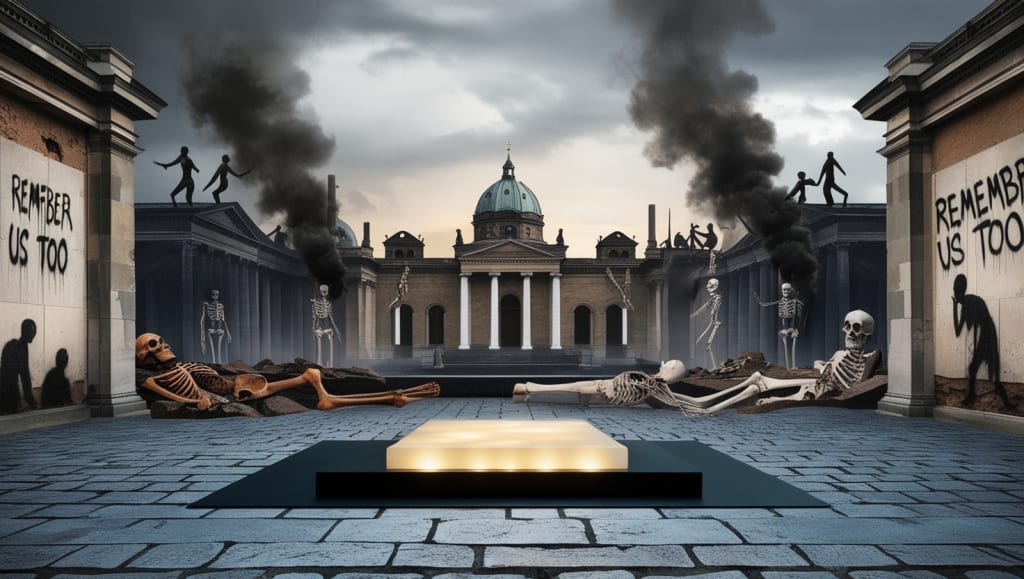
Europe has mastered the art of remembrance — just not for everyone. Across cities like Berlin, Paris, and Amsterdam, you’ll find meticulously maintained Holocaust memorials, plaques marking Nazi crimes, and museums dedicated to "Never Again." And rightly so. The horrors of fascism deserve eternal remembrance.
But move beyond Europe’s internal crimes — look toward its external conquests — and a strange silence falls. Where are the monuments to the Congolese murdered under Belgian rule? Where are the memorials to the millions enslaved by European powers? The starving Indians under British imperial policy? The Nama and Herero genocide in Namibia? The massacres in Algeria? This is not forgetfulness. This is amnesia by design.
Memory Is Political
Europe teaches its youth to grieve the sins that threaten its self-image as moral and civilized — like Nazism. But when it comes to colonialism, the narrative shifts: it was civilizing, beneficial, unfortunate but necessary, a product of its time.
In other words, when white people suffered at the hands of white supremacy, we must remember. But when Black and brown bodies were the ones destroyed — the memory is optional. Sanitized. Skipped. Ignored.
This double standard is not just historical — it shapes everything from immigration policy to foreign aid. It allows Europe to act as moral arbiter on the world stage while its museums remain stuffed with stolen artifacts and its institutions benefit from wealth built on conquest.
The Cost of a Crooked Mirror
This selective memory is not just an ethical problem; it's a practical one.
When Europe forgets what it did — when it erases the violence that built its wealth and power — it cannot understand why the Global South is skeptical of Western intentions. It cannot understand the trauma that still lives in formerly colonized societies. It cannot see how today’s global inequalities are not accidental but inherited.
This amnesia also feeds a resurgence of far-right politics in Europe. If colonialism was a footnote, if empire was noble, then multiculturalism becomes a threat. Migrants become invaders. “European identity” becomes white by default.
Why the Silence Persists
You might wonder: why is there so little reckoning? One reason is obvious — to fully remember would require accountability. Not just in words, but in wealth. In restitution. In returning land and artifacts. In rewriting history books and political frameworks. Europe would rather move on.
It wants to be seen as a land of human rights — without facing how those rights were historically denied to millions at its own hands.
The Courage to Confront
There are exceptions — activists, historians, and educators pushing for truth-telling. Some schools are updating their curricula. Some museums are starting to repatriate artifacts. But the pace is slow. And often, symbolic. Real memory demands real reckoning.
It means France must face Algeria. The UK must face India, Kenya, and the Caribbean. Belgium must say the names of the Congolese children mutilated under King Leopold. And it means Europe must accept that its wealth is not just the product of innovation — but extraction.
No Justice Without Memory
If we are serious about justice, we must be serious about memory. Not just memory that flatters us — but memory that haunts us.
To remember only the pain that affects you is not memory. It’s propaganda.
The path to a more equal world begins with telling the truth — all of it. No euphemisms. No half-stories. No statues for colonizers without context for their crimes.
Europe cannot preach about democracy while silencing its past. It cannot talk about global unity while clinging to stolen goods and stolen narratives. Amnesia is a choice. So is remembering.
About the Creator
David Thusi
✍️ I write about stolen histories, buried brilliance, and the fight to reclaim truth. From colonial legacies to South Africa’s present struggles, I explore power, identity, and the stories they tried to silence.
Keep reading
More stories from David Thusi and writers in Critique and other communities.
The Invention of Whiteness: How Race Was Manufactured to Divide and Rule
When we talk about race, it often feels like we’re speaking about something ancient and immutable. But the truth is more unsettling: race, especially the category of “whiteness,” is a modern invention — designed not by biology, but by power.
By David Thusi8 months ago in Critique
Standing While Falling
Quotation from Friedrich Nietzsche "He who wrestles long with monsters should beware lest he himself become a monster. And if you gaze long into an abyss, the abyss also gazes into you. Man is not destroyed by suffering, but by the meaning he makes of it."
By LUCCIAN LAYTH13 days ago in Critique
Miss Persephone's Manual to a Seemingly Ordinary Life
Miss Persephone was found at the dining table, her blue eyes swollen, her tears arriving and retreating like the tides of the ocean. Earlier that day, her family had visited her in the retirement home where she had lived for eight years. It was her eightieth birthday.
By Imola Tóth4 days ago in Fiction


Comments (1)
You make a powerful point. Europe's selective memory is a huge issue. It's wrong to ignore its colonial past. We need to face the truth and learn from it.