
Dissecting Frog Songs
A Self-Editing Epiphany


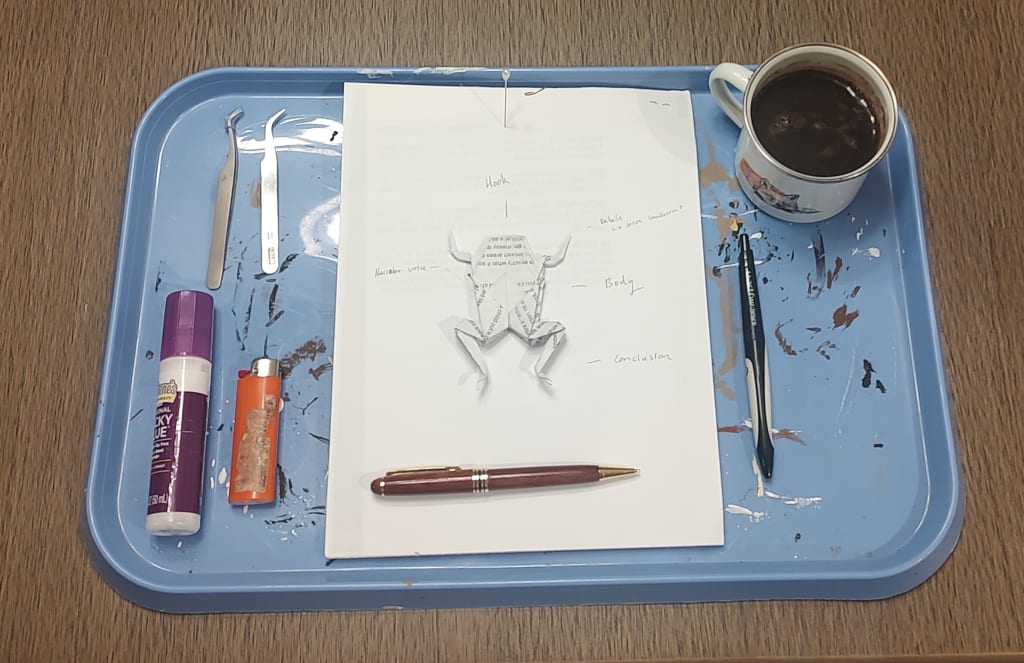
For the Self-Editing Epiphany challenge, I’ve decided to revisit my “Frog Songs” story.
It’s a story which taught me the importance of reading aloud as I write, because reading aloud helps me hear the focal point of the story. When I first read “Frog Songs,” at my local library's open mic night, it made me realize how dreadfully boring it was because it lacked a clear focal point.
Reading the hook, I can feel it ready to draw out:
Did you know frogs have their own stories to tell?
Neither did I, until one night after a long day on the range I was listening to them sing in the mire and found myself understanding what they were singing.
The idea in the hook is that this is a yarn. Probably told by some old cowboy getting ready to settle down by a campfire. But the wording here is too flowery and longwinded. To adjust his voice, I’ll keep the opening question, but parse down the second sentence:
Did you know frogs have their own stories to tell?
Neither did I, until one night I found myself understanding their song!
This feels better, but the second sentence is still too complicated, let's try again:
Neither did I, but one night I heard their song like plain English!
This is much more like some old codger working to pull his audience in. I can picture him looking around the fire, and maybe raising a finger when he says, ‘one night,’. Then he’d sit back with his coffee cup and start the story.
The body of the original story is too rambling and just doesn’t serve the core idea: hearing frog songs. I think I was trying to emulate the humor of writers like Patrick F. McManus and Baxter Black, but got too focused on trying to be humorous.
I’d written,
This was a long time ago, before internets and Wifis and cellphones so, for a child out in the back country, there were really only two things to entertain oneself: do chores or avoid chores.
My favorite pastime was avoiding chores, and what avoiding chores looked like on a cattle ranch in the country was “checking fence”. I will note, my friends, that if you aim to avoid chores of any kind it is important to find a task that looks like a chore but is enjoyable.
On its own, a tangent about ranch life may be entertaining, but here it doesn’t serve the story. The function of this part of the story is to give a sense of setting (on a ranch, before internet and cellphones were common) and to show that the narrator had gotten more out of the day than expected. If that’s the goal, I don’t need to worry chore theory or anything like that. Adjusted, I'll write:
This was a long time ago, before internets and WiFi’s and cellphones, so for my entertainment I could either stay inside and read schoolbooks or go outside and do ranch work. Given that choice, ranch work sounded more fun.
This feels better. It’s focused on developing the setting and the personality of the narrator. It helps shows that this story takes place sometime before the 2000’s, and that he felt chores were preferable to schoolwork.
The next segment of the story from “’Checking Fence’ is an age-old practice…” all the way to “…a 1:1 blend of neighbor cattle to our cattle” was a tangent from ‘avoiding chores,’. The goal of this part of the story is to develop the narrator’s exhaustion through the experience of sorting cattle. The original narration is a long, unrelated discussion about chores, so I’ll re-write the whole thing:
Oh, I’d do all sorts of things. Fix corral posts, toss hay for the horses, clean stalls, break coal, but my favorite thing was checking fence.
Now checking fence is exactly what it sounds like: you ride along miles of fence and make sure that there are no broken spots or gaps. It’s vital on a cattle ranch, you see, because a broken fence means your cattle could get out, and if the cattle get out they could go get mixed up with the neighbor’s cattle, and if that happens they make fast friends and it getting them separated gets complicated.
Usually, things were fine. A loose wire here, a missing nail there, which meant me and my horse, Roma, could spend the afternoon on a lazy ride. But that day, the cattle had found a low wire and turned it into a gate.
Keeping the narrower focus allows the narrator to get to the point. He’s able to tell bits about ranch life, set up the idea of a broken fence and introduce a sense of complication through the longer sentence structure. This leads to a reader a payoff with the downed wire which introduces the conflict of the story: sorting the cattle.
In the first version, the narrator goes on some discussion of inconvenience and the country math of sorting cattle. But that misses core idea of the section which is that the cattle are mixed, and it’s a problem that will take the rest of the day.
Ooo boy was a nervous at first. I’d been riding about an hour, so I figured I’d have to ride all the way back to get help and come back with the truck.
But then I saw the neighbor, Vern, sitting on his horse staring at the mess.
I “hullood” as I approached (and, if you don’t know, it’s important to ‘Hulloo’ when approaching someone if you’re out on the range, lest they’re armed and get startled).
Duly announced, and exasperations exchanged, we then debated whether it would be worth going back to a house to get more hands. One small fact about country logistics: the more you try to simplify a situation, the more complicated it becomes.
Which meant, we decided we’d best just figure it out ourselves. I won’t bore you with the details of the process, but I will tell you this: sorting cattle is where young cowboys learn all sorts of colorful words.
It was dusk when we finished getting the cows sorted and fence fixed.
Vern offered me a ride, but, tired as I was, I declined. Knowing Vern, going to get his trailer would take longer than just riding back an hour! I did, however, ask him to call my folks when he got home and let them know I’d be riding along the county road back to the house.
This parsed down version allows the narrator to insert tidbits of humor without losing the point of the story. If he’s speaking around a fire, he knows his audience didn’t grow up how he did so he interjects with country-tidbits but doesn’t get lost on the details. This also lets the story progress to where it needs to be for the Frog songs: showing that the narrator has been out all day, he’s tired but content, it’s dark, and he’s finally home.
This last section, starting with “It was quite dark by time I got home,” on through the ending, is where the narrative was leading. In the original story, this final scene didn’t emerge naturally from the long discussions of ranch logic and sorting math. Bit by focusing the body to serve this idea of frog songs and exhaustion, this ending picture feels more natural to the story. With that, the adjustments needed were relatively minor.
Which leads us to the frog’s song itself. This whole story may well be an excuse for the old cowboy to sing a song or recite a poem, and it’s the frog’s poem where I’ve attempted something different. In it, I’ve tried to emulate the rhythm of frog croaks by adding breath marks and unusual breaks. What I’m not sure comes across, is that the stanza breaks represent the sounds of other frogs chiming in as they sing their myth of how the frogs began to croak.
Playing with poetry aside, what “Frog songs,” taught me was the importance of reading my work aloud. When I read through it at that Open Mic, I realized how all over the place the ideas were. Through this process of asking myself, ‘how does this story sound aloud?’ I’ve been able to ask, ‘how does this idea serve the story focal point?’. I’m still learning to apply these concepts, but as I learn I’m seeing their impact through my newer stories like “A Singer So Shy,” and “The Warmth We Cannot Feel,”.
I still have a lot to learn as a writer, but I look forward to continuing this process as I learn to write with clearer focus.
****
"The Frog's Song" is the re-written version of "Frog Songs". Thank you for reading!
About the Creator
Judah LoVato
My collection of sometimes decent writing
Which I've left "there" for seekers to seek
Though I lack the grandeur of that Pirate King
Perhaps these pebbles can be a light
In this life, this laughing tale
Keep reading
More stories from Judah LoVato and writers in Critique and other communities.
A Man Called Ove
Ove is ready to die. Unfortunately, a new neighbor disturbs his death and forces him to live (and where’d the cat come from?). Humorous and heartfelt, A Man Called Ove is an honest look at the joy and sorrow of living told through the life of one cranky old man.
By Judah LoVato3 years ago in Critique
Cassie and Johnny
I’m the kind of dame you notice. I’m no femme fatale, but you can’t ignore me, at least not until I warn you about what’s coming, then everybody ignores me. Hell, they usually blame me afterwards and give Johnny all the credit for saving the day, but my Johnny couldn’t save a seat at the movies without my help. Sure, he’s brawny, but brainy? Not so much. Like that time I asked him to spot me five bucks, and he said he didn’t see it anywhere on me, and believe you me, he looked but good.
By Harper Lewis5 days ago in Critique
WELL DAMN Joe Budden Says He's Happy That J.Cole's Honda Civic Broke Down! "Tired Of The Fake Humble Gimmick"
If pride is the crown of all virtues, humility is the shabby little garbage swirling the gutters of the world. To J Cole, this bit of humble display cost him a hiccough in his roll out to his latest opus. In a nineties edition Honda Civic, he chose to go across the country and show off his modesty as a gimmick to hock his discount CDs.
By Skyler Saunders5 days ago in Critique



Comments (4)
Excellent work, Judah. Congratulations on your win! I read my work aloud, too, and believe it's a key asset to any writer. 👏👏👏
Wooohooooo congratulations on your win! 🎉💖🎊🎉💖🎊
Very enlightening--both in subject and how you handled the in-story editing.
How you connected the frog songs to larger themes, such as communication and survival. It made me reflect on how even the smallest creatures contribute to the ecosystem in their own unique way. Your thorough research and thoughtful analysis made this piece not only educational but also incredibly thought-provoking.