
Charming Classic - “Interstellar”
Levar’s Film Reviews

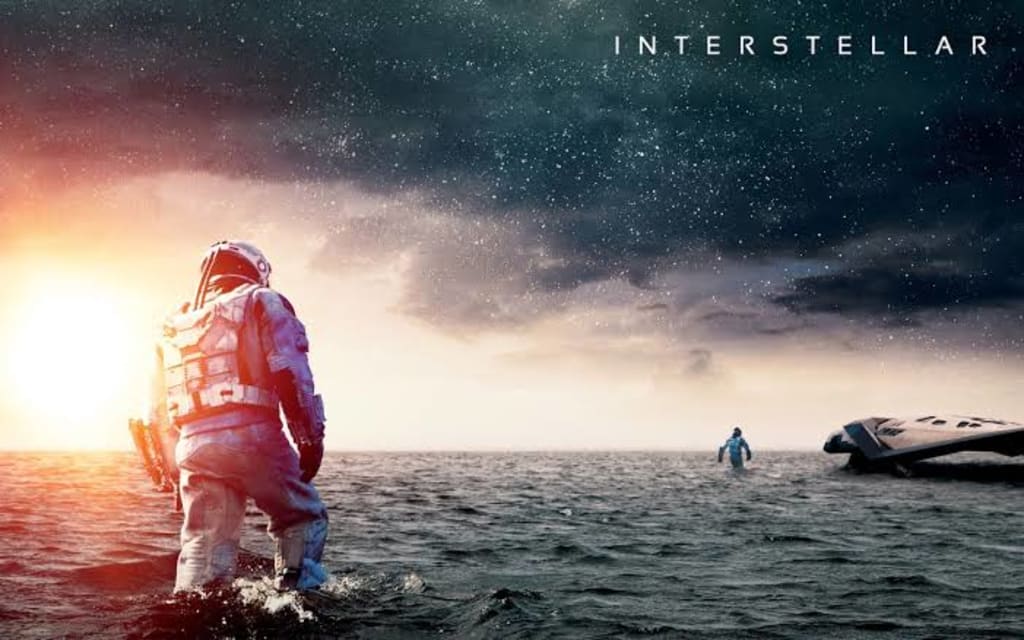
"Roads? Where we're going, we don't need roads" - Dr. Emmett Brown
Every Autumn, 'The Hollywood Reporter' begins its series of annual interviews with the most prestigious names in film and entertainment. They record a series of in-depth, group discussions that lead nicely to the awards season. These 'roundtables' are centered on the process of filmmaking, but with shared company of either actors, directors, writers, producers...you get the idea! The set-up is comparable to a glamourous, group therapy session, which makes for interesting viewing. Recently, I watched this year's (2014) 'The Writers' discussion. In it, Jonathan Nolan, co-writer of Interstellar and younger brother of Christopher, expressed his views on literature, screenwriting, and surprisingly, that he regards the time travel classic, Back to the Future, as a "perfect film".
You wouldn't necessarily think the co-writer of Inception, The Prestige and The Dark Knight trilogy, would select the comparatively, light hearted Back to the Future, as his choice of filmic perfection. After watching Interstellar though, I remembered Nolan's statement and it became all the more understandable to me.
I'm not sure I believe in a "perfect film". Much like the concept of time in Interstellar, perfection in any context is, of course, relative. In my view, for a film to be at all close to perfection, it needs to not only be cinematic, but it should also have a uniquely engaging narrative, flawless performances, enduring themes and something deeper to it, that resonates beyond articulation. For this reason I'd say The Shawshank Redemption is as close to perfection a film has come for me. By comparison Interstellar would fall shy of this status but it is undeniably, a great cinematic achievement.
By now we know Chrisptopher Nolan is a master of capturing big ideas on the big screen, in ways that never feel grandiose or self indulgent. Here, the idea is that Earth is on its last legs, crops have dried up and the main resource is corn. It's a future dystopia, albeit an unassuming one, with green fields and dust storms, as opposed to crumbling buildings and endless night. Due to there being a lack of resources, mankind has regressed in terms of his technological ambition, instead of flying cars and holographic gadgets, farming is once again the priority occupation.
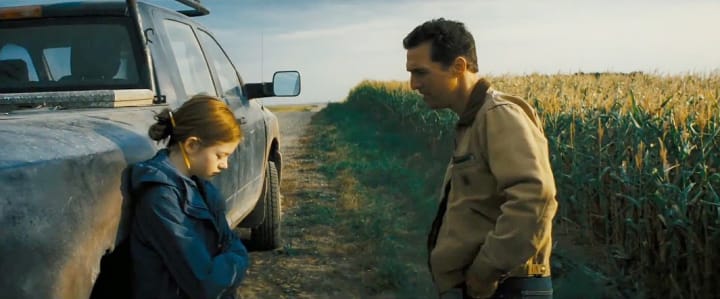
Matthew McConaughey stars as Cooper, a widowed father of two and an ex NASA pilot. He owns a large, rural corn farm, where he raises his son and daughter to be self sufficient. But even in this harsh environment, he's the kind of man to do so with a loving touch. It's clear from the outset that Cooper has a unique relationship with his pre-teen daughter, Murphy, it's a bond you feel has been reinforced by the loss of his deceased wife. Murphy claims to have a ghost in her room, which she's adamant is attempting to communicate with her. Given that Cooper isn't obtuse to the possibility of the fantastical, they soon realise that this 'communication', can be interpreted as morse code and co-ordinates, but the question remains for what and from whom.
Cooper and Murphy decide to follow the co-ordinates and discover a secret NASA space station. The facility is headed by Professor Brand (played by frequent Nolan collaborator Sir Michael Caine) who has discovered a wormhole on the edge of Saturn. The idea is that this wormhole allows for a swift and speedy transition, from our Solar system, to a new galaxy, where there are three potentially habitable planets. A mission took place some years prior with a group of astronaughts travelling to these planets to report on their suitability. The situation on Earth has become so dire, that Professor Brand estimates Murphy's generation will be the last to survive. He has devised two plans; Plan A being to find a habitable planet for mankind to escape to and in the event of failure, Plan B means fertilized embryos will be used to start humanity all over again. Due to the fact that the NASA facility has top minds but no top pilots, Cooper is entrusted with piloting this mission through the wormhole, to determine which of the three planets is the best option for man's salvation.
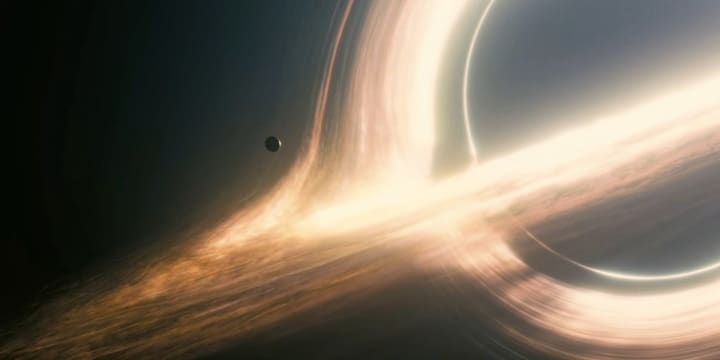
The film's middle act then delves into a space exploration narrative. Christopher Nolan takes full advantage of both the sound and IMAX visuals at this point, with space feeling all encompassing, yet eerie and beautiful in its silence. As their space shuttle approaches Saturn you get the similar feeling of awe you felt when first seeing an Imperial Star Destroyer looming over Princess Leia's Tantive IV. But even in space, Nolan manages to keep all of this grounded.
Cooper is joined by three astronaught companions, including Professor Brand's daughter, Amelia (Anne Hathaway) and two seemingly sentient, robotic machines. Together they make the huge journey of discovery to this new galaxy.
It's at this point, the major theme of time arises in new and wholly invigorating ways. It is a particular aspect of the film, which stands out as having been masterfully executed. A major obstacle for this mission, is the way in which time shifts in relation to gravity. Due to the fact the mission takes place in a separate galaxy, with different gravitational fields, time is of huge importance. One hour on a planet for example, equates to seven years on Earth.
After a failed attempt on a planet with waves the size of mountains, the crew lose just over three hours of their time, which translates as twenty three years in Earth time. It's at this moment we get a visual understanding of how several decades have passed for the explorer's families back on Earth. The crew receive one way video recordings from their loved ones, almost like a futuristic Facetime, which documents the past two decades. Cooper sees videos of his son now a man, with his own family, along a video of Murphy, who is the age he was when he left Earth. It's all a way of illustrating just how imperative, but also how ephemeral time has become. We experience Cooper's pain and heartbreak, having missed out on so much, so quickly, seemingly for the greater good.
The crew jouney to another planet where they find the post of one of the previous explorers, Dr. Mann (Matt Damon), who has been in a deep sleep chamber for several years. Due to feelings of hopelessness derived from isolation and the inhospitable planet he has discovered, Dr. Mann plots to sabotage Plan A, leaving Cooper and Amelia stranded on his planet, in an attempt to see out Plan B. Mann ultimately causes huge damage to the space vessel, meaning Cooper has to use his skill as a pilot and quick thinking, to see Amelia to saftey on the third planet and thrust himself into a black hole to have any chance of returning home.
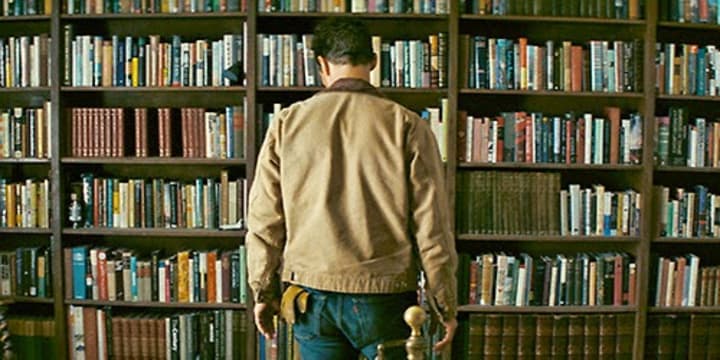
The final act of the film focuses on the explanation behind Murphy's ghost. After having appeared to have crashed his vessel, Cooper awakens to find himself in a 'fifth dimension', a space that 'other beings' have created to allow him to communicate within a humanly comprehendable, third dimension. In essence, Cooper can now see a young Murphy via a time loop, which allows him to communicate with her by manipulating the relationship between time and gravity. He drops books from her bedroom library to create messages and manipulates the physics of this space in order to leave morse code instructions for her. What we learn then, is that Cooper himself, was actually Murphy's bedroom ghost. Time exists as an oscillating construct, co-existing as it were, in past, present and future. By leaving these morse code and gravitational messages for Murphy as a child, Cooper does so in the hope she will one day solve them as an adult. The enduring message is that time and love are fundamentally intertwined constucts, that ultimately lead to man's salvation.
Much like Inception before it, Interstellar is a blockbuster that requires thought. It's a clever film that doesn't condescend. It allows you to both question it and make sense of it, provided you pay attention and for that it's all the more rewarding. Through sheer filmmaking talent, Christopher Nolan has managed to reign in a film that could've quite easily gotten lost in its own vastness. This undoubtedly has much to do with the story at its core, for which younger brother Jonathan deserves credit. Ultimately, it is he who has written a film that explores themes of love, hope and family, all intertwined with this concept of time. Clearly his views on Back to the Future were anything but hyperbole.
See the trailer here: Interstellar Trailer
About the Creator
Lev. Life. Style
I’m fascinated by culture’s ability to shape thought and behaviour. I value creativity as a means of aiding wellbeing and growth. Film, analysis, travel and meaningful discussion, are personal passions that I’m grateful to share.
Lev
Keep reading
More stories from Lev. Life. Style and writers in Critique and other communities.
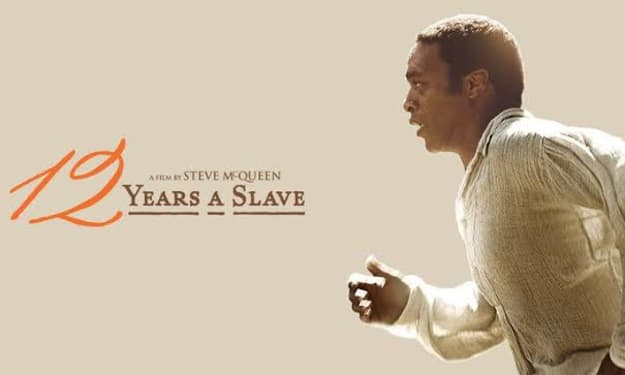
Charming Classic - “12 Years A Slave”
"Emancipate yourselves from mental slavery, none but ourselves can free our minds" - Bob Marley I was 5 years old when I first learnt of racialised, chattel slavery. I remember vividly a Saturday afternoon and my mum taking out our Roots, VHS box-set for me to watch. I remember seeing the box art of a man in chains and asking her if it was sad. She was honest enough to tell me it was, but lovingly explained that I needed to see it, "in order to know where your name comes from". I'm named after actor LeVar Burton who played the young slave, Kunta Kinte, in the Roots miniseries, as well as many roles in television and film (most notably Geordi La Forge in Star Trek: The Next Generation).
By Lev. Life. Style 9 months ago in Critique
Who Is Clavicular? The Looksmaxxing Streamer Who Ran Over A Stalker In His Cybertruck
What is so damaging to this current culture is the ant-intellectualism which pervades nearly every element of it. Clavicular, real name, Braden Peters equivocates physical form with getting women, making money, and overall being a strong “man.”
By Skyler Saunders20 days ago in Critique
A Jerk and an Idiot Meet in a Bar
A Jerk and an Idiot Meet in a Bar Well not in a bar, per se, social media. After all, it is the bar of our modern times. It’s where we hook up with friends, family, dates, or trysts. Places like Facebook, Instagram, TikTok, and others, all designed for social interaction with anonymity and limited consequences, for bad behavior. Often these entities dole out consequences to parties that are not causing a problem, and give a blind eye to serious problems.
By Alexandra Grant6 days ago in Critique
A Dart at Dusk
Seconds ago, the sullen sun set on the two of us… my exuberant furry companion and me. A fresh breeze embraces us, delivering welcome relief from the day’s oppressive heat. His typical stumbling and staggering along — apace with a sloth — has turned into trip-trapping, high-stepping, almost skipping along.
By Angie the Archivist 📚🪶2 days ago in Petlife


Comments (1)
I agree that perfection in films is relative. You mentioned Nolan's view on *Back to the Future*. I get why he'd see it as great. It has a fun premise and characters we love. But *The Shawshank Redemption* is special. Its story of hope and friendship is so powerful. And the acting is top-notch. What do you think makes a film come close to perfection for you? Is it the story, the acting, or something else? Interstellar is amazing too. Nolan really knows how to create a visually stunning world. But does it have that extra something that makes it perfect? Maybe it's subjective, like you said.