
Behind the Ride: The Hidden Crisis Facing Ojol Drivers
Thousands of app-based drivers are working longer hours for less pay, as demands for justice shake Indonesia’s ride-hailing industry.

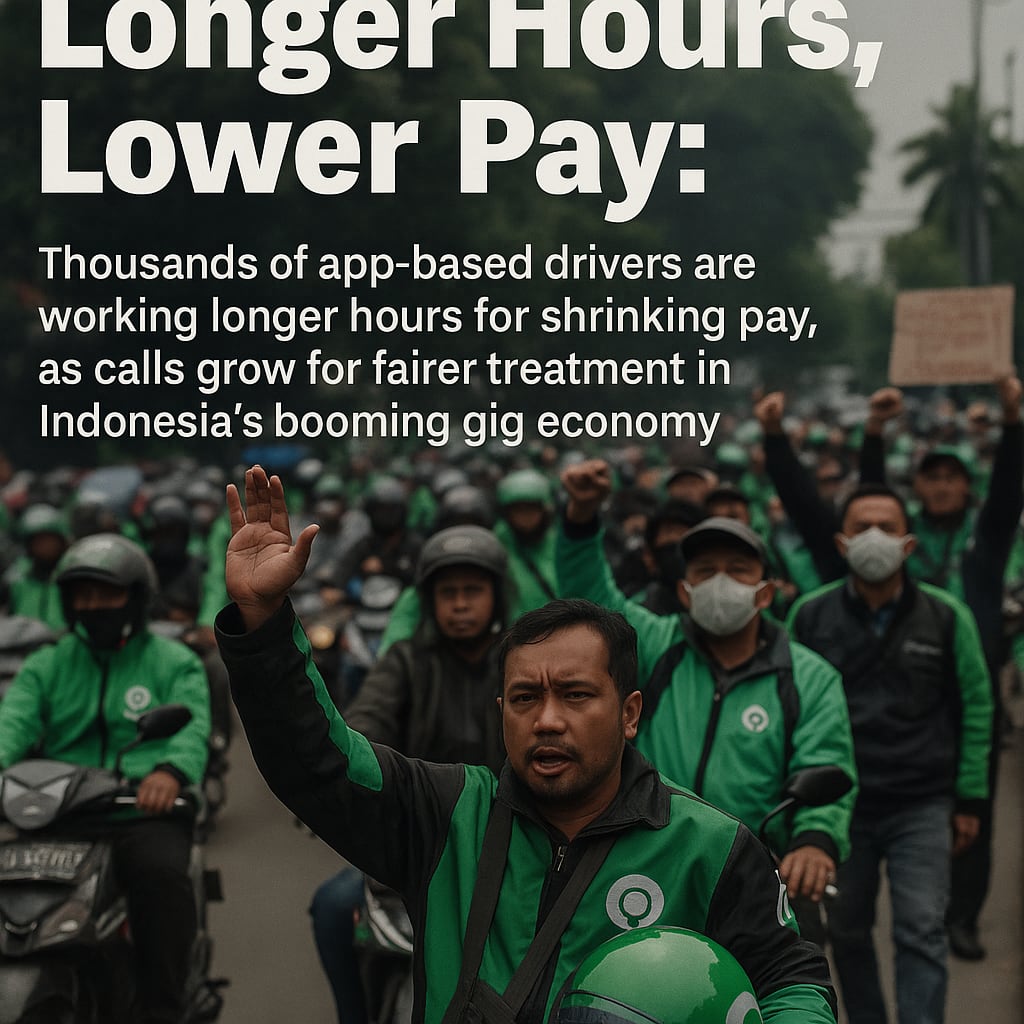
On May 20, 2025, Jakarta’s streets turned into rivers of green. It wasn’t a festival, nor a parade. Thousands of ride-hailing drivers—clad in green jackets—flooded the roads in protest, voicing their frustration against the very platforms that once offered them hope.
In Indonesia, being a ride-hailing driver—commonly known as “ojol”—is often a last resort. Many turn to it after being laid off or when all other job options run dry. It’s also a side job for some, like Sholeh, a restaurant worker who squeezes in a few rides every morning just to earn extra money. Yet even he admits that his app account often ends up in the negative, thanks to cash payments that don’t reflect well in the system.
But for those who rely on it full-time, the situation is increasingly bleak.
The Income Crisis
According to research by the Institute for Demographics and Poverty Studies (IDEAS), earnings for ride-hailing drivers have declined significantly over the past five years. Before the pandemic, drivers could bring home over Rp300,000 ($19 USD) daily. Today, it can take over 11 hours of non-stop work—covering more than 40 kilometers and completing 10 orders—just to earn Rp100,000 ($6.25 USD). That’s before subtracting costs for food, fuel, and phone data, which easily consume a third of daily income.
And it’s not just about long hours. App-based commissions are squeezing drivers harder than ever.
While government regulations cap commission cuts at 20%, many drivers report real deductions of 50%–70%. A fare of Rp23,500 might leave the driver with just Rp7,000 in hand.
The math no longer works in their favor. Some food delivery orders pay as little as Rp5,000 per trip—far less than they used to earn for the same work.
Demanding Change
That’s why they took to the streets. Drivers aren’t just asking for sympathy—they’re demanding structural change.
Their two main demands are:
Lower app commission cuts to a fairer 10%.
Reclassify drivers as employees, not just “partners,” so they can access insurance, job security, and better protections.
App companies argue that high commission rates are needed to fund service improvements and technology upgrades. They also claim that switching drivers to full employee status would mean cutting most of the current workforce—keeping only about 10% as formal staff and severing the rest.
But from the drivers’ perspective, the platforms benefit from a system that asks for everything while giving very little in return. Drivers use their own vehicles, pay for their own maintenance, and even purchase branded helmets and jackets—sometimes costing Rp300,000 or more—just to join.
A System Out of Balance
What makes this situation feel even more unjust is how the business model works. The companies don’t own the vehicles. They don’t cover insurance. They don’t manage road risks. Yet they take a significant share of every ride and delivery.
It feels, to many drivers, like modern exploitation—what some have called "digital colonialism." All the labor is theirs, but the profits go elsewhere.
And while these platforms do offer convenience to millions of users—including myself—it’s crucial that innovation doesn’t come at the cost of basic fairness.
The Way Forward
This is not an anti-technology stance. We need smart solutions, and ride-hailing apps have made life easier for millions. But progress must be human-centered.
If the people who keep the system running can no longer survive within it, then the system is broken.
Indonesia’s government must act—not just as a rule-maker, but as a bridge between business and the people. Fair profit for companies and fair wages for workers should not be mutually exclusive.
Because in the end, we all want the same thing: to live with dignity, to earn enough for our families, and to go home not in despair, but with peace of mind.[]
About the Creator
Keep reading
More stories from writers in Critique and other communities.
Cassie and Johnny
I’m the kind of dame you notice. I’m no femme fatale, but you can’t ignore me, at least not until I warn you about what’s coming, then everybody ignores me. Hell, they usually blame me afterwards and give Johnny all the credit for saving the day, but my Johnny couldn’t save a seat at the movies without my help. Sure, he’s brawny, but brainy? Not so much. Like that time I asked him to spot me five bucks, and he said he didn’t see it anywhere on me, and believe you me, he looked but good.
By Harper Lewis11 days ago in Critique
Do we really need AI videos?
By now, you’ve likely seen what the latest AI video model, Seedance 2.0, can do. If you haven’t, just look around. The videos flooding your feed—the ones with perfect lighting, cinematic depth, and hyper-realistic motion—they’re not real. They were all generated by AI.
By John Zhang6 days ago in Critique
The Piggy Project
I’ve had so many names in this life I lose track of which ones were ever really mine and which ones I wore because someone needed me to. Some were handed to me before I had words to refuse them, before I knew what they meant, before I knew I could say no. Most weren’t meant to hurt. That doesn’t mean they didn’t leave marks. Marks that told me who I belong to, who I am by way of who claims me, recognizes me in the good and bad, who walks beside me.
By Fatal Serendipity5 days ago in Confessions


Comments (1)
This is rough for the drivers. I've seen similar pay squeezes in the gig economy here. They're right to protest. Lowering commissions and reclassifying them could really help.