
Do we really need AI videos?
We have not created a tool, we have just built our own cage and we walked right in

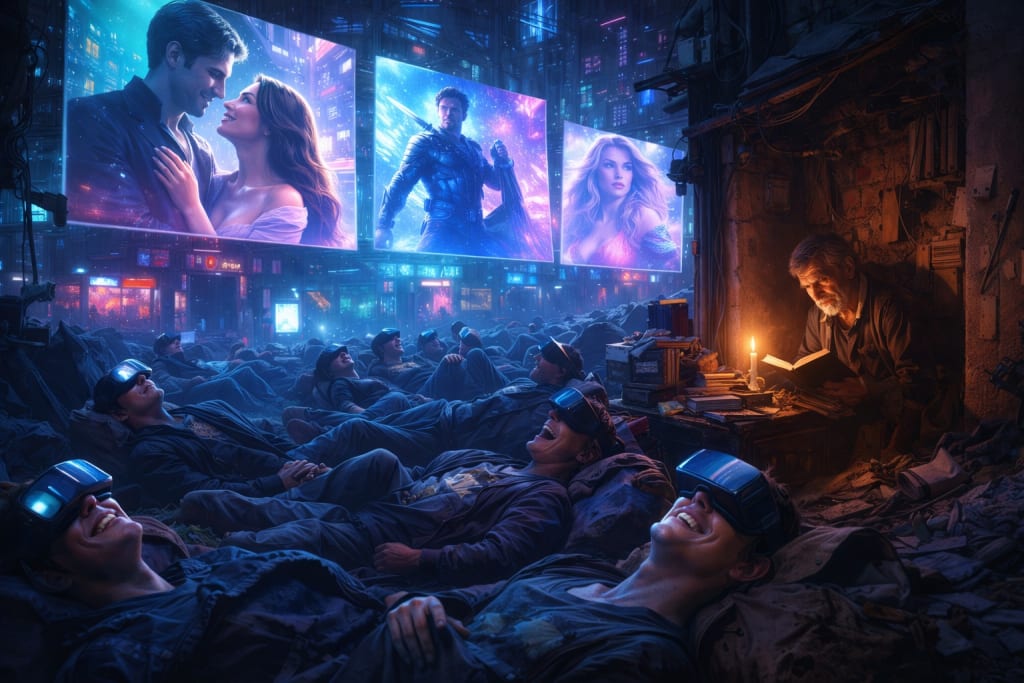
By now, you’ve likely seen what the latest AI video model, Seedance 2.0, can do. If you haven’t, just look around. The videos flooding your feed—the ones with perfect lighting, cinematic depth, and hyper-realistic motion—they’re not real. They were all generated by AI.
Just a year ago, Sora dropped and shocked the world. Now, Seedance makes Sora look primitive. What happens in another year? Another decade? This isn’t another guide on how to write the perfect prompt or "make a million dollars with AI." The internet is full of that. What I want to talk about is the source of this fear. I want to ask a fundamental question:
Why are we building this?
Think about it. Historically, invention had a clear logic. We invented the wheel to solve the problem of moving heavy things. We created antibiotics to solve the problem of deadly infections. Technology was about solving problems.
What problem does AI video solve? Is it that we don’t have enough content? The opposite is true. We are drowning in it. We spend our days sifting through a landfill of digital noise to find a single piece of genuine expression. So, why build a machine that can generate 10,000 hours of video in an hour?
The common refrain is that it "lowers the barrier to entry." It democratizes creation. That sounds noble. But if we truly wanted to lower the barrier, we’d build smarter editing software, better color-grading tools, and intuitive animation aids—things that help people express themselves.
AI video models don't do that. They don't help you express; they replace your expression. You type "a sad man on a bench," and it hands you a finished product. Where is your expression in that? Is his sadness from loss or failure? What story is hidden in the lines around his eyes? You don’t decide. You’re not a creator; you’re a customer ordering fast food. You get a Pre-made meal. You’re full, but you never cooked.
This is the consequence: the devaluation of human skill. A great photographer isn’t just someone with a camera. They are the sum of decades of experience—knowing the difference between the light at 6 a.m. and 4 p.m., knowing how to track a tear rolling down an actor’s face. That’s craft. That’s a moat built with a lifetime of effort.
Now, you type "cinematic lighting, shallow depth of field," and the AI spits out a technically perfect image. Decades of knowledge are compressed into a kilobyte of text. Some will say, "AI is just a tool, like photography was for painting." But that’s a false analogy. Photography created a new artistic language. Photographers still had to be there, to frame the shot, to develop the film. AI video is de-process. It removes the human from the loop.
We value things not just for what they are, but for how hard they were to get. We cheer Jackie Chan’s jump from a clock tower not because it’s graceful, but because we know it’s real. It’s his life on the line. If an AI generated a flawless, physics-defying jump, would you cheer? No. You’d scroll past. Because no one risked anything. It’s just math.
When the result can be generated with one click, the process loses its value. Future kids might see these perfect images and ask, "Why should I spend years learning to light a scene? I can just prompt it." When the struggle disappears, the ladder for mastery vanishes. If everyone is a master, then no one is.
But the real catastrophe isn’t just for creators. It’s for all of us. It’s the death of "seeing is believing."
Imagine this: your phone rings. It’s a video call from your mom. She looks worried, standing in your living room with the cat on the sofa. Her voice is panicked. She needs you to wire $5,000. It’s her face, her voice, her home. You’d send the money. And you’d be paying a server farm.
In the near future, a single photo and 30 seconds of audio are all that’s needed to generate that scene in real-time. The cat? A hallucination. The sofa? Filled in from an old Instagram post. The worry on her face? Perfectly simulated emotion.
This isn’t science fiction. It’s the logical endpoint. We are heading toward a world where anything on a screen must be assumed to be fake by default. We will enter a permanent state of distrust. We’ll have to perform "reverse Turing tests," desperately trying to prove we are human by introducing flaws—camera shake, background noise, imperfections—because perfection is the mark of the machine.
This destroys more than just art. It destroys trust. Courtroom video evidence becomes meaningless. Online shopping becomes a gamble where every buyer’s show could be a deepfake. Society runs on the shared consensus that a video is proof. That foundation is crumbling.
To fight this, tech giants are building a new infrastructure of truth—a digital notary stamping photos with unchangeable certificates. But this comes at a cost. The power to define "real" is taken from our eyes and handed to corporations. If your video doesn’t have the approved watermark, it’s considered fake. Your reality requires their permission to exist.
We are sleepwalking into a two-tiered world. For the masses, there will be the "dopamine slums"—an infinite, free, perfectly addictive ocean of AI-generated content. For a tiny elite, "reality" itself will be the ultimate luxury. They will pay a fortune for a slightly off-key human concert or a vacation with unpredictable weather, simply because it’s real.
The tech giants are so obsessed with what they can do that they never stop to ask if they should. They’ve built a hammer so powerful that they’re smashing every wall in sight, just to prove it works.
So, as we stand at this crossroads, the question isn't about prompts or profit. It’s about us. When we can have a million perfect, digital companions, will we still have the courage to love one flawed, difficult, real person? When we can generate a masterpiece in seconds, will we still have the patience to learn a craft?
If the answer is no, then we haven’t just created a new tool. We’ve built our own cage. And we walked right in.
About the Creator
John Zhang
The driving force behind MB9 Australia — a licensed renovation builder who brought world class Italian designer kitchens to Australia, specialising in kitchen, bathroom and full home renovations across the entire Sydney area.
Keep reading
More stories from writers in Critique and other communities.
Cassie and Johnny
I’m the kind of dame you notice. I’m no femme fatale, but you can’t ignore me, at least not until I warn you about what’s coming, then everybody ignores me. Hell, they usually blame me afterwards and give Johnny all the credit for saving the day, but my Johnny couldn’t save a seat at the movies without my help. Sure, he’s brawny, but brainy? Not so much. Like that time I asked him to spot me five bucks, and he said he didn’t see it anywhere on me, and believe you me, he looked but good.
By Harper Lewis6 days ago in Critique
WELL DAMN Joe Budden Says He's Happy That J.Cole's Honda Civic Broke Down! "Tired Of The Fake Humble Gimmick"
If pride is the crown of all virtues, humility is the shabby little garbage swirling the gutters of the world. To J Cole, this bit of humble display cost him a hiccough in his roll out to his latest opus. In a nineties edition Honda Civic, he chose to go across the country and show off his modesty as a gimmick to hock his discount CDs.
By Skyler Saunders6 days ago in Critique
When the Shelter Closes
Across the street from my house, a man slept under a tree, his dog by his side. My first, naive thought: he must be traveling through. But he kept coming back, often sleeping there during the day. Then it hit me—that person might not have a home.
By Bride of Sound7 days ago in Humans



Comments
There are no comments for this story
Be the first to respond and start the conversation.