
Artistic Qualities of an Aboriginal Rock Drawing
The Wanjinda and Michellango's Last Judgement

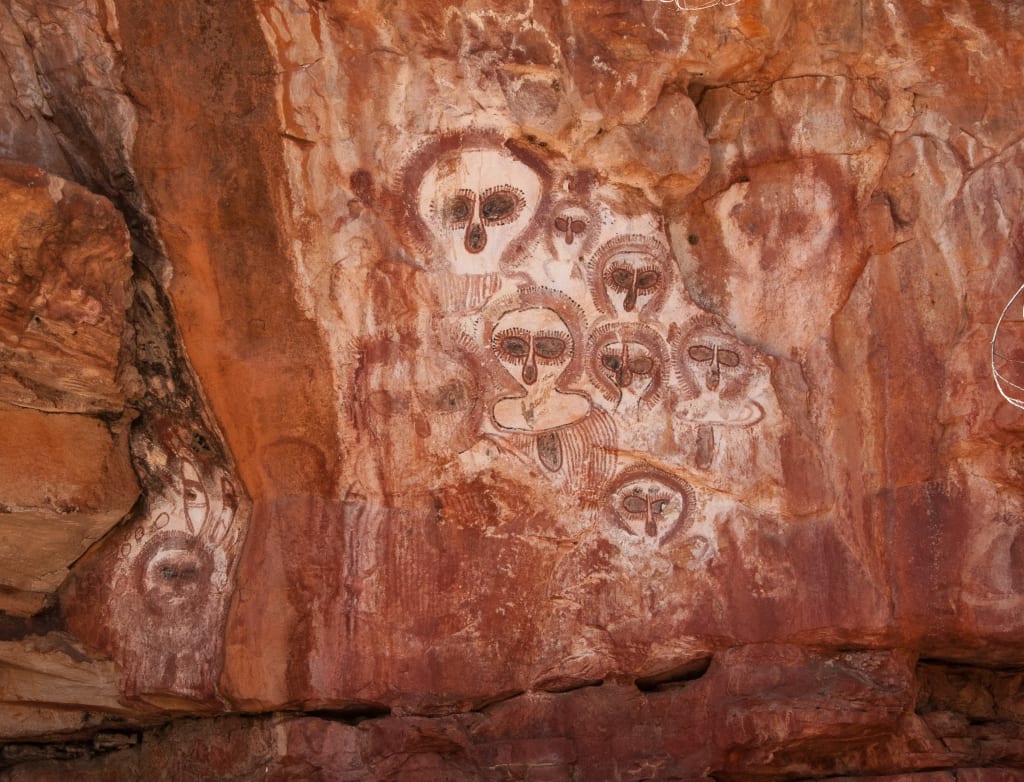
Art is a way through which certain people interact with each other and express themselves. The aboriginal rock drawing “Wanjinda” and Michellango’s “Last Judgment” show a lot of similar artistic qualities. The aboriginal rock drawing is one of the oldest forms of art found throughout the history of man. From the illustrations that were presented in the readings, it could be seen that the Aboriginal people are able to claim that they have the longest tradition in this medium and that tradition has not been broken. The examples of the earliest works which were created by the Aboriginal people and included various paintings and artworks that were created on rocks and in caves. It has been identified that many of the societies that were involved in creating this art have become extinct however Aboriginal art still thrives in Australia today. This is as there are artists in Australia who still use the traditional methods for creating artworks which have become part of Australian culture for thousands of years. Michelangelo's “Last Judgement” is also an important artwork from history and represents an important moment in Christian art. The focus of the paper is concentrated on comparing and contrasting the artistic qualities of Aboriginal Rock Drawings (The Wanjinda) and Michellango’s Last Judgment.
The artwork Michelangelo's “Last Judgment” is a painting that was used in the covering of a wall behind the Sistine Chapel altar. Unlike the artwork by the Aboriginal people that represents the culture of the people of Australia, the artwork by Michelangelo is of biblical inspiration as it showed the creativity and the genius of the artist. In the Aboriginal art we see that it is art performed based on their belief system as well. In the work of Michelangelo the work is attempting to capture religious belief. All the characters in Michelangelo’s work have been painted naked because of the representation of biblical inspiration where they are angels and spirits in the kingdom of heaven and natural. At the time the painting was unveiled some individuals agreed with it and others stating that the artwork should be redone in a way that the characters in the painting are well dressed. One of the major artworks of the Aboriginals is the painting of the Wandjina who are also referred to as the sky gods. It is stated historically that these sky gods are responsible for the control of the weather and the punishment of people who do evil. The paintings of the Aboriginals are done on sandstone rock walls which had overhang protection. It is believed that the drawings of these Aboriginals which are done on sandstone rocks are as old as 3,000 to 4,000 years. The artistic quality of sublime which was identified by Burke points to the fact that a source of sublime is infinity and he defines sublime as a comprised state of astonishment.
The sublime or astonishing characteristics in the artwork by Michelangelo “Last Judgement” shows an illustration which shows and displays a change in time and space and an introduction into new things. This was as the painting has some modern perspective to it which was targeted at going against the norm of the time, which was the traditional perspectives and compositions used in the creation of paintings and artworks at the time. In its own rights, the Aboriginal artwork Wandjina displayed a great degree of quality that was balanced and showed a high level of creativity. As a result of the high level of creativity, the artworks of these Aboriginals have been adopted for various trades. As identified by Burke, power has either pain or pleasure and this can be gotten through painting. The work by Michellango was a depiction of the second coming of Christ as its inspiration was drawn from the Bible. With this depiction, it could be seen that the painting revealed the pleasure that could be attained from the second coming of Christ; especially for those who will have the opportunity to sit at his right side. However, there is also the depiction that while some individuals in the face of judgment will have the cause to smile as Christ is impressed with the deeds which they have done throughout their lifetime, others will be sad because they will be condemned to hell as a result of their misdeeds.
It could be seen from the painting of “The Last Judgement” and the Wandjina paintings by the Aboriginals that they were both focused on figures that were high in their belief system. While the painting by Michelangelo is centered on Christ, the painting by the Aboriginals is centered on the gods of the sky. Another similarity which was noted from the artistic qualities of both artworks is the fact that various individuals face the consequences of their actions in life, either good or bad. The artwork by the Aboriginals which was focused on the gods of the sky revealed that it is believed that the gods of the sky usually punished individuals who committed any form of evil. The painting which was designed by Michellago also depicted the last judgment of humanity and the second coming of Christ and pointed to the fact that while those who performed good deeds and had good characters throughout their lives will enjoy paradise with Christ where as those who did bad deeds before the judgment and did not repent will be punished for their misdeeds. From the painting, it is visible that the imaginative vision of the artist was prevalent in the painting.
The balance between all the characters which were depicted in the painting revealed various saints with instruments. The way all the characters were arranged and the use of various elements of art including color among others reveals the creativity and the high level of imagination which the artist possesses. In the artwork of the Aboriginals showing the gods of the sky “Wandjina”, there is a high level of balance which could be seen as the various colors of black, yellow, white and red could be seen. Depending on the rock which was used for the artwork, it could be seen that the artworks were either vertical or horizontal. The two paintings which originated from different sources show us that there are deep ties and similarities in the the quality and content of art created throughout history and across cultures.
Sources
Austin, M. “Reading the World”. Norton Books, 2017. https://wwnorton.com/books/9780393420685
“Italian Renaissance Art. The Sistine Chapel Last Judgement”., Italian Renaissance Art.com. https://www.italian-renaissance-art.com/Last-Judgement.html#:~:text=The%20Last%20Judgeme nt%20by%20Michelangelo,that%20prevails%20in%20this%20painting., Accessed: September, 2021.
Cover Image
Wikipedia contributors. (2023). Wandjina. en.wikipedia.org. https://en.wikipedia.org/wiki/Wandjina#/media/File:Aboriginal_rock_art_on_the_Barnett_River,_Mount_Elizabeth_Station.jpg
About the Creator
Who Is Clavicular? The Looksmaxxing Streamer Who Ran Over A Stalker In His Cybertruck
What is so damaging to this current culture is the ant-intellectualism which pervades nearly every element of it. Clavicular, real name, Braden Peters equivocates physical form with getting women, making money, and overall being a strong “man.”
By Skyler Saunders20 days ago in Critique
White House defended a video
To Whom It May Concern, I am writing to express deep concern regarding the recent incident involving President Donald Trump during his visit to the Ford factory in Dearborn, Michigan. According to reports from CBS News and other outlets, the President appeared to respond to a heckler by **mouthing an expletive and displaying an obscene gesture**. While the White House defended this as an “appropriate and unambiguous response,” this behavior raises serious questions about the standards of conduct expected from the highest office in our nation.
By Organic Products 3 days ago in Critique
Do You have a Support Network?
Life is harder when you’re on your own. Human beings are social creatures, and we usually feel better when we have support from a strong social network around us. For most people, it’s our families that hold us together like glue.
By Elizabeth Woodsabout 9 hours ago in Psyche


Comments
There are no comments for this story
Be the first to respond and start the conversation.